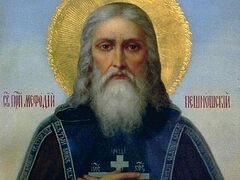
On April 7/20, the Orthodox Church honors the memory of St. Daniel of Pereyaslavl (now the town of Pereslavl-Zalessky in the Yaroslavl region), a great lover of strangers and wanderers, the founder of the Holy Trinity-St. Daniel Monastery in Pereyaslavl, and the godfather of Tsar Ivan IV the Terrible. The example of this little-known Russian saint teaches us mercy and care for those who have no one to help them.
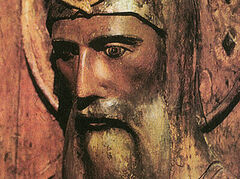
 St. Daniel of Pereyaslavl. Fresco on a pillar of the Holy Trinity Cathedral of the Holy Trinity-St. Daniel Monastery
The future St. Daniel, whose secular name was Dimitry, was born around 1460 in Pereyaslavl to pious parents named Konstantin and Theodosia. From an early age, the boy stood out from the other children by his love for church services and spiritual books, as well as a his keen interest in monastic feats. One day he read that true ascetics take little care of their bodies and therefore do not wash in the bathhouse. The sensitive and receptive child followed their example with determination.
Another time, having learned from the Life of St. Simeon the Stylite (c. 390–459) that the saint wrapped himself in a coarse rope and wore a hairshirt over it to mortify his sinful flesh, the boy decided to imitate him. He found a rope made of hair and wrapped it around himself in secret. Over time, the rope began to grow into his body, causing severe pain, so that Dimitry became weak and had difficulty moving. His parents were perplexed as to the cause of such a malaise, until one night they accidentally saw the rope virtually grown into the body of their sleeping son. Dumbfounded, they asked him why he had subjected himself to such torments. Desiring to hide his podvig, the boy replied: “I did it out of foolishness. Forgive me!”
When Dimitry learned how to read and write, his parents sent him to their relative, Jonah, abbot of St. Nicetas Monastery of Pereyaslavl (founded by Venerable Nicetas the Stylite in the twelfth century) to continue his education and grow spiritually. Life at the monastery and the example of his virtuous mentor had such a strong and wholesome effect on the boy that he firmly decided to embark on the path of monasticism. He secretly left the town and went to the monastery founded by St. Paphnutius (1394–1477) in Borovsk (now in the Kaluga region), where he took monastic vows.
He was given the monastic name Daniel, and placed under the spiritual guidance of Elder Leucius, known for his godly life. St. Daniel spent ten years under his direction, learning the observance of monastic rules, humility and obedience. Then, seeking a secluded life, the elder retired from the monastery. After that, St. Daniel stayed at the monastery of Borovsk for two more years. He gave himself over to monastic labors with all the fervor of a young soul, spending his time in fasting and prayer, preserving bodily and mental purity, and earning the love and respect of the whole brotherhood. They even wanted him to succeed St. Paphnutius and rule the monastery of Borovsk.
But fleeing from the temptation of authority and emulating his elder, the young ascetic left this monastery and returned to his native Pereyaslavl. He entered the Goritsky Holy Dormition Monastery of Pereyaslavl, where he was ordained hieromonk. St. Daniel wholeheartedly devoted all his energies to this new, responsible ministry. He often spent whole nights in prayer, and during the first year he celebrated the Divine Liturgy daily. With his strict and devout life, the ascetic garnered widespread attention—not only the Goritsky Monastery brethren, but also inhabitants of the surrounding villages began to come to him, seeking his prayers and advice. But most of all, St. Daniel became famous for the virtues of mercy to paupers and hospitality to wanderers.
Whenever wanderers came to the monastery, obedient to the Lord’s commandment he always received them and lavished care on them. He also asked them if there was anyone who had been abandoned on the road, frozen to death or killed by robbers. On learning that there were such homeless and forsaken people, at night the saint would secretly leave the monastery, pick them up and carry them on his shoulders to the “potter’s field”, which was located near the Goritsky Monastery. The “potter’s field” is an ancient name for a common grave or burial ground for wanderers and beggars. This name comes from the Gospel account of how, having received the thirty silver pieces back from Judas—the price of blood of our Lord Jesus Christ—the high priests bought with them the potter’s field, to bury strangers in (Matt. 27:6–8). It is to such a place that St. Daniel would bring dead wanderers, bury them, and then constantly remember them in his prayers.
One day, an unknown wanderer came to the Goritsky Monastery. No one knew anything about him, and he himself would say nothing except the single word “uncle”. St. Daniel became very attached to this man and gave him shelter in his cell. But soon the wanderer passed away, and the saint grieved for him very much. He lamented that he did not even know the man’s name to remember him in his prayers, and he so wanted to bury him by the church within the monastery. But it was forbidden. With aching heart, the saint carried the wanderer to the “potter’s field” and buried him there. For a long time he remembered this man, and sometimes, going out of his cell after prayers and looking towards the “potter’s field”, he saw a supernatural light rising up from the graves, as if from a multitude of flaming candles. The ascetic marveled at this phenomenon and thought: “How many saints of God are buried there! The whole world and we sinners are unworthy of them; they are not only despised, but also humiliated—after passing into eternity they are not buried beside holy churches, they are not commemorated; but God does not forget them, and glorifies them even more. What can I do for them?”
 The Goritsky Holy Dormition Monastery. Fotokto.ru
And God inspired St. Daniel with the idea of building a church where the supernatural light could be seen, and appointed a priest there to celebrate the Divine Liturgy and pray for the salvation of the souls of those who rested in the “potter’s field”, and above all, the unknown wanderer. The saint reflected often about this, but did not reveal his intentions to anyone, saying to himself: “If it pleases God, He will arrange it according to His will.”
Thus three more years passed. St. Daniel unceasingly prayed with tears to the Lord. And the Almighty answered his prayers. At that time the boyars Ivan and Vasily Chelyadnin had taken up residence in their family estate not far from Pereyaslavl. Previously been close to Grand Prince Vasily III (1505–1533), they had to leave the capital and settle in the outlying areas because they had fallen out of favor. They tried in every possible way to regain the Grand Prince’s favor, but all their efforts were in vain.
Then, on hearing about the local ascetic Hieromonk Daniel, the brothers invited him to celebrate the Divine Liturgy at their parish church. The saint arrived. But no sooner had he begun to celebrate the service than a messenger came from the Grand Prince with the news that the disgrace had been lifted and the boyars were ordered to return to their service right away. The brothers attributed it to the power of St. Daniel’s prayers. They fell at his feet and exclaimed, “Father, how can we repay you for your intercession? For through your prayers the Lord has lovingly softened the prince’s heart and shown mercy to us, His servants!” The saint answered them: “I am the worst sinner in the world—why do you honor me? Honor God above all else, keep His commandments and do what is pleasing to Him; purify your souls by repentance, do no harm to others, love everyone, give alms, and serve the Grand Prince faithfully. If you do this you will be happy in this temporary life and receive eternal joy in the age to come.”
Nevertheless, the saint revealed to them his cherished dream of building a church at the burial ground for wanderers. The grateful brothers Chelyadnin promised to intercede with the Grand Prince about this. After listening to that request, Vasily III praised St. Daniel’s zeal and ordered that the ascetic be given a charter for the construction of a church, along with resources to build it.
The saint just wanted to build a church above the “potter’s field”, but many who had heard about the construction of the church came to St. Daniel, and with his blessing set up cells close by and took monastic vows. So, in 1508, by Divine Providence a whole monastery was built over the “potter’s field”. St. Daniel chose an abbot, invited two priests, a deacon, a sexton and a prosphora baker, and the Divine Liturgy began to be celebrated daily at the monastery. The ascetic put up high crosses at the wanderers’ graves, and memorial services were often held at foot of the graves. The saint regularly visited the monastery he had founded, but he continued to live at the Goritsky Monastery, avoiding any authority or fame.
Grand Prince Vasily III frequently visited the new monastery and provided it with all possible support. One day, after St. Daniel had lived at the Goritsky Monastery for about thirty years, the Grand Prince returned to Pereyaslavl. While attending the evening service at the Goritsky Monastery, he heard Abbot Job being commemorated at the litanies. So he said to St. Daniel: “Go and live in your monastery and have yourself commemorated at the litanies; set up cenobitic life at the monastery and do not worry about its needs—I will provide everything.”
 Grand Prince Vasily III
The next time Grand Prince Vasily III and his wife Elena Glinskaya visited the monastery of St. Daniel was in 1528 on their way to St. Cyril’s Monastery of White Lake and other holy sites to pray for an heir. In memory of his stay at the monastery, the Grand Prince ordered the construction of a stone church in honor of the Holy Trinity. However, it was built later—on the occasion of the birth of the long–awaited heir, Ivan IV (the future first Tsar of Russia Ivan the Terrible) in 1530, and St. Daniel became the child’s godfather. Along with the Holy Trinity Church, a stone refectory was built in honor of the Laudation of the Most Holy Theotokos.
After St. Daniel had become the heir’s godfather, curious people began to come to the monastery to take a look at this man. And they always found him cleaning the stables or building the monks’ cells and latrines with his own hands. And everyone marveled at the elder’s meekness and simplicity, as well as his great industry. Although the saint had already reached advanced age, he continued his ascetic labors with the same zeal.
One day, as St. Daniel and his brethren were walking around the monastery, they saw three cripples outside the monastery fence. The elder said to one of the monks: “Take these three men into your cell and attend to them; the Lord has sent them for our benefit.” They were taken to the monastery and given good care. Then, knowing St. Daniel’s mercy, many of the townspeople began to bring seriously ill people to the walls of his monastery. Townsfolk would often stealthily bring their infirm relatives, being unable to feed them and care for them. The saint gladly received the sufferers into the monastery, took care of them, treating them and nursing them back to health, and comforting them with edifying words. Some of them would recover and return to their families, while many remained at the monastery.
Old age began to take its toll on him, and St. Daniel’s strength failed him. Believing him to be dying, the brethren arranged for him to be tonsured into the schema, but the elder lived in the angelic habit for several more years. Feeling the approach of his death, he took Communion of the Holy Mysteries of Christ and peacefully fell asleep in the Lord on April 7, 1540, at the age of eighty.
 Shrine with St. Daniel’s relics. Sudogda.ru
The news of the great ascetic’s death spread quickly through the surrounding area, with archimandrites, abbots, boyars, monks, priests, and peasants from Pereyaslavl and all nearby villages gathering for his funeral. St. Daniel was solemnly interred at the Holy Trinity Church. In 1652, his holy relics were uncovered, and he was canonized as Venerable Daniel of Pereyaslavl. The Lord glorified His saint with numerous miracles.
The Holy Trinity-St. Daniel Monastery was heavily damaged during the Time of Troubles in the early seventeenth century, but was rebuilt in the second half of that century with the funds of the boyars Baryatinsky. In 1923, the monastery was closed.
In 1995, its restoration began. Let’s take a look at the monastery at the present time—it is enclosed by a high stone wall. On the west side is the Holy Gate with the chapel over it dedicated to the Tikhvin Icon of the Mother of God (1889). On the opposite side towers the cathedral church of the Holy Trinity, built in St. Daniel’s lifetime (1532). The Holy Trinity Cathedral of St. Daniel’s Monastery is famous for its frescoes with scenes from the Apocalypse, created in 1662–1668 by the team of the famous icon-painter Gury Nikitin of Kostroma. The Holy Trinity Cathedral frescoes are ranked among the most significant works of the Kostroma School of Iconography of the second half of the seventeenth century. With the support of the “Orthodox Initiative” International Grant Competition, a virtual guide showcasing the frescoes of the Holy Trinity Cathedral of St. Daniel’s Monastery was launched in 2023. Using this guide, anyone can immerse himself in the world of the Book of Revelation of St. John the Theologian, and get a better understanding of the era when these murals appeared.
 Holy Trinity-St. Daniel’s Monastery. Deadokey.livejornal.com
Adjacent to the northern wall of the Holy Trinity Cathedral is the Chapel of St. Daniel, built shortly after the uncovering of his relics. St. Daniel’s relics rest in the arch connecting these churches. Adjoining the north-western corner of the St. Daniel Church is a seventeenth-century tent-roofed bell-tower. To the south of the Holy Trinity Cathedral towers the magnificent Church of the Laudation of the Most Holy Theotokos (1696) with a refectory and former abbot’s quarters. To the east of St. Daniel’s Church is the All Saints’ Church, originally built by St. Daniel and rebuilt in stone in the late seventeenth century.
Today, the Holy Trinity-St. Daniel Monastery has a united monastic brotherhood ruled by Abbot Panteleimon (Korolev). There is a Charity Storeroom at the monastery, where those in need can receive clothes and shoes, as well as a volunteer assistance service called “Bozhedele”. Abbot Panteleimon, the monastery’s father-superior, was inspired to organize “Bozhedele” by the example and instructions of St. Daniel of Pereyaslavl:
“The founder of our monastery wholeheartedly devoted his energies to caring for the poor, and before departing to the Heavenly Kingdom, he left a testament exhorting us to help orphans and the destitute. We tried to fulfill this testament, giving clothes and food to those who needed them, but people also needed other help, which we initially didn’t have enough time to do. When speaking about the frescoes of our Holy Trinity Cathedral, I like to quote the Gospel passage about the Last Judgment: Then shall the King say unto them on His right hand, Come, ye blessed of My Father, inherit the Kingdom prepared for you from the foundation of the world: For I was an hungred, and ye gave Me meat: I was thirsty, and ye gave Me drink: I was a stranger, and ye took Me in: Naked, and ye clothed Me: I was sick, and ye visited Me: I was in prison, and ye came unto Me (Matt. 25:34–36). These words are a strong rebuke to me each time I see them, and they have become an additional inspiration for creating an assistance service, in which I will try to take an active part as well.”
May these words of the Savior and the example of St. Daniel of Pereyaslavl inspire us to do good works as we have therefore opportunity (Gal. 6:10).