Geneva, April 21, 2026
 His Grace Bishop Daniil of Tartu of the Estonian Orthodox Christian Church. Photo: orthodox.ee
An international NGO has warned the United Nations Human Rights Council that the Estonian Orthodox Christian Church (EOCC) faces ongoing repression from legislative, administrative, and executive bodies, with its leadership at risk of removal and the Church facing the threat of dissolution—all justified by the Estonian authorities on national security grounds.
The warning was submitted by Justice for All International, a Geneva-based organization, as part of the Universal Periodic Review process, in which governments and civil society organizations submit reports on the human rights situation in a given country for consideration by the UN Human Rights Council. The review of Estonia is scheduled for May 2026.
The organization reports that a 2025 amendment to Estonia’s Law on Churches and Congregations prohibited the maintenance of “spiritual ties” with foreign religious authorities deemed security threats, allowed religious communities to be deregistered without judicial proceedings, and permitted the exclusion of clergy on non-transparent grounds. It calls on Estonia to repeal or substantially amend the legislation and to restore the autonomy and leadership of the Church.
An example of the climate the organization is warning about can be seen in the most recent yearbook of the Estonian Internal Security Service, published in April 2026, in which the EOCC is mentioned in the chapter on threats to the constitutional order. The Church has issued a formal reply disputing the characterization.
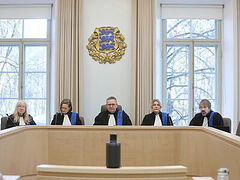
In its statement, the Church expresses deep concern at being included in that chapter, noting that the legal amendments affecting it have not been signed into law by the President of Estonia and are currently before the Supreme Court for a constitutional review. The Church describes its inclusion in the yearbook as a tendentious step intended to influence public opinion while the court case remains pending.
The Church also directly refutes a specific claim made in the yearbook—that its activities are directed and coordinated by the Department of Dioceses of the Near Abroad of the Moscow Patriarchate in the name of Patriarch Kirill. “This claim is not true,” the Church states, as its internal life, administrative decisions, and pastoral activities are conducted independently, without any external direction or coordination by Russian Church structures.
The Church notes that since the beginning of the war in Ukraine, it has repeatedly condemned the war and made its position publicly known, and that prayers for peace and for the swiftest possible end to the war are offered continuously in all its parishes.
The Church says it has repeatedly expressed its readiness for open and constructive cooperation with all state bodies and calls for dialogue.
Follow OrthoChristian on Facebook, Twitter, Vkontakte, Telegram, WhatsApp, MeWe and Gab!