Photo: znamhram.ru
Reverend fathers, brothers and sisters, all of you who are present and all who are watching the broadcast of today’s Divine Liturgy: Christ is Risen! Indeed He is Risen!
Three times from various people, and three times from the Apostles, we hear in the Holy Gospel the confession of one who recognized in Christ the Son of God. St. John the Baptist, who at the River Jordan saw the Spirit descending upon the Savior in the form of a dove, was the first among men to call Him the Lamb of God, Which taketh away the sin of the world (Jn. 1:29), and the Son of God. Martha, the sister of Lazarus, before the raising of her brother likewise confessed: Yea, Lord: I believe that thou art the Christ, the Son of God, which should come into the world (Jn. 11:27). And finally, the Roman centurion and the soldiers who were present at the Crucifixion, when they saw the darkening of the sun, the earthquake, and all that was happening then, feared greatly and exclaimed: Truly this was the Son of God (Matt. 27:54).
These three testimonies are complemented by three confessions from the Savior’s own disciples. Nathanael’s: Rabbi, Thou art the Son of God; Thou art the King of Israel (Jn. 1:49); Peter’s: Thou art the Christ, the Son of the living God (Mt. 16:16); and Thomas’: My Lord and my God! (Jn. 20:28) that resounds in today’s Gospel reading for the first Sunday after the Feast of Pascha, the Sunday which the Church calendar calls Antipascha, or the Sunday of the Apostle Thomas.
In the Biblical understanding, Sunday is the first day of the week, the day on which God began His creation, and at the same time the eighth day of the coming Kingdom, in which there will be no time. According to this understanding, Antipascha as the eighth day after Christ’s Resurrection is a foretype of the Kingdom of God to come—the first day of the new world, which Christ, by His death, brought to life. St. Gregory the Theologian, in his homily for this Sunday, compares the spiritual renewal of the world with the renewal of nature in spring: “Now has come the spring, earthly and spiritual, spring for souls and for bodies, spring visible and invisible. May we also share in it there, when, transformed here and renewed, we enter into the new life in our Lord.”
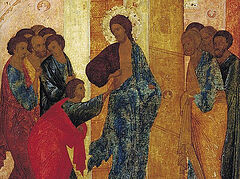
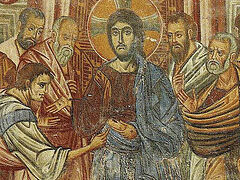
This day is called the Sunday of the Apostle Thomas in memory of his being assured of the reality of the risen Christ. But the very name Antipascha—Pascha in place of Pascha—is likewise tied to the name of the Apostle Thomas, because for him Pascha, his own personal encounter with the risen Christ, came only after eight days—a full week later than for the other disciples. When the disciples told Thomas about the risen Christ, he didn’t believe them—just as they themselves hadn’t believed when they saw Him at first; when, startled and bewildered, they supposed they were seeing a ghost. To persuade His confused disciples, the Savior showed them His hands, His feet, His side, and even ate in their presence.
Thomas was not with the other disciples when Jesus appeared to them and proved to them that He wasn’t a spirit or a phantom, but a real Man Who had risen from the dead in the body—in a body which was indeed transfigured, deified, and had become wholly spiritual, yet hadn’t ceased to be a body. What were the first words Christ spoke to the disciples when He appeared to them after the Resurrection? They were the words: Peace be unto you (Jn. 20:19). How urgently these words resound in our own days, when provocations and the rising tensions in international relations give rise to ever new armed conflicts. In spite of the countless wars that run through the whole of history, mankind seems stubbornly unwilling to admit that building is better than destroying, that progress matters more than the ruins of cities, and that schools and hospitals are far more needed than weapons and war shelters.
The Apostle Thomas wasn’t present at Christ’s first appearance. When the other disciples told him, We have seen the LORD, he answered them: Except I shall see in His hands the print of the nails, and put my finger into the print of the nails, and thrust my hand into His side, I will not believe (Jn. 20:25). Doubting Thomas stirs a certain unease in our soul. What if we, for our part, fail to doubt the Resurrection of Christ chiefly because we don’t think about it at all? The phrase “Doubting Thomas” seems clear and familiar to us, and we see no reason to reflect more deeply on his story. We often perceive Thomas’ doubt as a sign of weakness—for at the end of today’s Gospel the words resound: Blessed are they that have not seen, and yet have believed (Jn. 20:29). We’re eager to count ourselves among them, among those who haven’t seen and yet believe. Against the backdrop of our supposed faith, the Apostle Thomas seems to us a man of little faith.
Yet he reminds us of something quite simple. A Christian must doubt. He must doubt himself, the sincerity of his faith in God, the genuineness of his own spiritual experience. For faith isn’t naive credulity. God expects our questions. He isn’t afraid of our doubts. He’s ready to hear our questions and to answer them. And the more sincere our question—however audacious or unsettling it may seem—the more powerful God’s answer will be. Thomas reminds us that a life of faith is a call to follow Christ consciously and responsibly: to reflect upon Him, to seek Him with the mind, and to seek Him sincerely. This is precisely why the Church gives “Doubting” Thomas the place that rightfully belongs to him, and dedicates the first Sunday after Pascha to him every year. For the sincerity of his faith has become for the rest of us the guarantee of its truth. As St. Gregory the Great says: “Thomas doubted so that we might not doubt. And when he touched Christ’s wounds, he healed the wounds of our unbelief.”
 Metropolitan Rastislav of Prešov. Photo: moseparh.ru
Real faith begins with sincere courage—the courage not to be afraid of coming to Christ with our questions. Many of us don’t dare to ask the questions that truly trouble us. We’re afraid to admit our doubts. We fear what those around us will think. And so untruth accumulates in our relationships with God and with men—an untruth hidden behind the mask of a faith that appears firm but is in fact only on the surface.
We ought, however, to be aware that to live in self-deception is spiritually very dangerous.
The ascetic tradition of the Church has the concept of prelest—spiritual self-deception. It’s the state in which a man begins to believe his own ideas about his holiness, his wisdom, his exceptional character, or his spiritual advancement. Outwardly he may seem pious; in reality he’s drifting away from the truth. The danger is that self-deception closes a man’s spiritual eyes. One who thinks he already sees clearly ceases to seek the light. The Holy Fathers say that the greatest obstacle to spiritual growth isn’t weakness, but pride disguised as piety. A man in prelest no longer admits that he can be mistaken. He doesn’t listen to the counsel of others, he doesn’t see his own sins, and he gradually separates himself from humility, from unity, and from love—without which genuine spiritual life is impossible.
Convinced of his own perfection, he begins to judge and condemn—not his own real weaknesses and sins, but the supposed failings of his neighbors. If a man remains in such a state for long, not one stone will be left upon another in his spiritual world. Everything will be torn down: his good relationships with others, and his reverence for the Church, and nothing will any longer be sacred for him. He can reach the point where he blames God Himself for all the evil that happens in his life or in the world, or lays hands on himself, or even kills another man. Prelest, this dreadful spiritual illness, can overtake anyone who relies only on his own judgment. That’s why it’s so important to guard humility and sobriety, and to find an experienced guide, a trusted confidant and father-confessor, for your spiritual journey.
The way out of self-deception is simple—yet for those who suffer from it, it’s enormously difficult. It’s the willingness to see the truth about yourself. This alone can roll away the stone from the tomb of the conviction of your own perfection, and lead you onto the safe path of humility and of real spiritual life. For God leads not those who think they are perfect, but those who recognize their weakness and their need of His help. This is precisely why real faith is so important—real faith, and not its imitations or counterfeits. Thomas urges us to have the spiritual courage of coming to Christ just as we are. God expects our questions and isn’t afraid of our doubts. But He wants us to seek Him sincerely. Then the same thing can happen to us as happened to Thomas—doubt will be transformed into faith and confession.
Personal faith isn’t something we receive from the Church once and for all, as a rich inheritance. It must be continually preserved, deepened, and extended. It’s a path without end. To walk it means to overcome weariness and obstacles, and to triumph over doubts. It’s a path that demands the unceasing transformation of the man—a constant struggle against sin and the passions, and the hard labor of cleansing your own soul. May the example of the Apostle Thomas grant us the courage to press forward steadfastly along this endless spiritual path—the path that leads from doubt to sincere faith.