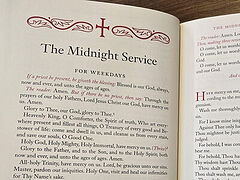
Church Slavonic Pentecostarion, 17th c.
Preserving the Paschal Garment of Rejoicing
“I am always saddened by this gradual decline of spiritual life after Pascha. First comes the growth of spiritual strength as one goes deeper into Great Lent. Everything inward becomes much easier, purer, and more peaceful in the soul; there is more love, prayer is better. Then come the extraordinary days of Holy Week, then Paschal joy. But then Saturday of Bright Week arrives, the doors of the altar are closed, as though the gates of heaven were being shut, and everything becomes harder. The soul grows weak, loses courage, becomes lazy, and every spiritual effort becomes difficult,” wrote Archpriest Alexander Elchaninov.
How can we fail to recognize ourselves in these words? Year after year, the Paschal joy that burst forth during Bright Week like a jubilant and pure spring begins, almost before our eyes, to fade away, to recede… and suddenly we catch ourselves: Mid-Pentecost is already here! And the Leave-taking is not far off.
It is time to take stock. How many days did the joy of the Paschal night truly remain in the heart? Was it only seven out of forty?
Joy as Worship of Christ
And yet, in the Pentecostarion—the collection of liturgical texts from Pascha to Pentecost—are these wondrous words:
“The divine disciples, beholding Christ, the Life, risen from the tomb, worshipped Him with great love, with upright character, and with gladness of soul.”
It follows, then, that by the Paschal gladness of the soul we worship Christ, and by preserving and rekindling our joy in His Resurrection we offer service to Christ.
And further, the Pentecostarion reminds us:
“Having attained the feast of Christ’s Resurrection, let us most earnestly keep His commandments, that we may worthily meet His Ascension and receive communion of the All-Holy Spirit.”
This means that the fullness of our joy on the Day of Holy Trinity, and the measure of our participation in the celebration of the Descent of the Holy Spirit, depend upon how attentively, diligently, sincerely, and—yes, joyfully!—we spend the Paschal days.
The Texts of the Pentecostarion: A Spiritual Navigator for the Day
But how do we avoid losing this joy? How do we keep it from dissolving into daily routine?
The answer comes in the Pentecostarion. It is like a compass that keeps us from straying off course. Its texts are permeated with exultation in the Risen Christ. They do not allow us to become “lost” in routine, but again and again lead us out into the open space of Christ’s Resurrection.
Today is not merely Thursday—it is Thursday of the Week of the Samaritan Woman. Not an ordinary Tuesday—but Tuesday of the Week of the Myrrh-Bearing Women.
At times, a single text from the Pentecostarion can:
-
fill us with Paschal vigor;
-
illumine us with joy;
-
warm the heart;
-
lift us up, “raising the soul out of earthly smallness, despondency, and confinement.”1
Practical Steps: How to Make the Pentecostarion the Navigator of the Day
In our family, we keep a simple rule. During the Paschal season, each day we read at least one text from the Pentecostarion appointed for that day.
Then we try to draw from it a spiritual lesson or a task for the day.
For example, during the week between the Sunday of the Myrrh-Bearing Women and the Sunday of the Paralytic, one may take the following texts and reflections:
Six Selected Texts from the Pentecostarion
Monday
Sing unto Christ!
“Early in the morning, the myrrh-bearing women beheld Christ and cried out to the apostles: Truly Christ is risen—come and sing with us unto Him.”
Today I shall strive to offer Christ earnest praise. But I will not limit myself only to singing the Paschal troparion. By words, deeds, and thoughts pleasing to Him, I shall praise Christ throughout the whole day.
Tuesday
With warm hearts let us bring myrrh!
“With warm hearts the women brought myrrh to the Savior. Rejoicing when they saw the radiant Angel, they proclaimed God to all and announced to the disciples: Truly from the tomb has risen the Life of all.”
Today I shall try, following the myrrh-bearers, to bring myrrh to Christ. First, the myrrh of heartfelt and fervent prayer. Second, the myrrh of sincere and loving treatment of my neighbor.
Wednesday
Take courage, O people!
“Hades is slain—take courage, O people; Christ, being crucified upon the Tree, destroyed it and set the prisoners free.”
Today I shall arm myself with holy boldness. I will not yield to despondency or sorrow, but “with force, with zeal, with courage and bravery”,2 in spiritual joy I shall fulfill the commandments of the Risen Christ.
Thursday
Let us worship Christ with love, upright conduct, and gladness of soul!
“The divine disciples, beholding Christ, the Life, risen from the tomb, worshipped Him with great love, with upright character, and with gladness of soul.”
Today I shall try to spend the whole day in heartfelt remembrance of God and of His Resurrection. To every temptation I will answer: I will not trade the Pascha of Christ for any pieces of silver. This will become my “upright conduct.”
Friday
To walk in the way of Christ!
“For many years my soul has been grievously sick; but do Thou, O Most Good One, heal it, as once Thou didst heal the paralytic, that I may walk in Thy way, which Thou hast shown to those who love Thee.”
What habits, what sins, what passions keep me from following Christ without stumbling?
I shall devote this day to spiritual diagnosis. What habits, what sins, what passions hinder me from walking after Christ unhindered? My conscience and the Gospel will give me the answer. I shall end the day with heartfelt repentance and prayer to the heavenly Physician for healing.
Saturday
May Thy Body and Blood, O Christ my Savior, be unto me for eternal life!
“Thou wast given gall to drink for our sake, O Savior, and Thou hast granted unto us Thy Body and Thy Precious Blood as food and drink of Thy eternal life.”
I shall reflect upon the closest bond between the Eucharist and Pascha. I shall realize that the Holy Mysteries are the pledge of eternal life and my participation in the Pascha of Christ here and now.