Photo: Pinterest
So, we have come to the second step of spiritual ascent. Do you hear what this step consists of? “The True Sabbath is the liberation of a rational soul that turns its mind away from the sphere of the senses, abandoning the natural work of the senses through natural contemplation in the spirit.” This is the second step for the soul. But how does it reach it? Fighting with the mind. This is how natural contemplation in the spirit is attained. If earlier the sight of a beautiful woman tempted a person, now it doesn’t anymore. When he sees a beautiful creature, his mind is carried away to heaven and he says, “If this creature is so beautiful, then how beautiful an angel must be! And the Cherubim, the Seraphim, and the One Who created them!” He transports his mind from earthly beauty to that of heaven—and he receives benefit instead of being tempted.
Previously, when he heard stirring music, it excited his mind and soul. But on the second step of spiritual ascent, it no longer excites him and even benefits him. Because he thinks: “If people can play the reed-pipe, trembita1 and organ so beautifully, then what must be in heaven! How angels sing there, and what dances must be there!”
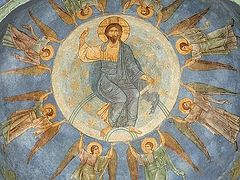
The King and Prophet David says: God is gone up with a shout, the Lord with the sound of a trumpet (Ps. 46:5). When the Heavenly powers saw the Savior removing the gates on high, all the angels blew their trumpets, everyone started singing, and in a chorus of great rejoicing and great singing, Christ ascended and abolished—did not open, but abolished—the gates of Heaven. He abolished them for all ages. And St. John Chrysostom says: “Do you see that He did not open them, but completely abolished them?”
Therefore, a person who has reached the second step of spiritual ascent thinks this way when he hears worldly singing, a man or a woman singing, or a trembita, or a reed-pipe. And when he sees the sun, he thinks like this: “If the sun shines so brightly here, then what must be where Christ, the Sun of Truth, is shining?”
Therefore, a person on the second step of spiritual ascent, through natural contemplation in the spirit—that is, the pure beholding God’s creation, immediately rises mentally from the visible to the imagined and invisible, as having received freedom from temptations, as St. Maximus says. His mind is transported from what he hears here on earth to the songs of heaven and says in his mind: “If these earthly people can sing like that, then what kind of songs must be there in heaven!” Also, smelling a wonderful fragrance, he reflects on the fragrance of flowers in Paradise; and so he rises with the mind and other senses, by contemplation transforming everything he sees, hears, tastes, smells, or touches—into spiritual reflections.
And the third stage of ascension—that is, the ascent of the soul to the highest step—is called the Sabbath of Sabbaths in the Scriptures. Those who have reached the third step of spiritual ascent need no more steps: they no longer need to contemplate earthly beauty in order to rise with their minds to the beauty above, or to hear earthly singing in order to rise to the singing above, or to smell something fragrant here in order to think about the fragrance of Paradise.
He who has reached the third step of spiritual ascent by the grace of Christ has become God by grace. He has attained deification by grace, or mystical theology—that is, he has a direct communion with God without mediators and no longer needs the step of creation. Christ lives in him, as Paul said: yet not I, but Christ liveth in me (Gal. 2:20), or, as he said elsewhere, But we have the mind of Christ (1 Cor. 2:16; cf. Gal. 4:6). When Paul said that he had the mind of Christ, it meant that he already lived in Christ, and Christ lived in him, which means that he was no longer speaking from his own mind, but from the mind of Christ.
Such a person is on the highest step, at the third stage of spiritual ascent (which very few, very rarely are vouchsafed nowadays), he is a son of God by grace. He has reached the eighth day, as St. Maximus says: “According to the Scriptures, the eighth day is equal to the third step of spiritual ascent.”2 It is also called the Sabbath of Sabbaths, not the liberation of the soul or dispassion, as in the lower steps.
The Sabbath of Sabbaths is called “the spiritual rest of a rational soul that has put aside even the natural work of the senses and brought out its mind even from the most spiritual reflections on creation.” How? “In an ecstasy of love, wholly connecting it solely with God in the ocean of love.”3
Such a person already knows nothing but to love God. He becomes like St. Anthony the Great, who would say, “I don’t fear God anymore.”
He was asked, “But why?”
“Because I love Him,” he replied
Burning with the love of Jesus in his heart, he was no longer afraid of death, hunger, thirst, fatigue, dishonor, or humiliation. Why? Because he lived in Christ, and Christ in him, and therefore was absolutely convinced that nothing would happen to him without the will of God. Such is a person whose soul has climbed to the third step of spiritual ascent.
My brothers, these things are a little difficult for you villagers. Monastics understand them better. But let me cite a simpler story in order to benefit you all.
If the Savior ascended to the heavens, then were there any saints who were lifted up? Yes. The Holy Scriptures tell us of the Old Testament Patriarch Enoch that he was taken up and could not be found, but it is unknown whether he was taken straight to heaven or not (cf. Heb. 11:5). The Prophet Elias was not taken directly to heaven either. But where? He was taken up as if to heaven.4
The Chronicle (or The Synopsis of Histories) by the eleventh-century Byzantine Monk George Kedrenos and other books contain a story about another saint who was taken alive to heaven. Do you know who it was? Adam’s son Seth. Sacred history tells us that Seth was greatly loved by God. God gave Adam this son instead of Abel who had been killed by his brother Cain. And this son was blessed by God with great gifts, for he was pleasing to God. And tradition tells us that Seth was taken to heaven. For what purpose? To learn astronomy from the angels. That is why St. Basil the Great said that astronomy is a second theology for believers. Because it originated from God, for the angels themselves taught man astronomy.
Tradition says that Seth stayed in heaven for forty days and forty nights and learned astronomy there: the movement of the stars, the eclipses of the Sun, the Moon and other signs that appear in the sky, so that people could know from them when God’s wrath is kindled, when He wants to change time and so on.
And when Seth was taken up and brought to God, he forgot about hunger and thirst, like the Prophet Moses on Mt. Sinai. He spoke with God and fasted twice for forty days, abiding in thoughts about God without food or water. It was the same with Seth. Since he spoke with God, and the angels taught him the signs of the stars, the movement of the Moon, and so on, when he came down to earth, his children no longer called him “father”. But what? “God”! His face shone so dazzlingly (see The Chronicle by Monk George).5
And the Scriptures say about Moses that on Mt. Sinai he received so much light from God Who gave him the Tablets of the Law that the children of Israel could not look at him (cf. Ex. 34:29-30; 24:17). Therefore, he had to cover his face with a veil, as his face radiated a dazzling glow. But the Scriptures say about Moses that he was only on Mt. Sinai, whereas Seth was in heaven for a certain period of time.
The sons of Seth are called the sons of God in Scripture (and Cain’s sons are called the sons of demons and the sons of men) because they began to call their father “God” (cf. Gen. 6:2). Seth brought so much glory and beauty when he came down from God. And his children asked him:
“Father, haven’t you become a god?”
And he answered them:
“No, my dears, I haven’t become a god. I am a servant of God and a mortal man like you, but I was where God is.”
“And what did He say to you, Father?”
“This is what He said to me: ‘Obey the laws of God, which you learned from Adam, who received them from God, and beware of marrying into the lineage of Cain’s family, because it is cursed.’”
The Scriptures say that God cursed Cain (cf. Gen. 4:11). And what else does the Scripture say? That the sons of Seth were tempted by the beauty of Cain’s daughters, loved them, and began to marry them. For this the wrath of God fell upon them (cf. Gen. 6:2–7). Seth had told them:
“Dear children, take care not to marry descendants of the family of cursed Cain. God warned that if you intermarry with this generation, giants will be born, and a flood will sweep over the face of the earth, destroying all people. You are a holy people, you are a branch from the holy root; don’t intermarry with these cursed savages!”
And Seth lived for 812 years. As long as he was alive, his sons didn’t violate the commandment of God. And when Seth died, his children told each other:
“Eh! Our father told me not to marry such-and-such a girl, but he is dead! And if I like her, why shouldn’t I marry her? Just because she’s from Cain’s family?”
And they broke their father’s commandment and began to marry women from the house of Cain.
And what happened next? Once they began to do so, giants began to be born. They grew by a whole palm in a day and became huge, like cedars of Lebanon, up to 560 feet tall. And they were the ugliest and vilest people on earth, as St. Dimitry of Rostov wrote, so that words cannot describe what they committed. For they even ate the babies that their wives miscarried—so vile they were.6
And for hundreds of years, God waited for their repentance until the Flood. The generation of giants lived until the Flood and lasted for 200 years. And because they did not reform their iniquities, God said, My spirit shall not always strive with man, for that he also is flesh… I will destroy man whom I have created from the face of the earth (Gen. 6:3, 7).
But let’s get back to our subject. Seth has not ascended to heaven today. But Who has ascended to heaven today? Christ Who created all the heavens—He has ascended. And what is He sending us from there? What did He say to the apostles? Tarry ye in the city of Jerusalem, until ye be endued with power from on high (Lk. 24:49). That is: “I will not leave you orphans. I will be with you till the end of time. For I will send you the Comforter—that is, another Person of the Holy Trinity. The Holy Spirit, the Comforter, will come. And when He comes, He will enlighten your minds so that you can understand all the Scriptures. He will tell you everything so that you can understand more profoundly the mysteries of Providence in the flesh, or for what reason I came down to earth and remained until this day, when I am ascending to heaven.”