Beloved believers!
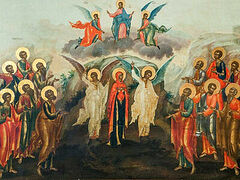
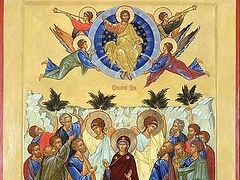
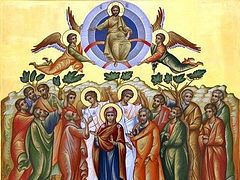
The Orthodox Church of Christ has a magnificent “belt” it is girded with every year. There are twelve “precious stones” shining on this “belt”—that is, the twelve great feasts. The Annunciation shines on one side of this belt, on the other—today’s feast, the Ascension of the Lord.
All the Divine festivals that adorn the “belt” of the Church have their dogmatic and mysterious origin from the Holy Scriptures: These are the Annunciation, the Nativity of the Savior, His Baptism, Meeting in the Temple, Crucifixion, Resurrection, and all the others. Thus, today’s Divine feast of the Ascension of the Lord was predicted a millennium before by the great King and Prophet David in the Psalms, where he says more than once: Be Thou exalted, O God, above the heavens: and Thy glory above all the earth (Ps. 107:6; 56:6, 12; cf. Job 22:12). He did not say that the Lord ascended to “heaven”, because our Savior did not ascend to one heaven, but to countless heavens.
And the Divine Apostle Paul also says that Now that He [Jesus] ascended, what is it but that He also descended first into the lower parts of the earth [hell]? He that descended is the same also that ascended up far above all heavens, that He might fill all things (Eph. 4:9-10; cf. Heb. 1:3). Thus, our Savior Jesus Christ did not ascend to heaven or above heaven, but above the heavens. No one knows the number of heavens; some have said that there are seven of them, others that there are nine. But the Scriptures do not reveal this to us. The heavens are innumerable, and God is infinite in His eternity, power, wisdom, and everything else.
Thus, our Savior Jesus Christ ascended far above all heavens (Eph. 4:10). But for what did the Lord ascend? For what reason did He ascend?
Did you hear this sticheron sung by the choir at Great Vespers this evening: “The Lord ascended into heaven, that He might send the Comforter to the world” (cf. Mk. 16:19; Acts 1:9)? So, the first reason why the Lord ascended from earth to heaven is to send us the Holy Spirit. This is what He Himself said in the Divine Gospel: It is expedient for you that I go away: for if I go not away, the Comforter will not come unto you; …even the Spirit of truth, Which proceedeth from the Father (Jn. 16:7; 15:26).
The second reason why the Savior ascended to heaven is to fulfill the dispensation that was established for us. You can hear what is written in the kontakion for this most holy feast: “When Thou didst fulfill the dispensation for our sake, and didst unite earth to heaven, Thou didst ascend in glory, O Christ our God.”
But what is this dispensation about? It is as follows. God the Father sent the Savior into the world, as the Divine John the Evangelist says: For God so loved the world, that He gave His only begotten Son, that whosoever believeth in Him should not perish, but have everlasting life (Jn. 3:16). And He did not send Him just to come and go away, but with a great mission concerning heaven and earth. And this mission has been fulfilled today.
The Word of God came to earth and became incarnate, as it is written, And the Word was made flesh (Jn. 1:14). It became incarnate, was born, was baptized, lived in obscurity for thirty years and preached the Gospel for three and a half years. And after that, It suffered the terrible and saving Passion for us sinners and for our salvation, as the Prophet Isaiah predicted: With His stripes we are healed (Is. 53:5). For our healing, He had to endure wounds and heal our spiritual wounds with His wounds. And after that, He rose from the dead, trampled down death by His death, and today His victory concludes with His Ascension to the heavens.
So, now Divine Providence for us has been fulfilled—that is, the great mission assigned by the Father to the Word of God: to come, be born, live among us, suffer and rise again for us and ascend to the heavens, from whence He had come down. This is the dispensation fulfilled by Jesus Christ. Today, on Ascension Day, Christ has fulfilled His dispensation for us. He has fulfilled everything that was written about Him in the Pre-Eternal Council of God.
The third reason why Jesus Christ ascended is to lift us up from earth to heaven, from hell to Paradise, from death to life. This is the last reason. For He said in His Divine Gospel: And I, if I be lifted up from the earth, will draw all men unto Me (Jn. 12:32).
But how do people ascend to heaven? And how does Jesus draw them up every minute? Did you hear the words of the Prophet Isaiah read at the last paremeia (Old Testament reading) this evening? In all their affliction He was afflicted, and the angel of His presence saved them: in His love and in His pity He redeemed them; and He bare them, and carried them all the days of old (Is. 63:9).
Have you heard what Jesus Christ came down for? For the sake of love.
Have you heard what He ascended for? To lift us up, the children of man, not in one day, not in two, not in a year, not in a hundred years, not in a thousand or ten thousand years, but all the days of old—that is, as long as the world stands.
But how do people ascend to heaven? By the gift of the Holy Spirit, by the grace and mercy of God. When a person wallows in mortal sin and is lukewarm, do you know where his soul is? In hell. He is lower than all the beasts of the field, all the birds of the air, and all creatures. Then his soul is in hell. But by genuine repentance and the grace of the Holy Spirit, by the hand of his father-confessor who absolves him of his sins, he ascends from hell to heaven, is lifted up from death to life, and from a sinful man who resembled the demons he becomes like the angels. And not only like the angels, but also like God as much as possible. Listen to what the King and Prophet David says: I have said, Ye are gods; and all of you are children of the most High. But ye shall die like men [as a result of sins], and fall like one of the princes [that is, the demons] (Ps. 81:6-7).
But why is sin compared to a fall? It is usually said, “So-and-so has fallen into the sin of fornication”, or “So-and-so has fallen into pride”, or into avarice, or drunkenness, or love of money, or hatred. Every sin is called a fall. Why? Because sins pull us down from God, throw us off the human level and turn us into beasts. As the King and Prophet David said, Nevertheless man being in honour abideth not: he is like the beasts that perish (Ps. 48:12). Thus, we humans turn into beasts; and worse than beasts: we become demons. After all, even demons do not blaspheme God openly, but people blaspheme Him in their minds. So that’s where sin brings us down. Sin always drags us down to the bottom of hell, like demons, but the grace of Jesus Christ and the grace of the Holy Spirit always lifts us up and exalts us.
For King Solomon says, For a just man falleth seven times, and riseth up again (Prov. 24:16). “Seven” in the Bible means a number without a number, eternity, infinity. That is, man repeatedly falls and rises. Thus, even if you fall all your life, you should not despair: rise again and again by the grace of the Holy Spirit through true repentance.
But how does the ascension of people from hell, and from the ranks of beasts, pagans and those who do not know God take place? Immediately? Not at all! This is what the Holy Fathers teach us. When a person ascends, he walks up the steps. He does not instantly become a saint, just as he does not instantly become a demon, but ascends by steps; those who are zealous on the path of salvation will ascend from measure to measure, as the King and Prophet David once said: They go from strength to strength (Ps. 83:8). First, they receive strength from the grace of the Holy Spirit in their hearts, part of the strength to stand in the commandments of Christ, receive a measure of virtue, and then they walk up the next steps.
And the Divine Fathers show us what these steps are. There are three steps of Divine ascent. What are they? You have heard it in the Scriptures, namely in Leviticus (Lev. 22:1–17), where it says about the Sabbath, the Sabbaths, and the Sabbaths of Sabbaths; the harvest, the harvests, and the harvest of a rational soul; and also about circumcision, circumcision of circumcision, and circumcision of the heart in the spirit, as the great Apostle Paul says (cf. Rom. 2:29).
It is mysteriously described in the Old and New Laws as the ascent of the soul to God. According to St. Maximus the Confessor,1 all these symbols, all these descriptions indicate ascension, or how the soul is lifted up until it becomes God by grace. According to the Scriptures, all this is symbolized by the sixth, seventh, and eighth days. All the three steps lead to deification by grace. These are moral development, natural contemplation in the spirit, and mystical theology—that is, the mysterious knowledge of God.
But what is the Sabbath of a rational soul? In the Old Law the Sabbath means rest. When our souls, tormented by sins, fall, and a conscience stained with sins by the grace of Jesus Christ starts well and rises from sin, and rises a little to the level of virtue, it finds some rest, but not perfection. So when you hear about the Sabbath in the Scriptures, know what it means.
This is what St. Maximus says: “The Sabbath is the dispassion of a rational soul that has completely cast off the destructive marks of sin through the active practice of virtues.” I’ll give you an example. Someone was an alcoholic, a fornicator, a murderer, a robber, and a lover of money. Poor, who knows what he’s committed in life, because we’re all sinners! But from the bottom of his heart he has confessed his sins to his father-confessor, cleansed his conscience, and resolved to abandon his sins: to practice temperance instead of drinking, moderation instead of gluttony, and vigilance instead of sleeping a lot. And by his actions, he has cultivated virtues instead of the sins that he had previously committed.
Now he is on the first step of spiritual ascent, but so far only with deeds, not with his mind. For do you hear what St. Maximus said? “The Sabbath is the dispassion of a rational soul that has completely cast off the destructive marks of sin through the active practice of virtues.” Not “roots”, but “marks”. This person, who strives to do good deeds instead of evil ones, actively practices virtues only by external actions, and he has only attained the first rest of his rational soul. He receives some consolation, but he is still tormented by thoughts, still sins mentally, and still remains in sin in his mind. And his inner warfare is terrible, because the struggle with carnal passions, with the passions by deeds, lasts until a certain point, while the mental struggle for abandoning sin with the mind continues until death.
And this is what St. Maximus says about the True Sabbaths. The True Sabbaths mean the second step of spiritual ascent. And they are interpreted as follows: the liberation of a rational soul that turns its mind away from the sphere of the senses, abandoning the natural work of the senses through natural contemplation in the spirit—that is, through meditating on God in creation and discovering the meaning of things.2
How does it happen? We sinners have rejected sin in practice, but in our minds we still fight, we still sin with our minds, we still serve sin with our minds, whether it is the sin of hypocrisy, deceit, lust, envy, hatred, pride, love of money, malice, anger, frenzy, and who knows what other spiritual passions. Some of them are visible, others are invisible, but worse and more destructive than the visible ones.
When Christ the Savior came into the world, He condemned neither lust, nor publicans and fornicators who committed carnal sins. Have you seen this in the Gospel: “Woe to you, harlots!”, “Woe to you, robbers!”, “Woe to you, publicans, for you are sinners and do iniquity”? No! But He would often say: “Woe to you, hypocrites! Woe to you, Pharisees! Woe to you, you foolish and blind scribes!” And who said this? Christ, the Word of God Who reads our souls. As Jesus, son of Sirach, said: The eyes of the Lord are ten thousand times brighter than the sun (Sir. 23:27).
He was God, and the common people loved Him because they felt the power of His Divinity, because He spoke as one having authority, and not as the scribes. They loved Him, but He too, looking at their sincere faith, loved them with all His heart as they, hungry, followed Him through the mountains on foot (cf. Mt. 7:29; 14:15–23; 15:32–38). As He multiplied the loaves in the wilderness, He said, I have compassion on the multitude (Mt. 15:32), because they were scattered like sheep without a shepherd. But He denounced the great men—the scribes, Pharisees, and Sadducees—seeing all their deceit and hypocrisy. Although He saw the grave sins of harlots, robbers, and publicans, He also saw their repentance, humility, and determination to reform. But as God the Knower of hearts He constantly rebuked the scribes and Pharisees, in whom He saw serious spiritual passions, such as hatred, envy, hypocrisy, malice, deceit, and others that are heavier than the carnal passions, saying to them: “Woe to you!”
Thus, there are mental sins that are invisible, but they are heavier and more evil than the carnal ones.