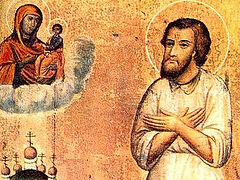
Photo: tsargrad.tv The blessed Isidore was born in Germany, apparently near Brandenburg. He was the son of wealthy Roman Catholic parents and was at first raised in the Catholic faith. Later, however, out of deep conviction, he embraced the Orthodox faith and, leaving behind his father’s house and riches, took upon himself the difficult ascetic labor of holy foolishness for Christ. Carrying a wanderer’s staff, he traveled through many cities and lands, meekly enduring insults, mockery, and beatings everywhere, suffering both cold and heat, and wearing out his body through labors by day and night.
By day he feigned madness for Christ’s sake, while by night he prayed unceasingly to the Lord, saying to himself with tears:
“Isidore! Through many tribulations must thou enter into the Kingdom of Heaven.”
Thus, journeying from city to city, Isidore finally reached the Russian city of Rostov, where he settled permanently. There, on marshy ground, the blessed one built himself a hut of brushwood, which protected him neither from cold nor from heat, but only concealed his labors of prayer from human eyes. During the day he wandered through the city enduring abuse, while at night he returned to his hut and prayed until dawn. Only occasionally during the daytime did he allow rest to his exhausted body, and even then only upon a heap of manure or the bare hard earth.
Strong was the blessed one’s love for the Lord, and for this the Lord glorified him with His grace. Even during his lifetime Isidore received from God the gift of working miracles. Here are some of his wondrous deeds:
Once, certain merchants were sailing across the sea with their goods when suddenly a terrible storm arose, threatening shipwreck. In order to appease Heaven, the merchants—like the companions of the Prophet Jonah—cast lots to discover for whose sins this danger had come upon them, intending afterward to cast the guilty man into the sea. The lot fell upon a merchant from Rostov.
The merchants placed him upon a plank and set him adrift upon the sea, while the ship sailed on. There was no hope of rescue for the Rostov merchant. The waves were already prepared to swallow the unfortunate man when Blessed Isidore appeared and carried him back onto the ship. Seeing their companion suddenly upon the vessel again, his fellow travelers were struck with fear; the unseen Isidore strictly forbade the rescued man to speak of him.
On another occasion, Prince Vladimir Andreyevich of Rostov had prepared a lavish banquet for his guests. Blessed Isidore came to the palace and asked the steward to relieve his thirst and hunger, but the steward drove him away with curses.
During the feast, the prince ordered drink to be served to the guests, but to the astonishment and horror of all, the vessels contained no drink at all. At that very moment Isidore appeared with a prosphora for the bishop who was present there, and suddenly the vessels were found filled with wine, for the correction of their hard-heartedness.
St. Isidore reposed on May 14, 1474. One townsman learned of his death in the following manner: While passing by the blessed one’s hut he sensed an extraordinary fragrance, and moved by it, looked into the dwelling. Having already passed into eternity, the saint lay peacefully with his hands folded upon his breast.
When the blessed one’s venerators learned of his repose, they came and buried his body. Later, on the place where his hut had stood, and with the blessing of the bishop, a church was built in honor of the Ascension of the Lord.
After the blessed repose of St. Isidore, a man who had lost his reason through drunkenness and fallen into madness was brought to his grave. During the moleben, the unfortunate man regained his sanity. On another occasion, a priest wished to uncover the holy body of Isidore, but for this he was struck with illness, from which he was healed only after praying at the blessed one’s tomb.
The relics of the blessed saint still rest beneath a crypt. During the reign of Tsar Ivan IV, a stone church was built over them in place of the former wooden one.
His contemporaries called Isidore “Tverdislov” (“Firm of Word”), because whatever he said invariably came to pass.
From: D. I. Protopopov. Zhitiia sviatykh, chtimykh pravoslavnoiu rossiiskoiu tserkoviiu, a takzhe chtimykh grecheskoiu tserkoviiu, iuzhnoslavianskikh, gruzinskikh i mestnochtimykh v Rossii [Lives of the Saints Venerated by the Orthodox Russian Church, as Well as Those Venerated by the Greek Church, the South Slavs, the Georgians, and Locally Venerated Saints in Russia]. Published by bookseller D. I. Protopopov.