Tallinn, June 15, 2026
 Photo: orthodox.ee
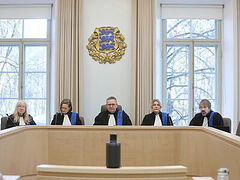
Estonia’s Supreme Court ruled on June 8 that amendments to the Churches and Congregations Act don’t unconstitutionally restrict religious freedom, rejecting a petition from President Alar Karis and clearing the way for enforcement of a law that could compel the Estonian Christian Orthodox Church to sever its ties to the Moscow Patriarchate.
The law, which prohibits Estonian religious associations from maintaining ties with foreign religious organizations whose activities allegedly pose a threat to the Estonian state, was passed by Parliament on April 9, 2025. President Karis declined to promulgate it twice before parliament passed it a third time on September 17, 2025, prompting his October petition to the Supreme Court challenging the law as unconstitutional.
The Supreme Court ruled that while the law involves “serious interference with freedom of religion and association,” it can be interpreted narrowly and applied in a manner consistent with the constitution.
The court specified that ties to a foreign organization become prohibited only when they pose a real—not abstract—threat to national security, and that compulsory dissolution may only be used as a last resort. Six of the seventeen justices dissented, arguing the law fails to meet constitutional standards of legal clarity.
The court also noted that while the law’s necessity had been discussed in the context of the Estonian Church’s ties to the Moscow Patriarchate, the ruling was limited to abstract constitutional review and didn’t assess how the law would apply to any specific religious association.
The Estonian Church acknowledged the ruling but said it doesn’t resolve the underlying questions. “It remains problematic how freedom of religion and association is guaranteed in a situation where a religious association could be compulsorily dissolved on account of its canonical ties, regardless of whether its own activities pose a threat to Estonia’s national security, constitutional order, or public order.”
The Church said it’s considering an appeal to the European Court of Human Rights, stating that “the Supreme Court’s ruling doesn’t remove all questions concerning the protection of fundamental rights and freedoms guaranteed by the European Convention on Human Rights.”
The Estonian Church also reiterated that it doesn’t pose a security threat, saying: “Our activities and commitment to Christian ideals do not and cannot pose a threat to Estonia’s national security, constitutional order, or public order.” The Church called on its faithful to “maintain peace, dignity, and trust in God.”
The Estonian Council of Churches, while condemning Kremlin support for the war in Ukraine, had expressed concern that the law sets a dangerous precedent for state interference in a church’s self-determination.
Follow OrthoChristian on Facebook, Twitter, Vkontakte, Telegram, WhatsApp, and MeWe!