We’re reading chapter 18 of Revelation and with God’s help, we’ll try to look at what’s said there. The previous chapter talked about one of the seven angels who showed the Apostle John the destruction of the harlot, the seven heads, and the ten horns. Then the angel explains the mystery that the Apostle saw. He saw a woman who reveled in the blood of the saints and the blood of the witnesses of Jesus Christ, and was horrified. The angel spoke of a woman sitting on a beast with seven heads and ten horns. The beast he saw, that was there and now is gone, came out of the abyss and is going to be punished.
The seven heads are the seven mountains that the woman sits on; and there are the seven kings, five of whom are gone, one is, and one is still to come. The beast he saw is the eighth king, but he’ll also go to destruction. The ten horns that he saw were the ten kings. They haven’t yet received a kingdom, but they’ll take power together with the beast for a short time. They’ll fight against Christ and against the Lamb. The Lamb will defeat them, because the Angel, Christ, is the Lord of lords and King of kings. Those who are with Him are the called, the chosen, the faithful. The waters that the harlot sat upon are people, nations, tribes, and tongues. The ten horns that the Apostle saw on the beast will hate the woman-harlot and will ravage her, strip her naked, and burn her with fire. God will allow them to destroy this unclean woman themselves, whom the Apostle and prophet John saw in that vision.
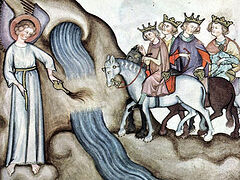
Continuing, he says: And after these things I saw another angel come down from Heaven, having great power; and the earth was lightened with his glory (Rev. 18:1). You see, the angels, like messengers of God, have great authority from God to fulfill what He has commanded them. The angels of God walk in the light of God. The works of the holy angels aren’t in darkness, nor are those of God’s saints, nor are those of God Himself. The works of God are filled with light, like the works of the angels and saints—their presence is full of light.
And he cried mightily with a strong voice, saying, Babylon the great is fallen, is fallen, and is become the habitation of devils, and the hold of every foul spirit, and a cage of every unclean and hateful bird. For all nations have drunk of the wine of the wrath of her fornication (Rev. 18:2–3). Why did this fall happen? The verse continues: And the kings of the earth have committed fornication with her, and the merchants of the earth are waxed rich through the abundance of her delicacies (Rev. 18:3). Do you see the terrible condition in this description of the harlot, with whom all nations, and the kings and merchants of the whole world have sinned and committed fornication? We’ve said that all these are riddles, mysteries, that we can’t know their exact meaning. There are various suggestions: Some speak of Rome, which was a mighty city where all the evil against Christians was committed. Rome fell, with all that followed from it. Others say this is a kind of state, an ideology, a sinful condition that has polluted and defiled all nations, kings, merchants—all the known and prominent figures of the world with their depravity. We can’t understand and explain this precisely. Over time, it will manifest itself and become clear how to explain all these things.
And I heard another voice from Heaven, saying, Come out of her, My people, that ye be not partakers of her sins, and that ye receive not of her plagues (Rev. 18:4). The Apostle and Evangelist John the Theologian then heard another voice from Heaven, which appealed to the people of God to come out of and separate from her so as not to participate in her sins and not be defiled by her. You see, God gives orders to His people, the people of the Church, to the people who believe in Him and want to be dedicated to Him, telling them to leave there so as not to be subjected to this state, to have no connection with it, to not participate in its sins and not be subjected to its plagues. This is a commandment of God, very often pronounced in the Old Testament as well, when God gives a commandment to His people to depart to another place, to depart from a place of sin, unbelief, and debauchery, to have absolutely no communion with this position.
My brothers and sisters, we must all keep this in mind in our simple, everyday lives, and not approach those things that aren’t of God, that are impure; things that have sin within them; things that are disgusting in the eyes of God. We must avoid commingling with all of this so we don’t become responsible and complicit in all the sin that covers these circumstances; and so we don’t get infected with the plagues that follow after this situation. Not just to avoid plagues, but also because we’re weak people. The Fathers of the Church, inasmuch as they were humble men, didn’t say: “I don’t take risks, I won’t fall, I won’t sin, I’ll be attentive. It’s fine, there’s no danger here; I’m not a child anymore,” and so on. The Fathers didn’t say that. Only a proud man who believes he can handle it could say that. But maybe he can cope the first, second, and third time, but the fourth time he stumbles.

Demons, as St. John Climacus says, often retreat in battle and thus a man loses his vigilance: He may move among places and sinful people and not feel that he’s being tempted or defiled. He stops watching himself, abandons watchfulness, thinks that it doesn’t concern him, doesn’t affect him. But when you find yourself in a state of carelessness and indifference, that’s when they strike, and you fall like a dead man. A humble man, however, behaves cautiously and says: “I won’t go down there; I won’t walk on rotten planks—I can’t be certain I won’t sin.” You don’t know what could happen. He watches himself and strives to avoid those things that serve as the occasion for sin.
Of course, you know, that’s great wisdom—to avoid the causes of sin. The Holy Fathers even said that very few, or maybe even no one, risks sinning while amidst the causes. When I say “cause” I mean the causes of sin. You know yourself but don’t keep watch. For a time you think that all’s well and you’re not at risk—that’s the devil stepping back—and you start believing in yourself and you stop being attentive. Then the hour comes when you’re at a turning point and you’ll be crushed. A wise man is attentive, avoiding anything that can cause a fall, because he understands that we’re weak and we don’t know what could happen to us.
Why should I keep temptation at my feet? Why should I have a cause for sin before me? We don’t know what state we’ll be in the next moment—such that with one careless movement we can destroy everything that God has arranged by His boundless mercy in our soul. This is the art of wisdom—to observe yourself and avoid these things. The Fathers would say: “Flee and be saved.” This is very wise. Don’t just sit there when you see the danger of sinning. Cut off any opportunity to sin.
None of us should trust ourselves. We’ve betrayed ourselves many times, disappointed ourselves so many times, deceived ourselves so many times. We’re not always masters of our own selves. When the time comes when the passions begin to act within us, you can destroy your whole self. The whole history of the Church and the Holy Fathers show us this. They weren’t ashamed to depict the fall of saints, ascetics, great monastics, who fell because they didn’t watch out for the causes of sin. They thought they had reached dispassion and weren’t at risk anymore. They stopped watching out for occasions for sins and suddenly found themselves among sin, committing great transgressions. They described their falls in order to teach us.
We have the example of the Prophet David. He was a prophet, not an ordinary man like us. He was a prophet of whom God said: I have found David the son of Jesse, a man after Mine own heart (Acts 13:22). Can you imagine what kind of virtue he possessed for God to say that David was like Him? How holy he was! However, since he wasn’t attentive to himself when Bethsheba was washing, and he sat and watched her, he was carried away by the passion of fornication, consorted with her, and had her husband killed. And that was a prophet of God, a man of high holiness and a bearer of grace—who became a fornicator and murderer. Of course, he repented, and God accepted his repentance and gave him the gift of prophecy and other gifts again. But he transgressed because he gave up his vigilance. Had he been attentive to himself, he wouldn’t have fallen.

Our conscience is no small matter—it must never leave us unattended, so we don’t say: “I’m already eighty or ninety years old—there’s no danger.” We, as spiritual fathers, can tell you that people fall even at ninety. We’ve even seen centenarians who have fallen into sin. Someone may already be at the point of death, ready to surrender his soul into the hands of God, and yet continue to struggle against the passions and remain in a dangerous position. Brothers, let us be very attentive. Humility and attentiveness. A proud man doesn’t keep watch, because he assumes he’s fine. Let us watch over ourselves and we’ll understand that wherever we failed to watch over ourselves, that’s where we fell, unfortunately.
How many of you have a TV at home that you don’t turn on? At least one? Don’t answer—you know the answer. People say: “I have a TV, but I don’t use it.” Fine, you don’t turn it on for a month, two, three. But I’ll tell you when you will. It’ll be sitting there in your bedroom. One day you’ll be feeling weak, and the evil one will wake you up just as your favorite show’s starting—everything will line up just right. The devil’s very good at arranging things like that. If there are any brave souls among you—be my guest. I’m not so brave, I’m afraid. But you’re brave folks—you have TVs. People even put them in their children’s bedrooms. Save us, O Lord! What can happen to the souls of young people with all the opportunities they now have to stain their souls? This tells us: Get away from this environment so as not to participate in its sins and not be defiled.
To be continued…