China, Cathedral of the 'Surety of Sinners' Icon of the Theotokos, Russian church in Shanghai. Photo: collections.lib.uwm.edu Childhood. Tomorrow something extraordinary is about to happen. At our new Cathedral of the Most Holy Theotokos “Surety of Sinners” in Shanghai, the crosses are to be raised upon the domes.
I remember the sea of people gathered around the church, like on Pascha. My father lifts me up, and I strain to catch sight of the Vladyka as he blesses the crosses prepared to be hoisted aloft. I raise my eyes. High in the sky, the great central dome comes into view, and then… I freeze in wonder. Catching the rays of the sun, a golden cross slowly ascends heavenward.
Lord! What beauty!
Next to the cathedral stood the diocesan house. We boys, though we were somewhat afraid, loved to climb to the top floor and look down from there at the people passing by. Sometimes Vladyka would find us standing at the window. Ashamed, we would press ourselves against the wall, but he would gently call us over, affectionately ruffle our hair, bless us, and send us away in peace with a kind word of encouragement.
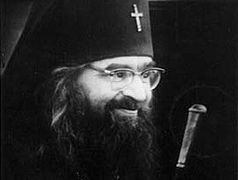
Behind the diocesan house was an open playground where we spent our days. Vladyka, who for the most part went everywhere on foot, would always stop whenever he passed by. He would come over to the children, bless us, and speak with us with fatherly kindness. I can still see before me his gentle, smiling face.
When I was already a university student, I fell gravely ill and was admitted to a Catholic hospital on the outskirts of the English Concession, in the part of the city where the Vladyka lived. My condition was serious. I remember the overwhelming joy that filled my heart when I saw the dear countenance of our beloved Vladyka standing beside my bed, his eyes radiant with compassion and concern.
How Vladyka prayed!
I remained in the hospital for several weeks, and on a certain day each week Vladyka would come to comfort me and pray. Truly, you were a good shepherd!
Vladyka could easily have instructed one of the priests to visit the sick. But despite his daily services, the heavy burden of diocesan affairs, his care for the children’s orphanage, and the rather primitive means of transportation in the city, he himself—partly on foot and partly by tram—made these long journeys to visit the sick and the suffering in hospitals and prisons, thereby fulfilling the command of the holy Apostle Paul: In all things shewing thyself a pattern of good works (Tit. 2:7).
And who could ever forget the Paschal service in the cathedral on the night of Holy Pascha? How Vladyka shone then, with a radiance not of this world! How, as he censed the church, he seemed to sweep through it like a whirlwind! How triumphantly and joyfully he proclaimed—indeed, almost shouted—the Paschal greeting! Never have I seen anything like it anywhere else. Indeed, the Vladyka always celebrated the divine services with such profound prayerfulness and spiritual fervor that both the concelebrating clergy and the faithful were themselves drawn into a spirit of prayer and reverent awe.
2. During the war, life was hard for the Russian exiles in Shanghai under the Japanese yoke and the growing influence of the Soviet regime. Vladyka shared with us all our sorrows and privations.
The war came to an end. Soviet influence stood ready to engulf all of Russian China. But God showed mercy. The situation was difficult for Vladyka as well, for he had no contact with Metropolitan Anastasy, who at that time was restoring the life of the Russian Church Abroad after the devastation of the war. Vladyka was also trusting by nature. Although some accused him of political inconsistency, in his heart he never abandoned his true convictions. He proved this not only by offering repentance before the Council of Bishops, but also by becoming, as the spiritual leader of his flock, the one who led the exodus of the Russian refugees from China—first to the Philippines, and then to America.
 On the island of Tubabao, the Lord once again granted me the blessing of meeting my beloved Vladyka and of experiencing his gracious kindness toward my unworthiness, for at that time I was a lonely and bewildered wanderer. Although he already possessed a visa to enter the United States, he considered it his first duty to share the exile of his spiritual children, whom the Providence of God had cast upon those islands of palm trees and typhoons.
Within a remarkably short time, church life began to flourish. A temporary diocesan chancery was established, a convent was organized, three churches were opened, and beside the monastery there arose a “Cathedral,” housed in a spacious military barracks and, by Pascha, crowned with a handmade onion dome.
Vladyka eventually departed for America; and it is well known how, by the power of his spirit, he prevailed upon the mighty of this world to admit his persecuted flock into the country. Once they had tasted freedom, people valued it in different ways, and they repaid the elder also in different ways. Yet one thing may be said with certainty: Vladyka never harbored resentment against anyone. He treated even those who were ill-disposed toward him as though nothing had ever come between them. It is this quality above all that fills me with admiration. Oh, if only we all knew how to conduct ourselves in such a manner in these difficult times!
Whenever I later visited Washington, I could not help but notice the lasting mark Vladyka had left there, both upon the life of the Church and upon the people who lived there.
3.
Time passed. In the 1950s, the Lord directed my steps to Paris, where the Vladyka was then living in Versailles. Never shall I forget my meeting with that gracious archpastor.
Vladyka was living at the Cadet Corps. My arrival was unexpected. His secretary received me and directed me to Vladyka’s study on the upper floor. With a trembling heart I ascended the broad staircase, from whose walls the portraits of the Russian sovereigns looked down upon me. I knocked at the door and heard, “Amen.” At the time I did not know that I ought to respond, “Through the prayers of our holy fathers...”
I entered.
Seated behind a writing desk strewn with letters and papers, the Vladyka was busy writing. The aged hierarch’s humble appearance—barefoot, clad in a worn cassock, his hair falling loosely about him—presented a deeply moving image of humility and simplicity. I stopped in the doorway.

The moment he saw me, Vladyka cried out with joy. His face suddenly lit up with a radiant smile, and, springing from his chair, he blessed me and drew me into his embrace. I could scarcely restrain my tears of joy.
Our conversation flowed with animation. One memory led to another, one familiar name to the next. In that brief meeting it seemed as though we had relived the whole course of the previous several years.
When he learned that I intended to travel throughout Europe, the Vladyka took down a Holy Trinity Calendar and handed it to me, pointing to its list of Orthodox parishes throughout Europe.
“Go with God. Whenever you arrive in a city, go first to the local priest. Tell him that I have sent you.”
By God’s mercy and through Vladyka’s wise counsel, I traveled through nearly all of Europe. Everywhere I found not only spiritual care, but also friends and acquaintances who showed me the treasures of their cities in a way that no travel agency could ever have done.
At length the hour of parting arrived. The Vladyka suggested that we go down to the house church below. There he served Vespers, after which he gave me his final blessing for the journey.
I approached to receive his blessing, but he said,
“No, no—I shall walk with you to the tram.”
From the Vladyka’s residence to the tram stop was no short distance. I felt embarrassed that the elderly hierarch should accompany me so far, yet he would not hear of anything else.
And when the tram finally departed, I continued for a long while to gaze with deep emotion at the bent figure of the aged bishop, still standing there, blessing me as I set out upon my journey.
4.
The years passed.
University. Marriage. Civil service. Parish work.
Meanwhile the thoughtful and deeply spiritual letters of my beloved Vladyka continued to arrive. Then, quite unexpectedly, came his invitation that I enter the service of the Church. It was at that very time that the Council of Bishops was considering the glorification of Fr. John of Kronstadt, a cause for which Vladyka John had labored with particular zeal. About the same time I was granted a remarkable dream: Dear Fr. John himself blessed me and exhorted me not to doubt.
That very day my wife underwent a serious operation. Yet her condition did not improve, and we had nearly given way to despair.
Then, unexpectedly, the telephone rang. Vladyka spoke to my wife: “Consent to his ordination, otherwise you will continue to be ill.”
Soon afterward Vladyka came to visit us. He shared our family meal and conversed with us most graciously. Then, as he was taking his leave, he suddenly turned to my wife and asked, “Well then, my dear—which shall it be: the diaconate or the priesthood?” Throughout the entire evening he had not mentioned the matter by so much as a single word.
Needless to say, such a decisive statement from Vladyka made a profound impression upon us. We submitted ourselves to the decision of our Abba.
On his next visit to the East Coast, it was Vladyka himself who ordained me to the holy diaconate. I can only bear witness that his words proved true. After I was ordained a deacon, my wife’s health improved markedly.
Thus several years passed. Throughout that time, Vladyka never forgot us in his letters, and whenever he came to New York he invariably telephoned to inquire after us. Then came another proposal from our Abba—to accept a parish as a priest in his diocese. Again came deliberation, and again my wife’s illness returned. This time we said to ourselves that perhaps Vladyka was once more pointing us toward the source of healing. And so we consented. But by then Vladyka had already departed this life.
The Lord counted me worthy of the priesthood, and today I cannot but bear witness that, for the second time, my Matushka’s health was restored without any medical intervention. We have never doubted that this came through the intercessions and prayers of our beloved Vladyka.
5.
Vladyka’s letters no longer arrive, yet we continue to feel his loving care for us with undiminished strength, and we live by the memory of him.
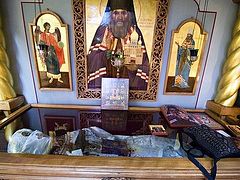
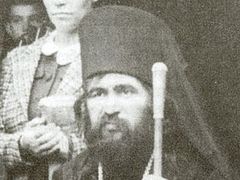
 Before my eyes there rises the bent figure of the aged hierarch, somehow reminiscent of the venerable Elder Seraphim. There he stands—a righteous man of our own times, a faithful follower of the holy and righteous wonderworker Fr. John of Kronstadt; a true non-possessor, seeking no glory in the dignity of the episcopate, aspiring neither to honors nor to splendid vestments; a good shepherd, ever the first to set an example of loving care for his neighbor; a pastor who lived by the Church, in the Church, and for the Church; a Christian who had conquered anger within himself, and whose face therefore shone with a joyful smile; a father overflowing with love; a bishop who never wearied in his labors; a man who knew no limits in his ascetic striving; a servant of God laboring day and night in attentive and unceasing prayer; an intercessor before God for mankind, through whom many received healing and the fulfillment of their hopes.
Truly, brethren, For such an high priest became us, who is holy, harmless, undefiled, separate from sinners, and made higher than the heavens (Heb. 7:26).
Our ever-memorable Vladyka John followed this apostolic ideal throughout his much-laboring life, and in no small measure attained it.
This is all the more marvelous as Vladyka lived in our own age, when mankind had grown so impoverished in faith and piety. Is not this the very reason for the misunderstanding that so often confronted him—even from those who, one would think, belonged to the Church itself?
Yet, in testing men’s hearts, all that the Lord permitted during Vladyka’s lifetime has now vanishing like smoke before the eyes of all. With each passing day this chosen lamp of righteousness shines ever more brightly, strengthening the faithful to persevere in the Christian struggle of humility, patience, and love.