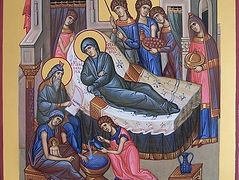
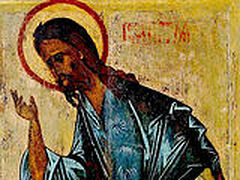
Photo: ikonaspas.ru Dear brothers and sisters in the Lord! Greetings to all of you on the feast of the Nativity of St. John—the holy Prophet, Forerunner and Baptist of the Lord! Open open his Life—there are some moments there that I would like to reflect on.
We know that there are very special chosen ones of God, special saints. Of course, the first of them is the Most Holy Theotokos, then the holy Forerunner and the twelve apostles. These are those closest to Christ, the very first of His chosen ones. It is very important and very interesting to analyze their lives.
Just a few years after St. John’s birth, King Herod started persecuting Christ and wanted to kill Him, ordering all the babies in Bethlehem to be massacred. Having learned of this, the holy Forerunner’s mother fled with him into the desert. His father, Zechariah, was murdered.
Then the holy Forerunner grew up in the wilderness. Humanly speaking, his life was very hard and even brutal. He wore clothing woven from camel’s hair, which was very rough and uncomfortable, ate locusts and wild honey, lived in the wilderness, and died a martyr’s death, suffering for the truth—the holy Forerunner was beheaded.
The decision to bring about this martyr’s death was made at a feast, where a drunken king fulfilled the desire of some lustful young woman. And of course looking at all this, we should reflect on why the Lord leads His chosen ones along such a sorrowful path.
There is a wonderful apostle—the Apostle Paul. Most of the Epistles that came down to us were written by him. So he was the “father of Orthodox missionary work” who devoted his whole life to laboring for Christ. The Lord revealed to him a very interesting thing. The Apostle Paul had a certain disease, described in his Epistles as a thorn in the flesh, the messenger of satan (2 Cor. 12:7), which tormented him. And when he begged the Lord to deliver him from this, the Lord said no, for My strength is made perfect in weakness (2 Cor. 12:9). My strength is made perfect in weakness!
Just before Christ was betrayed, the Apostle Peter said, Lord, why cannot I follow Thee now? I will lay down my life for Thy sake (Jn. 13:37). It would seem that he a great saint, since he longs to suffer for Christ and follow Him to the end. But we know that it was not pleasing to God, so the Lord allowed St. Peter not only not to follow Him, but even to deny Him three times and say: I do not know the Man (Mt. 26:72).
Why did this happen? On the contrary, the holy Forerunner was able to suffer for the truth to the end and receive a martyr’s death. Because his desire was based on the profound humility that we see throughout his life. People flocked to him and even mistook him for the Messiah. But when Christ came, the Forerunner humbly said, He must increase, but I must decrease (Jn. 3:30).
The Pharisees who were supposed to have accepted Christ harbored a deep animosity towards Him and eventually crucified Him on the Cross. And the Apostle Peter’s desire was nevertheless based on asserting himself in his presumption: “Lord, I can suffer for Thee myself!” and he failed.
And so, the entire lives and preaching of the apostles were accompanied by imprisonments, persecutions, and torments, and almost all of them died as martyrs. This is a very important lesson for us, because when a person comes to the Church and begins to integrate into its life or becomes interested in Church life, he is afraid of this theme of sorrows—which is always present everywhere in Orthodoxy.
There was one amazing man and confessor—Bishop Benjamin (Milov; 1887–1955) of Saratov and Balashov, who languished in Soviet labor camps for seventeen years. And he left behind a diary, in which are written two very important points. Firstly: “Blessed be God Who never allows His servants to be tempted beyond their capacity.” And secondly: “A soul without the grace of God is a complete zero.”
This is a very important lesson that people learn through their experience of sorrows and suffering. And what does this lead them to? The Lord becomes the sole hope in their lives. The holy apostles and the holy Forerunner walked this path. The Lord said of such people: He that believeth on Me, the works that I do shall he do also; and greater works than these shall he do (Jn. 14:12).
And this applies to all saints up to our days—that’s another very important point. Take St. Ambrose of Optina; he suffered from five chronic, severe and debilitating illnesses for decades, but he received grieving people every day from eight in the morning until eleven in the evening! And did anyone who knew him ever say that he was poor and unhappy? Or would anyone say the same of the holy Forerunner, who led a life as hard as the apostles? Absolutely not!
On the contrary, we understand that we are so far away from the blessedess and fullness of life that they had, because the supreme essence in man is the spirit. And we see from these people’s experience that the body can be very weak, it can be sick and suffer. From a purely social perspective, a person may be a loser; but if he acquires such spiritual power, people will flock to him for consolation.
Or take Mother Theodosia of Skopin, who died not so long ago.1 For over forty years, she was paralyzed and confined to bed, and her hands couldn’t even move. And so what? Multitudes of people flocked to her every day. Did governors, bishops, and priests come to comfort her? Not at all! On the contrary, they came to be nourished by spiritual consolation from her, because this woman really possessed great spiritual strength, while from a purely human point of view she was absolutely infirm.
The remarkable thing is that spirituality is the supreme power in man. Not the body, not the soul, but the spirit! The Spirit determines everything. There is a spiritual law that the Holy Fathers speak about, and it is the lesson that we learn from studying the Lives of the Saints and the Forerunner: “Give blood and receive spirit.” There’s just no other way. And no one should be afraid of this, brothers and sisters, because the Lord will guide every person on His own unique path.
Here is a very simple moment: A person comes to church—and what is the first thing he encounters there? One of the hardest things is the restrictions: fasting, prayer rules, and attending services. It would seem that this limits you, but in fact it gives you spiritual strength. These restrictions contain spiritual power. And what is spiritual life essentially about? The answer is that everything should have its place, time and measure.
And if it this observed, then a person truly becomes happy. There should be a proper place in life for friends, family, work, rest, entertainment, and prayer. But there must be spiritual life in everything—it should never stop. But when everything else finds its measure and its place, then a person finds the fullness that he seeks in life.
This is a very important point and lesson from the Lives of the Saints. True, their lives were not easy, and the sorrows they went through may even frighten us, but they were people of great spiritual power. They acquired such spiritual power though they are no longer with us in body, we still feel their presence as we turn to them in prayer.
If we talk to people, I believe we can hear a lot of stories about how they were rescued by the Mother of God, the holy Forerunner, or one saint or another. That’s what kind of people they were—even many, many years after their repose, they are still our spiritual power and support.
And the Lord guides all of us to this spiritual power. Therefore, we should not ask: “I have come to God, and my whole life should be a bed of roses. Why isn’t it so?” All that the Lord allows each one of us to experience is for our benefit.
And it is important to know that the Lord will certainly give us the spiritual strength to endure all this. We just have to rely not on ourselves, but on God, and not forget to ask Him for this in prayer. And the last thing I would like to mention is the very important spiritual experience of St. John Chrysostom, who said: “When sorrow comes to you, thank God for it.” Even if you don’t want to, even if everything inside you resists it, nevertheless thank Him. The tribulation will pass very quickly. When something good comes, and if you want to have this grace and joy with you for a longer time, thank God. And this joy will remain with you for a long time.
Glory to God for everything! May the Lord help you! Amen.
1 Schemanun Theodosia (Kosorotikhina; 1922 or 1923–2014) lived in the village of Oktyabrsky in the Skopin district of the Ryazan region. The blessed eldress was beloved all over Russia for her spiritual counsel, extreme humility, the gift of unceasing prayer and clairvoyance.—Trans.