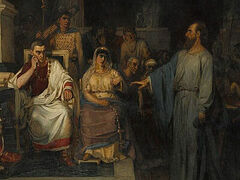
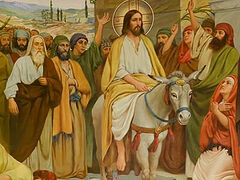
The Heavenly Banquet of the Righteous. Detail from the icon The Last Judgment. Russia, sixteenth century.
But seek ye first the kingdom of God, and his righteousness…
—Matthew 6:33 (KJV)
The Kingdom: The Heart of the Gospel
The concept of the Kingdom of God is not merely one theme among many in the Gospel proclamation. It is its central axis, its very essence and meaning. Christ’s entire ministry is summed up in “the gospel of the kingdom” (Mark 1:14–15; Matt. 4:23; 9:35; 24:14). The Savior’s first recorded words are: “Repent: for the kingdom of heaven is at hand” (Matt. 4:17, KJV). The Evangelist Luke likewise presents the Kingdom of God as the very subject of the glad tidings, the Good News itself: “I must preach the kingdom of God to other cities also: for therefore am I sent” (Luke 4:43, KJV).
Yet at the very dawn of Christian history we encounter a remarkable fact: Christ and His disciples speak about the same thing—the Kingdom—yet they understand it in entirely different ways. This divergence is not merely a historical paradox or a logical inconsistency. It is a profound theological lesson for each of us.
The Language and Number of the Kingdom
In the Greek text of the New Testament, every expression related to the Kingdom is built around one central word: βασιλεία (basileia). The term signifies not so much a territory or a state as royal authority, kingship, or reign. In Christ’s preaching, basileia refers above all to the reign of God, His sovereign rule. For this reason, the Kingdom is not something external; it is God’s own dominion at work in the hearts of men.
The word βασιλεία occurs 162 times in 154 verses of the New Testament. The overwhelming majority of these occurrences—approximately 135—refer specifically to the Kingdom of God, the Kingdom of Heaven, or the Kingdom of Christ. Of these, 103 are found in the Synoptic Gospels (Matthew, Mark, and Luke), underscoring the centrality of the theme in our Lord’s own preaching.
The New Testament employs three principal expressions:
-
“The Kingdom of God” (ἡ βασιλεία τοῦ Θεοῦ) appears approximately 68–72 times throughout the Gospels, the Acts of the Apostles, and the Epistles. This is the primary expression used by Christ Himself and by the Apostles after Pentecost. It denotes God’s sovereign reign extending over the hearts of believers.
-
“The Kingdom of Heaven” (ἡ βασιλεία τῶν οὐρανῶν) occurs 32 times, exclusively in the Gospel according to St. Matthew. This reflects the Jewish custom of avoiding the direct utterance of God’s Name, while also emphasizing the heavenly origin and spiritual nature of the Kingdom. Biblical scholars are unanimous that Matthew’s “Kingdom of Heaven” and the other Evangelists’ “Kingdom of God” are exact equivalents, as is evident from the parallel passages.
-
“The Kingdom of Christ” (ἡ βασιλεία τοῦ Χριστοῦ) appears only a few times, and only in the Epistles (Eph. 5:5; Col. 1:13). It emphasizes that the Kingdom of God is realized through Christ as King and Mediator. It is the very same Kingdom, revealed and governed by the Savior.1
Significantly, nowhere does the New Testament employ the expression “the Kingdom of Israel” (ἡ βασιλεία τοῦ Ἰσραήλ) in the political and earthly sense in which the Apostles themselves initially understood it. The phrase appears repeatedly in the Septuagint (the Old Testament)—for example, in 1 Kingdoms (1 Samuel) 24:21—but it is entirely absent from the New Testament.
The only passage that alludes to such an idea is the Apostles’ question in Acts 1:6: Lord, wilt thou at this time restore again the kingdom to Israel?
Even here, however, they are speaking of the restoration of a former kingdom rather than employing it as a fixed theological expression.
The absence of this formula is itself a theological witness. The earthly, political Kingdom of Israel is no longer the object of Christian hope. It remains in the Old Testament as a type and foreshadowing. In its place stands the spiritual, universal Kingdom that is “not of this world.”
By comparison, of the 162 occurrences of basileia, only about 27 refer to earthly kingdoms, the kingdom of satan, or Old Testament political expectations (Matt. 4:8; Mark 3:24; Mark 11:10; Rev. 17:12, among others).2 Unlike these temporal kingdoms, the Kingdom of God, the Kingdom of Heaven, and the Kingdom of Christ are eternal, spiritual, and universal.
Two understandings: Christ’s and the Apostles’
For our Lord, the Kingdom is an inward, spiritual, and moral reality.
When Pilate questioned Him, Christ declared plainly: My kingdom is not of this world (John 18:36) His Kingdom is not a political empire or a territorial state.
When the Pharisees asked Him when the Kingdom of God would come, He answered: The kingdom of God cometh not with observation… for, behold, the kingdom of God is within you. (Luke 17:20–21)
What a remarkable word: within. Not in Jerusalem, nor in Rome, nor in political institutions, but in the human heart. The Kingdom of God begins for us when the Holy Spirit comes to dwell within our hearts, teaches St. Luke of Crimea.3
Educational instruction above logic
From the standpoint of formal logic, we seem to encounter a violation of the law of identity: the same term is used in two different senses. Why, then, does the Lord not immediately correct His disciples? He acts differently—not to drive them away, but to teach and save them.
First, Christ condescends to His disciples’ weakness. He speaks to them according to the measure of their imperfect understanding, just as a mother lisps to her infant. Had He abruptly shattered their Old Testament expectations, they might have stumbled, like the two disciples on the road to Emmaus who lamented, But we trusted that it had been he which should have redeemed Israel (Luke 24:21). The Lord allows them to retain the familiar vessel—the word Kingdom—so that, through Pentecost, He might gradually fill it with new wine, with its true heavenly content.
Second, the Savior affirms the primacy of living experience over abstract concepts. Before Pentecost, the Apostles knew the word Kingdom, but they did not yet know its reality. After the descent of the Holy Spirit, they realized that their former expectations had nothing in common with what they had actually experienced. As St. Silouan the Athonite teaches, God can be known only by the Holy Spirit.4 Until a person enters the Kingdom through repentance and partakes of it by grace, he will inevitably project onto it his own cultural, ethnic, and political assumptions.
They expected a throne in Jerusalem—He established His throne in their hearts
Third, the Lord teaches the lesson of newness rather than restoration. The Apostles asked about restoring what had once existed. Christ directed their gaze forward, toward fulfillment and transfiguration. Had the Kingdom merely been the restoration of an earthly monarchy, Christianity would never have become the New Covenant.
Instead, the Lord declares: Behold, I make all things new (Rev. 21:5). They expected a throne in Jerusalem; He established His throne in their hearts (cf. Luke 17:21).
Thus, the apparent divergence between Christ and His Apostles is a deliberate act of divine upbringing. It demonstrates that God’s revelation cannot be confined within the Procrustean bed of human categories. Whenever it seems that the Lord says one thing while we understand another, this is not a reason for doubt but an invitation to metanoia—to the transformation of our minds and hearts.
The Kingdom in Acts, the Epistles, and Revelations
At first glance, the doctrine of the Kingdom seems to recede into the background in the books written after the Gospels. In the Acts of the Apostles, the preaching centers on Christ crucified and risen. The Epistles proclaim justification by faith and divine grace. The Apocalypse depicts Christ’s final victory over evil, corruption, and death.
Yet this impression is deceptive. After Pentecost, every trace of the earlier duality disappears. These books present only Christ’s understanding of the Kingdom as a spiritual, inward, grace-filled reality. Neither the Apostles nor their disciples ever return to political hopes. For them, the Kingdom is the power of God reigning within believers’ hearts, the Church as the Body of Christ, the new life in Christ, righteousness, peace, and joy in the Holy Ghost.
The word Kingdom itself appears less frequently—not because it has lost its importance, but because it has become woven into the fullness of divine revelation. Having found Christ Himself, the Apostles unfold the reality of the Kingdom under other names: Grace, Redemption, Sanctification, Deification, and the Church.
Therefore if any man be in Christ, he is a new creature (2 Cor. 5:17) That is precisely the Kingdom begun within the human heart. Accordingly, the Book of Acts concludes by describing St. Paul as one who was preaching the kingdom of God, and teaching those things which concern the Lord Jesus Christ (Acts 28:31). The Kingdom is now not a political program but the proclamation of the Risen Christ and the salvation offered to all nations.
It is here that we hear: We must through much tribulation enter into the kingdom of God (Acts 14:22.) The Kingdom is entered through the Cross, not through earthly triumph.
In his Epistles, St. Paul gives precisely the same definition of the Kingdom that Christ Himself taught: For the kingdom of God is not meat and drink; but righteousness, and peace, and joy in the Holy Ghost (Rom. 14:17) Not a word is said about politics, national borders, or worldly power. Everything points instead to the inward life bestowed by the Holy Spirit.
In the Book of Revelations, the Kingdom appears in its eschatological fullness as the new heaven and the new earth, wherein dwelleth righteousness (cf. 2 Pet. 3:13). It is not the restoration of the old Israel but an entirely new creation.
The book concludes with the Church’s prayer: Even so, come, Lord Jesus (Rev. 22:20). For the Kingdom is Christ Himself, coming in glory. The post-Gospel writings know nothing of the earlier ambiguity. For the Apostles, enlightened by the Holy Spirit, the Kingdom of Christ is the Kingdom of Heaven—and nothing else. Earthly Israel remained behind as a type and shadow. In its place stands the Israel of God (Gal. 6:16): the Church, uniting all who believe in Christ.
Prosperity or bearing the Cross
Sadly, this crossroads in the understanding of the Kingdom of God did not remain in the past. It is reenacted in the heart of every one of us whenever we read the Gospel or pray, Thy kingdom come (Matt. 6:10).
Many Christians today, often without realizing it, repeat the path of the Apostles before Pentecost by treating Christianity as a means of attaining earthly well-being. For them, faith becomes a kind of “magic wand” for solving family, financial, and social problems. They seek an earthly Kingdom of God here and now, expecting the Lord to “restore” their status, prosperity, and comfort. This is the very same mistake the Apostles once made, except that in place of a political Israel stands the individual self with all its worldly desires.
But there are others—true Christians—who hear the authentic voice of Christ. They understand the Kingdom as the grace of God reigning in the heart, as conformity to God and union with Christ. They know that earthly life is not a place of comfort but the path of bearing the Cross.
The Lord Himself warned us: In the world ye shall have tribulation (John 16:33). And the Apostles confirmed: We must through much tribulation enter into the kingdom of God (Acts 14:22) The true Kingdom begins not with the resolution of worldly problems, but with the crucifixion of the old man and the taking up of one’s cross.
Today, just as two thousand years ago, Christ gives us no outward guarantees. Instead, He gives us Himself. He does not promise a life of comfort and security; He promises that, in the midst of suffering, His grace will be with us. That grace dwelling within the heart is the reality of the Kingdom. It does not make a man an earthly victor or a worldly success; it makes him partaker of the divine nature (2 Pet. 1:4).
The Heavenly Kingdom of Israel: Conclusion
In light of everything that has been said, we may answer the question directly: the Kingdom of Christ is the Kingdom of Heaven, not the Kingdom of Israel in the earthly and political sense that the Apostles attached to those words before Pentecost. The Lord unequivocally rejected such an understanding: My kingdom is not of this world (John 18:36). He came to establish the Kingdom of the Spirit—the reign of God in human hearts, independent of geographical boundaries and material circumstances.
Yet the rejection of an earthly kingdom does not abolish the very concept of Israel. On the contrary, in the New Testament it receives a new, spiritual fulfillment. The Church of Christ is the new Israel (cf. Rom. 9:6–8; Gal. 6:16)—Israel according to the Spirit rather than the flesh, those who through faith have entered into the promise given to Abraham. The Apostle Peter describes believers as a chosen generation, a royal priesthood (1 Pet. 2:9)
The true Israel is therefore no longer defined by the inhabitants of Palestine but by all who believe in Christ, regardless of nationality or place of residence. Their Kingdom is heavenly, though it manifests itself on earth in righteousness, and peace, and joy in the Holy Ghost.” (Rom. 14:17)
Thus, when we speak of the Kingdom of Christ, we are not choosing between the Kingdom of Heaven and the Kingdom of Israel as though they were two competing alternatives. Rather, we affirm that the heavenly Kingdom is realized through the new, spiritual Israel—through those who bear Christ within themselves.
Earthly Israel was only a type and foreshadowing. The true Israel is the Church, and her Kingdom transforms the world by first transforming the heart of every believer. For this reason, the books written after the Gospels contain no trace of the earlier ambiguity. The Apostles’ original understanding—earthly and political—was a misconception corrected by the Holy Spirit. Christ’s understanding—spiritual and inward—remains the unchanging ideal that runs throughout the entire New Testament, from the hidden Kingdom within the heart to the eschatological Kingdom that shall be revealed at the end of the ages.
The contrast between a carnal and a spiritual understanding of the Kingdom of God is reproduced in our own lives as well. How often, like the Apostles before Pentecost, do we expect God to grant us outward things—comfort, security, support, solutions to our problems! How often do we seek the restoration of something earthly instead of searching for the Kingdom within ourselves! Yet again and again the Lord calls us back to Himself, who dwells within the heart.
Whenever we ask the Father, Thy kingdom come, we must be prepared for the fact that His Kingdom comes through the Cross, and not apart from it. It comes through the renunciation of the idol of earthly prosperity and through our acceptance of the grace-filled union with the Crucified Christ. Bearing the Cross is not an occasional possibility; it is the very law of authentic spiritual life.
Let us, then, seek above all this Kingdom—righteousness, and peace, and joy in the Holy Ghost. Let us receive God’s grace into our hearts, bearing our earthly cross with patience and love. Then, according to Christ’s promise, Seek ye first the kingdom of God, and his righteousness; and all these things shall be added unto you (Matt. 6:33)