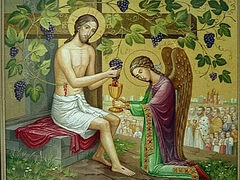
The Antiphons and Only Begotten Son (1676–1682). Photo: valaam.ru
In our previous talk, we discussed the prayers of the First and Second Antiphon. And today, with God’s help, we’ll continue to look at the Divine Liturgy.
Third Antiphon
So, after the choir sings the Second Antiphon, followed by a brief doxology to the Holy Trinity: “Glory to the Father, and to the Son, and to the Holy Spirit, both now and ever and unto the ages of ages. Amen,” the hymn “Only-Begotten Son” is sung, named after its first line. Let’s read it:
Only-Begotten Son and Immortal Word of God,
Who for our salvation didst will to be incarnate of the holy Theotokos and Ever-Virgin Mary;
Who without change didst become man and was crucified;
Who art one of the Holy Trinity, glorified with the Father and the Holy Spirit:
O Christ our God, trampling down death by death, save us!
This hymn is dedicated to Christ, Who is the “Only-Begotten Son and Word of God.” Why is Christ called “Only-Begotten?” Because He is the only One “born” of God the Father. The Logos, the Son of God, is begotten of the Father outside of time. That is, there was no time when the Son wasn’t yet born, as happens with us. The Son has always been with the Father. The Father doesn’t precede the Son by even a single second. This is explained by the fact that there is no time in the Holy Trinity. The Godhead is subject to neither time nor space.
We are also sons of God. Holy Scripture calls us sons and children of God. But we’re not from the essence of God. We become His children and receive deification through the work of uncreated Divine grace. God adopts us to Himself, whereas the only one born of the Father, the only “Only-Begotten,” is the Son and Word of God, Christ.
Immortal Word of God, Who for our salvation didst will to be incarnate of the holy Theotokos and Ever-Virgin Mary
Although You’re the Immortal God, the hymn continues, You deigned to become Man for the sake of our salvation. The foundation of our faith lies in this truth: God, Who created the world out of nothing, became Man for our sake. God entered the history of the world at a specific time, as a specific person—Jesus Christ. The Logos became incarnate, that is, He took on flesh from the Ever-Virgin Mary. We call her the Theotokos because she gave birth to God in the flesh, and Ever-Virgin because she was a virgin during and after the birth of Christ.
Who without change didst become man
These words mean that the Divinity of the Son was neither changed nor diminished in His Incarnation. Christ remains perfect God while being perfect Man, but without the sin that is inherent to us.
So, the perfect God became Man, received flesh from the Most Holy Theotokos and Ever-Virgin Mary and the Holy Spirit. Christ was born of the Holy Spirit, not from the union of man and woman, as all of us, and therefore He didn’t inherit the predisposition to sin that is inherent to fallen human nature. In Him, the consequences of the fall found no foothold, and He became the New Adam, with Whom we can unite in the Holy Mysteries of the Church. By uniting with Christ in the Sacraments, we heal our sin-damaged nature, our inner man, and we “graft” ourselves onto the blessed state of the New Adam.
This is why it’s necessary to live by the Sacraments of the Church. Sometimes we hear people say: “I believe in Christ, I read Holy Scripture. Isn’t that enough?” That’s all good, but to live the new life of Christ, to unite with Christ, to be “grafted” onto the Body of Christ, to the Church, we must first receive Holy Baptism, then commune of the Body and Blood of the Lord, and participate in the other Sacraments of the Church, which are the source of life for the soul. Communion with Christ in the Mysteries is as essential for the human soul as breathing oxygen and eating food is for the body.
The Church and the Gospel aren’t some kind of ideology or philosophy. It’s not enough just to believe in Christ or consider yourself His follower. If you don’t live by the Sacraments, then none of this will do you any good. Then you’re no different than the followers of some philosophical trend. Christ said clearly: Except ye eat the flesh of the Son of Man, and drink His Blood, ye have no life in you (Jn. 6:53). We’re dead if, for one reason or another, we don’t commune of the Body and Blood of the Lord—of course, after appropriate preparation, praying with humility and repentance to unite with Christ.
And was crucified… O Christ our God, trampling down death by death
Death, which enslaved the human race after the fall, was trampled upon by Christ’s death on the Cross and His Resurrection. This is what we sing about at Pascha: “Christ is Risen from the dead, trampling down death by death.” Whenever we attend a funeral, we see how important it is, both for the one who has reposed and for those who remain, to have faith that death has been defeated by Christ, and therefore, the hour is coming when all the dead will rise, just as Christ rose. This faith was held by the martyrs, monastic saints, the righteous, and the whole innumerable host of saints of our Church, who now abide with Christ.
That’s why St. John Chrysostom says in his beautiful Catechetical Homily read at Pascha: “Let none fear death, for the death of the Savior has set us free.” I’ve been present at the repose of many Christians, including both monks on Mt. Athos and believers in the world. I can say that true Christians pass from this present temporal life into the future eternal life with spiritual peace and tranquility. Of course, it can be difficult to leave this world. Death is like being born into another reality. Nevertheless, if Christ is present in a man’s soul, then he easily leaves this world. Otherwise, death can be scary. It’s terrible to see the death of people who don’t believe in God, who had no connection with Him in their lives, who didn’t know God the Father, and therefore are left alone at the hour of death. As a loving father, God does everything to help each of us, but He doesn’t abolish our freedom of choice.
Trampling down death by death
What else does this mean? The means of Christ’s victory over death is death itself. And for us Christians, this is the only way to overcome evil, the world, and all the sorrowful circumstances we face. Any other way is worldly, not of God. In other words, if we want to overcome evil with evil, this struggle isn’t of God. For example, if we try to overcome revenge with revenge, this isn’t God’s way of fighting. If we want to overcome our opponents with worldly power, to crush them, to trample them into the mud, to grind them to dust, this is not of God. The way that God overcomes is through death. When we understand this, then we’ll stop opposing, resenting, defending our rights, and endlessly asking why: “Why’d he do that to me? Why’d he say that to me? Why’d he treat me so unfairly? Why’d he humiliate me? Why are all these evil things happening to me?”
Christ has shown us what true victory is. The Savior overcame death when He came Himself over to death. The saints overcame the world when they surrendered themselves into the hands of the world, and the world did with them as it pleased. And what did it do with them? It betrayed them to torment and execution. The moment the saints were killed, they overcame the world. This is proven by the fact that they entered the Heavenly Kingdom and have remained saints forever.
And we Christians need to understand that we have to go through death. Where? At work, at home with our family, at school—everywhere. We face many difficulties every day because we want to keep God’s commandments, for which we’re often mocked, insulted, treated unfairly, slandered, and even exploited by those around us. They treat us like this only because we want to be Christians. All of this is the dark visage of death that wants to devour us. And the brave Christian lets death devour him. What does this mean? It means we allow people to say whatever they want about us, to treat us as they please, and not rebel against them because of it. If we do this, we’ll see that victory will be with us and we’ll find ourselves with the saints in the Heavenly Kingdom. It’s very important to understand what the art of spiritual warfare is and learn how to fight not with worldly methods, but Divine.
Who art one of the Holy Trinity, glorified with the Father and the Holy Spirit … save us!
We pray that Christ, Who trampled down death and is glorified with the Father and Holy Spirit, might save us—from sin, from the passions, from suffering, from our base inclinations and desires, from everything that torments and wearies us and prevents us from feeling the peace of Christ in our soul.
Prayer of the Third Antiphon
Following “Only-Begotten Son,” the deacon exclaims the third litany: “Again and again in peace let us pray to the Lord…” Meanwhile, the priest stands before the holy altar reading the prayer of the Third Antiphon in a low voice. Let’s take a look at this prayer.
O Thou Who hast bestowed upon us these common and concordant prayers, and Who hast promised that when two or three are agreed in Thy name, Thou wouldst grant their requests: Do Thou Thyself now fulfill the requests of Thy servants to their profit, granting us in this present age the knowledge of Thy truth, and in that to come, life everlasting.
The deacon, having not yet received the grace of the priesthood in its fullness, prompts the people to pray, to this or that action, for example, to bow their heads, to stand with the fear of God, to attentively listen to Holy Scripture. And the priest speaks directly to God on behalf of the people and prays to the Lord to give all believers everything they need.
O Thou Who hast bestowed upon us these common and concordant prayers, and Who hast promised that when two or three are agreed in Thy name, Thou wouldst grant their requests
The Lord says in the Gospel: Where two or three are gathered together in My name, there am I in the midst of them (Mt. 18:20). He didn’t say: “Where there is one man in My name, there am I with him,” but: Where two or three. You might object: “If two or three people have gathered, why should God be with them? They already have a full company. Someone who’s alone needs God much more.”
The Lord said this because He doesn’t want us to be isolated individuals. He wants us to be unified with our brethren, to avoid egocentrism, greed, and willfulness. What else is an assembly of Christians in the name of the Lord, if not the Church? That’s why priests aren’t allowed to serve Liturgy by themselves. They can’t say: “I’m going to go to church, lock myself inside, and serve Liturgy by myself.” This is forbidden in the Orthodox Church. Priests can serve Vespers, Matins, a moleben, or any other service by themselves. But Liturgy—no. There must be at least one other person with him. After all, Liturgy isn’t the private work of a priest; Liturgy is celebrated by the Church for the sake of the whole world, and there should be at least two people gathered together to celebrate it.
It’s long been noticed and testified to that the prayer of the Church, the common prayer of Christians, truly works miracles. Countless times we’ve witnessed how circumstances, the state of things, events, have changed when several people gathered to pray for some kind of need together. But without such prayer, circumstances tend to take a less favorable turn.
When you’re in a place where people pray, their prayer has a beneficial effect on your soul, as if giving you an impetus and motivation to pray. For example, when we go to some monastery, we immediately feel that it’s a completely different kind of place, with a completely different atmosphere. Why is that? Because a monastery is a place where people pray, where the spirit of prayer permeates the air. You feel the same thing when you enter a church where the Sacraments are celebrated: It’s as though some weight is lifted from you; you sense that things are different there, that it’s a place unlike all the other places you pass through every day. That’s why it’s important for us to choose places where we receive spiritual help.
It’d be good if we could pray not only by ourselves, but also with others. First of all, with the family. Joint family prayer is of great importance and useful for both the spouses and their children. Even if this prayer is very short. If spouses pray together, there are far fewer disagreements between them.
You may ask: “What if my husband doesn’t want to pray with me?” Of course, it’s impossible to force someone else to pray, but make the attempt. Look at your neighbor’s spiritual capacity: How long can he pray? How can he pray? What is he capable of? And if you’re able to help him in some way, do so. But if he still doesn’t want to, then you must never pressure him, and still less reproach or judge him, thinking: “Here I am praying while you’re watching TV.” It’s better to pray for your spouse as well, who doesn’t want to pray himself for whatever reason.
Prayer works miracles. When we face difficulties and problems, it’s good to ask our brothers in Christ to pray for us, as we should pray for others. We have to devote time to prayer for other people who need it. If we had a screen where we could see what’s happening in the whole world at the moment, we’d see how many people are in the hospital, how many are on their deathbeds, how many have no help from anywhere, how many are suffering incredible difficulties. We shouldn’t feel contented and self-sufficient, but we should feel our unity with the whole world and our obligation to pray for others. And above all, pray for our salvation, because salvation is the first and most important thing we need. Of course, you can also pray for other daily needs.
To be continued…