Sts. Cosmas and Damian of Asia
Verily, verily, I say unto you, He that believeth on me, the works that I do shall he do also; and greater works than these shall he do; because I go unto my Father (John 14:12), the Lord Jesus Christ promised. And His immutable promise is fulfilled in our lives, as witnessed by the miracles wrought in the name of Christ by His saints—our elder brothers and sisters—who hasten to our aid whenever we turn our eyes in faith toward our Heavenly Father.
“The Ward Was Flooded with Light”
 Elder Ambrose (Lazaridis) The following miracle happened to one of the well-known modern Greek elders, Fr. Ambrose Lazaridis (1912–2006), in 1937, when, bearing the name Chariton as a ryassophore monk, he was living in asceticism at Koutloumousiou Monastery on Mt. Athos.
One hot August day, Monk Chariton decided to go to the monastery garden to gather figs, without first obtaining the abbot’s blessing. He climbed one of the fruitful fig trees and began gathering the fruit, but a branch broke, and the monk fell to the ground. The impact was so severe that his leg was broken in two. Fr. Chariton began to cry out from the terrible pain.
The monks came running to the garden and carried their brother to the monastery infirmary, beside which stood a small chapel dedicated to the Holy Unmercenary Physicians Cosmas and Damian. But because Mt. Athos was occupied by the Fascists at that time, desolation reigned everywhere, even in the monastery infirmary. There were no doctors, and Fr. Chariton’s condition seemed hopeless.
Yet where there is no hope of human assistance, help from Heaven hastens to come. Recalling that terrible night, when he lay suffering unbearable pain, the elder related:
“We have come to help you; do not be afraid. Everything will be all right,” St. Cosmas said
“What happened at midnight? I saw the Holy Unmercenary Physicians Cosmas and Damian descend bodily from the dome and approach me. The ward was flooded with light. ‘Poor fellow! How did he manage to break his leg so badly?’ St. Damian said. St. Cosmas came to the head of my bed and said to St. Damian: ‘Go to his leg, take hold of it, and pull it outward!’
“St. Damian went to my leg and pulled it. The pain was beyond description! ‘We have come to help you; do not be afraid. Everything will be all right,’ St. Cosmas said.
“And what happened? When he pulled my leg, it knit together! The bones, the muscles, and everything else—nothing was visible anymore! Then the pain disappeared. I immediately leapt up and began to dance and sing, without even realizing what I was doing. The monks awoke. ‘Monk Chariton must have lost his mind from the pain—singing at such a late hour...’
“The monks came running to the infirmary. ‘Why did you get up? Sit down before you break your other leg as well!’
“‘Look!’ I said. The chapel of the Holy Unmercenary Physicians stood before us. ‘Those two who are seated upon their thrones came here an hour ago. One stood at my head and the other at my feet. They pulled my leg, set it back in place, and now there is nothing wrong with me!’
“The monks did not sleep that night, and in the morning they celebrated the Divine Liturgy. I went to the service as well. They celebrated the Divine Liturgy for three days in succession.”
“Put the Cross Back”
 Hieromartyr Charalambos
“Why did you remove the Cross from your room? Put the Cross back, and everything will be fine!”
The Hieromartyr Charalambos of Magnesia is one of the glorious martyrs of the Early Church. He received the crown of martyrdom at the age of 113, on February 10, A.D. 202. During the Middle Ages, the faithful especially sought the intercession of St. Charalambos during outbreaks of plague, but he continues to help people suffering from many different illnesses.
In 1992, an Athenian woman named Irini Lemos suffered a heart attack. Hoping to restore her health, she traveled to Switzerland for an expensive surgical procedure. Before departing from Athens, someone gave her a copy of the Life of St. Charalambos. Throughout the journey, and during a sleepless night in her Swiss hotel, she read the saint’s Life, earnestly asking him to help her.
 St. Stephen’s Monastery in Meteora
At dawn, St. Charalambos himself appeared in her hotel room, took her by the hand, and said, “Why are you so distressed? I have come to help you. But you must correct the disorder you have caused in your home. Why did you remove the Cross from your room? Put the Cross back in its proper place, and everything will be fine!”
Indeed, Irini owned an old Cross which she had taken down from the wall, replacing it with a modern photograph.
The next morning, when Irini arrived at the clinic, her preoperative examinations revealed that she was completely healthy. Returning to Greece, the very first place she visited was the Monastery of the Holy Archdeacon and Protomartyr Stephen in Meteora, where the honorable head of St. Charalambos is preserved. She remained grateful to the saint for the rest of her life.
Dr. Marina of Andros
 Icon of St. Marina at the Monastery of St. Marina on the Island of Andros, Greece In 2003, the Vasiliou family appeared on Cypriot television with an urgent appeal for help. Their young son, Andreas Vasiliou, was suffering from leukemia and desperately needed a bone marrow transplant. Fortunately, a compatible donor was found, and the family prepared to travel to the United States for the highly complex operation.
Before leaving for America, however, they heard about the Monastery of St. Marina on the Greek island of Andros, where one of the saint’s fingers is preserved as a holy relic. The Vasiliou family telephoned the monastery’s abbot, Fr. Kyprianos, asking him to pray for their suffering child. Fr. Kyprianos promised to pray for Andreas’s recovery and expressed the hope that St. Marina—the protectress of children—would help him in the operating room.
 Andreas Vasiliou
The Mysterious “Doctor” Was St. Marina Herself
After the necessary examinations at the American hospital, little Andreas, who was fighting for his life, was taken into the operating room. A few minutes before the crucial surgery was to begin, an unfamiliar young woman entered the surgeon’s office. She introduced herself as Andreas’ personal physician and asked permission to be present during the operation.
From the young doctor’s words, it became immediately apparent that she possessed exceptional medical knowledge, and the American surgeon gladly invited her into the operating room. She did not merely observe the operation—she actively participated in it, directing the medical staff and instructing them what needed to be done at each stage. The operation was a complete success.
Afterward, the surgeon thanked his “colleague” and left the operating room. Andreas’ parents hurried to him, anxious to learn how the operation had gone.
 The Vasiliou Family “Everything went perfectly,” the surgeon replied. “But there is one thing I cannot understand: If you have such an excellent doctor, why did you come to me?”
Perplexed, the parents insisted that they had no personal physician. Yet the American surgeon assured them that the entire staff had seen Andreas’s doctor. They searched for the mysterious visitor, but she had disappeared without anyone noticing her departure.
The Vasiliou family realized that Fr. Kyprianos’ prayer had been fulfilled and that the mysterious “doctor” had been none other than the Holy Great Martyr Marina herself. Indeed, the young woman who had entered the surgeon’s office had introduced herself simply as Marina of Andros.
Today Andreas Vasiliou, now a grown man, travels every year with his parents to the island of Andros to give thanks to St. Marina and to glorify God, Who is wondrous in His saints.
Nineteen Incisions
 St. Nektarios of Aegina Not long ago in Greece, a young couple who loved each other deeply were married. Yet during the very first week of their marriage, inexplicable troubles began to arise between them: constant quarrels, discontent, and arguments without any serious cause.
The young wife began praying fervently to St. Nektarios and frequently made pilgrimages to venerate his holy relics on the island of Aegina. Before long, she developed mysterious pains, but the doctors could find no medical explanation. Her father also fell ill and was diagnosed with malignant tumors. To make matters worse, the couple was unable to have children.
Burdened by these trials, they paid little attention to one strange occurrence that repeated itself day after day. Every morning, when they awoke, they found filth upon their bed, yet whenever they tried to pick it up, it could not be grasped. This continued for six whole years.
One evening, when the young woman was sitting in her living room on the verge of despair, the door suddenly opened, and St. Nektarios entered the house together with her late grandfather, who had been a priest.
“I have come,” St. Nektarios said. “Do not be afraid. Today we shall make three incisions in your abdomen with a lancet. Lie down.”
Filled with an indescribable sense of peace, the woman obeyed the saint. He made the incisions and then said: “I shall come again tomorrow.”
And indeed, on the following day St. Nektarios and the priest appeared once more. “Today,” St. Nektarios announced, “we shall make nineteen incisions. He began the operation, and when he reached the final incision, he said: “Now watch where the evil spirit will leave your body.” During the nineteenth incision, the demon came out through the little toe of the woman’s foot.
After the “operation”—the casting out of the evil spirit—St. Nektarios explained everything to her.
“After your wedding, when you rented this house, the landlady became jealous of you. She secretly entered the house and threw all of this”—the saint pointed to the filth—“upon your bed. She also poured bewitched oil upon the steps. Your father was the first to step on that oil, and that is why the tumors appeared.
“But one day, when he came to me on Aegina, I healed him. At the threshold of the church I removed his tumors and one hundred fifty grams of dead blood. Yet he did not return to thank me.”
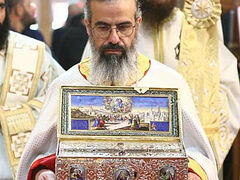
 Reliquary Containing the Relics of St. Nektarios
After these words, the heavenly visitors disappeared.
St. Nektarios’ disappointment was not without reason. Indeed, as the woman’s father was leaving the church on Aegina that day, he absentmindedly touched the back of his head and discovered that the tumors had vanished. Overwhelmed with joy, he was so astonished that he forgot to return to the church, venerate the saint’s relics, and thank him for his miraculous healing. Instead, he hurried home to tell his family about the miracle.