Does an animal have a soul? Is it appropriate to pray for a beloved cat or dog? Is it humane to euthanize a suffering animal? And after death, do our pets go to heaven? Nearly every pet owner has pondered these questions.
Each year on the second Tuesday of June, many countries around the world observe a special occasion—World Pet Memorial Day. In connection with this observance, Archimandrite Savva (Mazhuko), a monk of St. Nicholas Monastery in Gomel, and Priest David Proskuryakov, a cleric of the Astrakhan Diocese, discussed these questions.
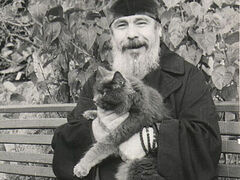
 Fr. David is holding Fr. Savva’s cat, Anfisa.
—Father Savva, hello! The subject of our conversation today is animals. Many people have pets, and, more generally, we are constantly interacting with animals throughout our lives. What is the proper Christian attitude toward them? And do they have a soul like the human soul?
—To answer that question, we first need a very precise definition of what we mean by the word soul. What is the soul? Personally, I have never found a definition that completely satisfies me. The explanations I encountered while studying at seminary and later at the theological university struck me as rather unconvincing. So I prefer to regard the soul as something we apprehend more intuitively. We know that a human being has a soul—but what exactly is it?
I do not think an essentialist approach is particularly helpful here. By that I mean the familiar methodological pattern, inherited from Aristotle, of trying to break a phenomenon down into its most fundamental elements. In the case of the soul, I doubt that method really works. Of course, experienced theologians could refute me in no time with quotations, citations, and impeccable logic. But I am speaking here not as a theologian, but simply as an ordinary man—a priest who loves animals very much.
It seems to me that when we speak of the soul, we are speaking of a unique pattern woven by a person’s life. I think there is a certain correspondence between what we call the soul and what we call personhood. Again, theologians would undoubtedly correct me here—and rightly so. After all, I once studied Orthodox anthropology myself. I remember both the textbook and the examination, during which I actually argued with the author of that textbook at St. Tikhon’s Orthodox University. Even so, there are still certain things that simply do not persuade me.
For my part, when I speak of the soul—or of personhood—I mean the unique biography of a human being. Or rather, I should say that I mean that. It seems to me that there is a distinctive pattern formed by the unrepeatable course of a person’s life—or even an animal’s life—through time. That pattern is unique. In a profound sense, a person is his biography. A person is his history. And, in a certain sense, I believe that this is what we call the soul.
These are, of course, questions for theologians, philosophers, and others who enjoy discussing such subtle matters. But for practical life, I think the most important thing is to understand that I truly am unique—and not merely in and of myself, but in the sight of God. My story, my very existence, is possible and precious only because there is Someone in eternity who sees me in my entirety, from the beginning of my life in time to the final unfolding of my personhood.
Theologians often say that personhood is a mode of existence. Others speak of an underlying metaphysical or ontological foundation that makes such a mode of existence possible. Those are matters for theologians and philosophers. I count myself among neither. What matters is to me is to experience myself enduring before the eyes of God. And the person I am at this very moment is not the whole of who I am.
When St. Seraphim of Sarov looked at a pilgrim who came to him, he saw both the person’s past and future, because God had granted him spiritual vision. That is how the Lord sees every human being—as a complete whole.
I am convinced that a person is his biography. And therefore, when we speak about the animals who become part of my own life story, we can also say that those whom I love share in my unique and utterly unrepeatable journey before the Lord.
One could perhaps even try to imagine a history of animals. Aristotle, after all, wrote a work called The History of Animals. In reality it is more a work of zoology than history, containing many fascinating observations about different creatures. Today it is probably rather amusing to read, yet in its time it represented a careful and reverent effort to gather detailed knowledge about the animal world.
But history, in the fullest sense, still belongs uniquely to human beings. And here, I think, we must also speak of the spiritual dimension—not merely the life of the soul, but a realm in which meanings emerge that transcend the biography of any single individual, meanings that are greater than one person’s life, greater than his personal existence, greater than the span of his life lived before the eyes of God.
When we speak about animals, however, I do not think we can properly ascribe history to them—not history in the sense in which we speak of human history. That would be a kind of anthropomorphism. We are accustomed to recognizing the limitations of anthropomorphism when we apply it to a higher order of being—to a mode of existence that transcends our own. But there is also a downward form of anthropomorphism, when we project human qualities onto creatures lower than ourselves in the hierarchy of being—when we attribute human historicity or spirituality, for example, to trees, animals, or even mosquitoes. We inevitably humanize everything we touch. We impart something genuinely human to trees, animals, and plants alike. In a sense, humanity is contagious.
Yet when I say that someone or something I love becomes part of my story, of my unique and unrepeatable biography, then perhaps that is the basis for believing that, in some way, this animal also shares in my eternity. For the indelible biography of a human being is not simply an endless cycle of time. It seems to me that it bears the imprint of eternity. It is an image of the person that can never be erased, a portrait in which everything remains.
This is precisely what gives us grounds to believe that repentance is possible. Repentance does not erase what has happened; rather, it rearranges it into a different pattern. Street artists sometimes begin with what appears to be nothing more than a chaotic jumble of random lines and splashes of paint. Then, suddenly, everything comes together into a recognizable portrait. Human biography is something like that.
And part of that biography may include what a person loves—for better or, unfortunately, for worse. After all, we may love not only animals but also things that are unworthy of a human being. That means that even when my love is distorted by sin, it can draw into eternity something that is itself unworthy of eternity. And that, it seems to me, is the metaphysical basis for the possibility of hell.
—In other words, it is not really correct to consider the soul of an animal—or its ultimate destiny—apart from the person to whom it belongs?
—I think so as well. Man is the image of God. He is unique. Human beings cannot be placed on the same level as animals.
I have a reputation as an advocate for animals and as someone who dearly loves cats, dogs, crocodiles—and frogs too, for that matter. I was recently in the Botanical Garden in Moscow, and I deliberately went there just to listen to the frogs. They have wonderful ponds where the frogs sing.
Then some of my readers abandoned me, renounced me, and even sent angry letters to me when they discovered that I am not, in fact, an animal worshipper in the sense that has become fashionable among certain progressive urban circles today—people who are prepared to vilify another human being, or even destroy him, all in the name of defending a cat or a dog. To my mind, that is another form of moral corruption.
I truly love animals. But human beings have an astonishing ability to corrupt even their noblest impulses. Love for animals can itself become disordered. I do not mean in the clinical sense, but as a kind of emotional excess, an undisciplined sentimentality.
Such emotional excess can appear in compassion as well. Pity is a noble feeling, yet even pity can become distorted. A person may pity someone so indiscriminately and without restraint that this pity ultimately harms both the one who pities and the one who is pitied. Compassion, too, can become like that.
—In one television interview, the well-known naturalist Nikolai Drozdov was asked, “Who is better—a dog or a human being?” He gave an interesting example. Imagine a man walking behind an elderly woman carrying a bottle of vodka and a sausage home for her husband. The man snatches them from her and runs home. If his true friend were waiting for him there, that friend would say, “What have you done? Let’s go after that woman immediately and make this right.” But a dog would simply be delighted with the sausage and would wholeheartedly approve of what its master had done. Human beings are immeasurably greater than animals.
—I do not think the two can even be compared. In my opinion, such comparisons are fundamentally mistaken. Again, this is another form of anthropomorphism. People often do not realize that they have become carried away, projecting exclusively human experience onto a world that is not human.
Animals live in a world parallel to ours. Cats and dogs inhabit a reality that runs alongside our own because they live outside the realm of morality. Strictly speaking, there is neither good nor evil there. Certainly, we can observe the beginnings of social behavior among animals. Nowadays it has become fashionable to quote modern primatologists, and there are many popular books arguing that the animal world has its own ethics, and so forth. But that, again, rests upon an entirely unwarranted methodological assumption—that the same laws governing human life also govern the lives of animals. They do not.
 Panel mural on a street in Zelenogradsk.
For example, my cat Anfisa once carried a sparrow right into my monastic cell. I could lecture her endlessly, telling her she ought to be ashamed of herself, that the sparrow had nestlings to feed, that it was breeding season, that she should have pity on those little fledglings instead of leaving them without a parent. But it would all be completely pointless, because she is acting according to instinct. She is driven to catch her prey and bring it back. That is what she understands to be her purpose.
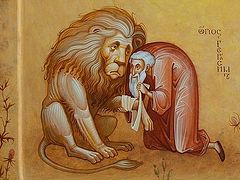
—But what about the lions that refused to harm Great Martyr Panteleimon?
—That is an entirely different matter. There we see the action of God’s grace upon the created world.
A bear is, in reality, an extremely dangerous animal. Visit the Vologda region, and people there will tell you plenty of stories about bears and wolves. Yet the bear lived peacefully with St. Sergius of Radonezh, and it obeyed St. Varlaam of Khutyn and St. Seraphim of Sarov. That was the work of divine grace. It is a completely different kind of story.
—So we should not interpret those incidents as examples of an animal making a moral choice? It is not that the animal looked at the situation and decided, “I must not do this; it would be sinful.” The very concept of sin simply does not exist for animals, does it?
—Of course not. Animals belong to an entirely different order of existence. In fact, we can scarcely imagine what the original order of creation, according to the Creator’s design, was meant to be. Everything has been so profoundly distorted by the Fall that we can only speculate. Occasionally, however, traces of that original order break through under the action of God’s grace. The uncreated power of God reveals itself like a flash of lightning, a rare manifestation. It is not something that occurs according to natural law.
It is not the case that if a monk has spent forty years in ascetic struggle, bears will automatically obey him. It simply does not work that way.
There is an instructive story about the great Russian actor Vasily Ivanovich Kachalov. His father was a priest in Vilnius. The family’s original clerical surname was Shverubovich; Kachalov was merely a stage name. One of his uncles also served in the Diocese of Vilnius.
This uncle, after reading many spiritual books, became convinced that he possessed the grace of God to such an extent that he could walk on water as though on dry land. He gathered together his elderly, devout parishioners, took the Holy Gifts, and led them to the river, intending to demonstrate that, as a true priest and experienced man of prayer, he would walk across the water with the Eucharist and thereby lead everyone to true salvation.
Needless to say, he sank. It was a terrible humiliation. Afterwards he was even sent to a monastery to do penance—not because he had fallen into spiritual delusion as such, but because he had dropped the Holy Gifts.
The same principle applies here. The manifestation of God’s grace is something that cannot be planned, measured, catalogued, or controlled. It lies beyond the boundaries of the created order. It comes into this world from beyond creation itself, where the Spirit bloweth where He listeth.1 When the Holy Spirit recognizes, as it were, someone who belongs to His own household—as happened with St. Seraphim of Sarov—then He acts through that person. Animals behave differently, plants respond differently, indeed the whole of creation is affected.
Consider St. Gregory of Narek, the great saint of the Armenian Church. Though highly educated and the son of an Armenian nobleman, he entered a monastery, where he was assigned the humble obedience of tending sheep in distant pastures. He spent several years caring for the flock.
When he finally returned to the monastery, he was told that this period of testing had come to an end. In the middle of the monastery courtyard he planted the shepherd’s staff that had been given to him for his work. According to his Life, the staff took root, sprouted leaves, and became a flourishing bush. Pilgrims later came to venerate it because, as the account says, Gregory had never once struck a single sheep with that staff. Though shepherds ordinarily use such a staff to discipline the flock, he never did, for his heart was filled with compassion for every living creature. The staff itself became a sign of that merciful heart.
But a merciful heart is not simply refined emotions or an ecological mindset. It is the work of the grace of the Holy Spirit. That distinction is essential.
There is a real temptation today to confuse contemporary philosophical trends, our prevailing worldview, and the entire cultural atmosphere in which we live with the teaching of the Holy Fathers.
People will say, “Look—even Greta Thunberg is one of us.”
No, she is not.
Or they point to those who defend animals or feed stray dogs and conclude that they are walking the same path as St. Gregory of Narek, St. Seraphim of Sarov, or St. Isaac the Syrian, who spoke of acquiring a merciful heart.
But they are not the same.
The merciful heart and the blessed hands of St. Gerasimos of the Jordan or St. Seraphim of Sarov were hearts and hands overshadowed by the Holy Spirit and filled with the grace of God—not by emotional excitement or ideological zeal.
If an environmental activist rushes to rescue dogs or cats, that is certainly commendable. Saving them is a good and noble work. But the Holy Fathers walked a different path, and these are by no means identical paths.
—Is it acceptable to have a pet spayed or neutered in order to prevent unwanted offspring?
—I think we should approach this with simple common sense and follow the principle of choosing the lesser evil. Adults understand that we are often forced to choose not between good and evil, but between a greater and a lesser evil. Someone has to make the decision, or else bear the consequences and adapt.
I believe that animals are naturally meant to reproduce. That is part of the purpose of their existence, because an animal is, in the fullest sense, a creature of its species. A human being, by contrast, can be viewed on several levels: as a member of the human race, certainly, but also as a person whose value transcends the species itself. We exist, as it were, on two planes.
To repeat, an animal exists primarily as a representative of its kind. It does not exist as an individual person, though it certainly has individual characteristics. Above all, it exists as a continuation of its species, and the purpose of its life is to pass that life on.
For example, I have always been struck by the expression on the face of a mother cat after she has given birth. It is unforgettable. I love watching a cat with her kittens, and I always enjoy having kittens or puppies around. Yes, they require a great deal of work, but they are wonderful. There is such a sacred, blessed pride in the face of a mother cat who has fulfilled her calling. Beyond that, it hardly seems to matter whether she herself survives or what becomes of her afterward.
That is why I think there is something unhealthy about the widespread trend toward sterilizing animals. Even so, I repeat that we must be guided by common sense and by the principle of the lesser evil. Sometimes sterilization is indeed the right course.
—That naturally leads to another question. If an animal is gravely ill, should we wait for a natural death, or is euthanasia permissible?
—An animal is not a human being. A person sometimes needs to pass through sorrow and suffering in order to be purified. An animal has no need of such purification. They are already innocent. In that respect, they are actually better than we are. They carry no moral vices on their conscience—because they have no conscience. I look at my Anfisa and think to myself that she does not have the slightest bit of conscience, and yet I love her.
 —So a person may make that decision?
—Yes, that too falls under the principle of the lesser evil. Sometimes it really is better not to let an animal continue to suffer. Why should it suffer?
At the same time, one can look at the matter differently, and each person must make that decision according to his own conscience. Caring for a sick animal may be something the owner himself needs. It becomes part of his own biography, his own story, his own ministry and spiritual trial. There are no ready-made formulas.
That is why conversations about animals can continue endlessly. Every case is a unique chapter in the life of a particular person into whose story this animal has entered. Whether it is a cat, a dog, a little crocodile, or a raccoon—it has become part of your life, and now you must decide how to respond. As the familiar saying goes, you are responsible for those whom you have domesticated.
—I once had a parishioner whose capuchin monkey, Masha, became seriously ill. She sent a prayer request into the altar asking for prayers. She wrote: “For the health of Irina,” and then in parentheses, “Masha the capuchin.” That raises another question: should we pray for animals? Is it appropriate to do so?
—I think we can pray for everyone. At the very least, we can ask God’s blessing upon all creatures.
You are absolutely right that, first and foremost, you were praying for the owner. If we are speaking about the Church’s liturgical prayer, then, of course, we do not commemorate animals in the same way that we pray for members of the Church. Animals are not members of the ecclesial community. But we may pray for them insofar as they are part of the life story of our brothers and sisters in Christ.
For that reason, we cannot serve a Moleben for the health of a monkey or a cat, nor can we celebrate a memorial service for them after their death. They are not members of the Church. Yet they are part of the lives of those who have cared for them.
That is why we may pray for their caretakers and guardians. I do not even like the word owner; somehow it does not seem quite right.
—When it comes to cats, one sometimes wonders who really owns whom. Your cat Anfisa would strongly object to the idea that you are her owner!
—This subject is practically inexhaustible, but I think we have managed to clarify at least some of these questions. Thank you, Father, for such an engaging conversation.
—Thank you.