Noah’s Ark. Ancient History before Caesar. France, the thirteenth century
Let every thing that hath breath praise the Lord (Ps. 150:6).
To gain a deeper understanding of Sacred History and to appreciate the Word of God more fully, it is important to become familiar with the animals mentioned in the New Testament. The sacred authors frequently refer to animals for spiritual and edifying purposes.
As we know, animals were created before mankind (Gen. 1:20–25). God entrusted Adam with the task of naming them, and later commanded Noah to preserve representatives of every kind from the Flood. During the biblical period, the land of Israel was home to a rich and varied wildlife. The Bible mentions approximately 130 species of animals, of which about one-third are birds, one-third are mammals, and one-third are predators.
In ancient times, the southern regions of Palestine consisted largely of arid steppe, making livestock raising the principal occupation. By the third millennium B.C., many animals had already been domesticated, including long-horned cattle, horses, sheep, camels, goats, donkeys, and dogs. Among the wild predators found in the region were lions, bears, leopards, wolves, and foxes, while the mountainous areas were inhabited by deer, dorcas gazelles, fallow deer, and other species. Under the Old Testament Law, animals and birds were classified as either “clean” or “unclean” (Lev. 11). In the New Testament, however, this ceremonial distinction was abolished, as revealed in St. Peter’s vision (Acts 10:9–16) and affirmed by the Apostle Paul (1 Tim. 4:3–5).
By observing the behavior and habits of animals, people came to attribute human characteristics to them. Thus, merciful and kind people are compared to sheep and doves, which symbolize such virtues as humility, gentleness, and peace. By contrast, greedy, avaricious, and cruel sinners are likened to wild beasts and bloodthirsty predators. In the folklore of many peoples, the wolf is portrayed as greedy, fierce, treacherous, and ravenous; the fox as cunning and crafty; the sheep as meek and submissive; the bee as industrious; and the cat as lazy. Throughout traditional literature and folklore, animals serve as symbols of various human virtues and vices.
The animals mentioned in the New Testament also provide insight into the daily life and customs of the Jewish people, revealing how they regarded animals and the role these creatures played in their lives. Such details bring the biblical world to life, making the Scriptures more vivid and engaging, and helping us to understand more fully the teachings of Christ and His parables, in which animals frequently appear as illustrative figures. Everything connected with the earthly life of our Lord Jesus Christ is precious to us.
 The Lamb of God. Fresco of the Xeropotamou Monastery, Mount Athos, Greece
THE LAMB is a biblical symbol of defenselessness, meekness, and the Old Testament sacrificial offering. On the first day of Unleavened Bread, when the Passover lamb was sacrificed, the disciples asked Jesus: Where wilt Thou that we go and prepare that Thou mayest eat the Passover? (Mk. 14:12; cf. Lk. 22:7).
The Lamb of God is one of the central images of the New Testament and the symbolic title of our Lord Jesus Christ, Who became the atoning sacrifice for the sins of the whole human race (Rev. 5:5–13). When St. John the Baptist saw Jesus approaching, he declared to his disciples: Behold the Lamb of God, Which taketh away the sin of the world (Jn. 1:29).
When sending His disciples out to preach, the Lord told them: Behold, I send you forth as lambs among wolves (Lk. 10:3). After His Resurrection, He commanded the Apostle Peter: Feed My sheep (Jn. 21:15–17). In obedience to this command, Peter proclaimed the Gospel and later wrote to the first Christians: Ye were… redeemed… with the precious Blood of Christ (1 Pet. 1:18–19). (See also THE SHEEP.)
ACRIDIDAE are a family of grasshoppers that includes locusts, which St. John the Baptist ate while living in the wilderness: John was clothed with camel’s hair, and with a girdle of a skin about his loins; and he did eat locusts and wild honey (Mk. 1:6). This simple diet reflected his ascetic way of life. Under the Law of Moses, locusts were considered clean animals and could be eaten. They remain a traditional food in many countries of the Middle East. Locusts are also mentioned in the Book of Revelation (Rev. 9:3–11).
 The leopard-spotted skin distinguishes the Beast from the Sea from the Red Dragon in illustrations of the Book of Revelation.
THE LEOPARD is a large feline predator mentioned several times in Holy Scripture. It is known for its speed, agility, strength, and predatory nature. In the Revelation of St. John the Theologian, the beast that symbolizes the antichrist is described as being like a leopard (Rev. 13:2), evoking the animal’s cunning, ferocity, and bloodthirsty nature.
 Abraham’s Servant Finds Isaac’s Future Wife, Rebekah. Artist: Aliya Nurakisheva / Pravoslavie.ru
THE CAMEL is an even-toed ungulate whose meat was forbidden to the Jews under the Mosaic Law. It has long served mankind as a beast of burden, prized for its intelligence, patience, and endurance. Camel hair is woven into coarse cloth for clothing and other textiles. Around the twelfth century B.C., camel caravans began transporting goods over long distances, earning the camel its familiar title, the “ship of the desert.”
By the seventh century B.C., the inhabitants of Palestine had developed a method of preparing writing material from camel skins, which later became known as parchment.
In the New Testament, the Lord used the camel as a striking image in His teaching. Rebuking those who placed their trust in wealth rather than in God, He said: It is easier for a camel to go through the eye of a needle, than for a rich man to enter into the Kingdom of God (Mt. 19:24; Mk. 10:25; Lk. 18:25). Likewise, condemning the scribes and Pharisees for their meticulous observance of minor legal requirements while neglecting the weightier commandments of the Law, He declared: Ye blind guides, which strain at a gnat, and swallow a camel (Mt. 23:24).
 The Nativity of Christ. A fifteenth-century Greek icon. Byzantine Museum, Athens (detail).
THE OX (BULL) is a domesticated ruminant, renowned for its strength and endurance. Among the ancient Jews, the ox was one of the most indispensable domestic animals. It was used for plowing fields, threshing grain, and transporting heavy loads, while its meat also served as food. The Law of Moses commanded: Thou shalt not muzzle the mouth of the ox that treadeth out the corn (1 Cor. 9:9; cf. Deut. 25:4). Some farmers were prosperous enough to own several yoke of oxen, as illustrated in the Gospel of Luke, where a man excuses himself from attending a banquet, saying: I have bought five yoke of oxen, and I go to prove them (Lk. 14:19).
When the Lord healed a crippled woman in the synagogue on the Sabbath, the ruler of the synagogue was indignant because the healing had taken place on the Sabbath. Jesus replied: Thou hypocrite, doth not each one of you on the Sabbath loose his ox or his ass from the stall, and lead him away to watering? (Lk. 13:15). On another occasion, after healing a man suffering from dropsy on the Sabbath, He asked: Which of you shall have an ass or an ox fallen into a pit, and will not straightway pull him out on the Sabbath day? (Lk. 14:5).
 The Nativity of Christ. Russia, seventeenth century.
As one of mankind’s oldest and most valuable helpers, the ox was considered worthy to be offered in sacrifice at the Temple. Thus, when cleansing the Temple, the Lord found those that sold oxen and sheep and doves (Jn. 2:14–15). The ox is also mentioned in the Book of Acts, when the people of Lystra, astonished by the miracles performed by the Apostle Paul, mistook him for a god: Then the priest of Jupiter, which was before their city, brought oxen and garlands unto the gates, and would have done sacrifice with the people (Acts 14:13).
In Christian symbolism, the ox represents patience, strength, steadfast labor, and Christ Himself as the true sacrificial offering. An ox and a donkey are often depicted in icons and paintings of the Nativity of Christ, and sculptural representations of the ox sometimes adorn baptismal fonts (See also CALF).
THE WOLF is a wild predator of the canine family, known for its ferocity and bloodthirsty nature. It posed a constant threat to both people and livestock, and the Hebrews regarded it as an “unclean” animal, symbolizing cruelty, violence, and greed.
Warning His disciples against false teachers, the Lord Jesus Christ said: Beware of false prophets, which come to you in sheep’s clothing, but inwardly they are ravening wolves (Mt. 7:15). When sending His disciples out to preach the Gospel, He told them: Behold, I send you forth as sheep in the midst of wolves (Mt. 10:16). In the Gospel of John, the Lord describes Himself as the Good Shepherd Who lays down His life for the sheep when the wolf attacks the flock (Jn. 10:11–13).
Before departing from Miletus for Jerusalem, the Apostle Paul warned the elders of the Church about the rise of heretics after his departure: Take heed therefore unto yourselves, and to all the flock… For I know this, that after my departing shall grievous wolves enter in among you, not sparing the flock (Acts 20:28–29).
THE SPARROW is a familiar small bird, noted for its timidity and quick movements. In the New Testament it appears in the Lord’s teaching on Divine Providence: Are not two sparrows sold for a farthing? and one of them shall not fall on the ground without your Father (Mt. 10:29). By these words Christ teaches that Christians should place complete trust in the loving providence of their Heavenly Father, Who never abandons His children, even in the most difficult circumstances of life.
Sparrows were among the least expensive birds sold in the marketplace—two were sold for a farthing, and five for two farthings (Lk. 12:6). Their low price emphasizes the Lord’s point that if even such insignificant creatures are under God’s care, how much more precious are human beings in His sight.
 A raven brings food to the Prophet Elias. A fragment. Gracanica Monastery, Serbia
THE RAVEN is a large bird with glossy blue-black plumage, a powerful beak, and strong wings. Under the Law of Moses, it was regarded as an “unclean” bird because it fed on carrion (Lev. 11:15; Deut. 14:14). The Lord Jesus Christ used the raven to teach His disciples complete trust in God’s providence: Consider the ravens: for they neither sow nor reap; which neither have storehouse nor barn; and God feedeth them (Lk. 12:24).
 The Baptism of the Lord. Painting on the northwestern vault of the Cathedral of the Sretensky Monastery, 1707.
THE DOVE (PIGEON) is one of the “clean” birds according to the Law of Moses and is mentioned frequently throughout Holy Scripture. The wild dove was domesticated more than five thousand years ago. In the account of the Flood, a dove returns to Noah’s Ark carrying an olive leaf, bringing the joyful news that the waters had receded from the face of the earth (Gen. 8:11).
The breeding of pigeons was a common occupation among the Jews, who built stone dovecotes to house them. Because doves are noted for their gentleness and harmlessness, the Savior instructed His disciples: Be ye therefore wise as serpents, and harmless as doves (Mt. 10:16).
At the Baptism of Christ, the Holy Spirit descended upon the Savior in the visible form of a dove: And, lo, the heavens were opened unto Him, and He saw the Spirit of God descending like a dove, and lighting upon Him (Mt. 3:16; cf. Mk. 1:10; Lk. 3:22; Jn. 1:32).
On the fortieth day after Christ’s Birth, the Most Holy Theotokos came to the Temple in Jerusalem to offer thanksgiving to God for Her divine Son, presenting the sacrifice prescribed by the Law: a pair of turtledoves or two young pigeons (Lk. 2:24). Merchants who sold these birds conducted their business in the Temple precincts, and it was they whom the Lord drove out, saying: Make not My Father’s house an house of merchandise (Jn. 2:14–16; cf. Mt. 21:12; Mk. 11:15).
In Christian symbolism, the dove represents purity, innocence, simplicity, and peace. The white dove, in particular, has become a universal symbol of peace, and a dove carrying an olive branch appears on the emblem of the World Peace Congress.
 The Meeting of the Lord. Russia, the seventeenth century
THE TURTLEDOVE is a small migratory bird that appears in Palestine in early spring. Turtledoves were sacrificed and eaten as “clean” birds. They are mentioned in connection with the visit of the Mother of God to the Temple of Jerusalem, when She was to sacrifice two turtledoves or two young pigeons (Lk. 2:24).
 Moses makes a copper serpent. A Byzantine miniature
THE SERPENT (VIPER, ASP) is a venomous snake with white and black spots; a person bitten by it immediately died. It is the first animal to appear in the Old Testament: the serpent tempted Eve. The serpent is an image of cunning, malice and guile. When he [St. John the Baptist] saw many of the Pharisees and Sadducees come to his Baptism, he said unto them, O generation of vipers, who hath warned you to flee from the wrath to come? (Mt. 3:7; Lk. 3:7). Jesus, rebuking the wicked Jews who were able to do good only to their children, said: What man is there of you, whom if his son ask bread, will he give him a stone? Or if he ask a fish, will he give him a serpent? (Mt. 7:9–10; Lk. 11:11). In an allegorical form, the Lord expressed the power given to the disciples over the evil spirits: Behold, I give unto you power to tread on serpents and scorpions (Lk. 10:19). The Lord said that those who believed in Him would have the following qualities: they would pick up snakes, which would not harm them (Mk. 16:18). In the New Testament, the image of the serpent is also associated with the atoning sacrifice of Christ. Predicting His death on the Cross, the Savior said, And as Moses lifted up the serpent in the wilderness, even so must the Son of man be lifted up (Jn. 3:14).
Jesus Christ rebuked the Jews who accused Him of casting out demons by the power of Beelzebub, the prince of demons: O generation of vipers, how can ye, being evil, speak good things? for out of the abundance of the heart the mouth speaketh (Mt. 12:34). He indignantly branded the scribes and Pharisees: Ye serpents, ye generation of vipers, how can ye escape the damnation of hell? (Mt. 23:33). The Apostle Paul testified about sinners: With their tongues they have used deceit; the poison of asps is under their lips (Rom. 3:13). On the island of Melita (now Malta), he cast a viper that had fastened onto his hand into a fire, and since it did him no harm, the island inhabitants assumed he was a god.
Revelation says that as a result of the victory of the Heavenly hosts, the old serpent—the devil—was cast down from Heaven to earth by the Archangel Michael: And the great dragon was cast out, that old serpent, called the devil, and satan, which deceiveth the whole world: he was cast out into the earth, and his angels were cast out with him (Rev. 12:9).
 The Parable of the Sheep and Goats
THE GOAT is an undemanding animal, which is content with very meager pastures. Goats are excellent climbers and can graze in places inaccessible to other domestic animals. The Israelites bred them in large numbers, using their hair to make clothing and their skins to make furs. In ancient times, sheep and goats would graze in the same pasture (Gen. 30:35), and this custom explains the words of the Savior in His speech about the Last Judgment: And before Him shall be gathered all nations: and He shall separate them one from another, as a shepherd divideth his sheep from the goats: and He shall set the sheep on His right hand, but the goats on the left (Mt. 25:32-33). The kid is mentioned in the Parable of the Prodigal Son when the elder son rebukes his father: And yet thou never gavest me a kid, that I might make merry with my friends (Lk. 15:29).
THE GNAT. This word appears in the New Testament only once, when the Lord rebukes the scribes and Pharisees who were concerned about fulfilling the minute requirements of the Law, while ignoring its most important commandments: Ye blind guides, which strain at a gnat, and swallow a camel (Mt. 23:24).
 The Four Horsemen of the Apocalypse. Fresco of the Novospassky Monastery, Moscow. Photo: Pravmir.ru
THE HORSE in Biblical times was primarily a war animal (Rev. 8:7; 9:9, 19). Warning people against backbiting, the Apostle James writes: Behold, we put bits in the horses’ mouths, that they may obey us; and we turn about their whole body (Jm. 3:3). Horses are mentioned in the account when the Apostle Paul was taken into custody to Caesarea in 59 A.D. (Acts 23:23–34). In Revelation, the four horses and their riders acquire symbolic significance. The four Apocalyptic Horsemen represent the history of mankind. First, a blissful life in the Garden of Eden (the white horse). Some early interpreters (Sts. Irenaeus of Lyons and Andrew of Caesarea) saw in the rider on the white horse Christ Himself and His final victory over evil. The white horse symbolizes the triumph of Divine justice. After the fall of Adam and Eve (the red horse), the lives of their descendants were filled with disasters (the black and pale horses) (Rev. 6:2–8). The black horse is a symbol of sorrow, need and hunger. The pale horse symbolizes death, followed by hell. It is given power over a fourth of the earth. It should be noted that the interpretation of the symbols in Revelation varies depending on the theological school, the era and the cultural context.
 Samson fighting the lion. The first half of the eighteenth century, Russia, Kargopol region
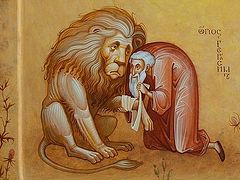
THE LION is a predator. In ancient times, there were many lions in Palestine, because the Jordan River was surrounded by the jungle. However, lions no longer live in Israel today. There are many allegorical references to the properties of the “king of the jungle” in the Bible, especially in the Old Testament. For instance, Samson and King David fought with lions.
In the New Testament, the lion’s image has a double meaning. On the one hand, it is used to describe the devil as a predator lying in wait for people. In his First Epistle, the Apostle Peter says, Be sober, be vigilant; because your adversary the devil, as a roaring lion, walketh about, seeking whom he may devour (1 Pet. 5:8). On the other hand, the lion is a symbol of Jesus Christ as a Victor and King. In Revelation, the Word is described as the Lion of the tribe of Judah (Rev. 5:5), which is reminiscent of Patriarch Jacob’s prophecy about the Messiah (Gen. 49:9–10).
The lion as a symbol of authority, might, and royal dignity is the emblem of Mark the Evangelist, who portrayed Jesus Christ with the aura of Divine glory and spiritual power.
THE FOX is a predatory animal. In ancient times, there were many foxes in Judea, and their cunning and slyness were proverbial among the Jews. When someone told Jesus that he would follow Him, He replied, The foxes have holes, and the birds of the air have nests; but the Son of man hath not where to lay His head (Mt. 8:20; Lk. 9:58). Go ye, and tell that fox… (Lk. 13:32), is how the Lord responded to the crafty, hypocritical and bloodthirsty King Herod.
THE MOTH is an insect that is a pest, so the Lord’s words are understandable: Lay not up for yourselves treasures upon earth, where moth and rust doth corrupt, and where thieves break through and steal (Mt. 6:19-20; Lk. 12:33). The Apostle James said to the rich: Your riches are corrupted, and your garments are motheaten (Jm. 5:2).
THE SHEEP is an herbivorous animal; its offspring are called lambs (see LAMB). This animal was domesticated in the third millennium B.C. for its thick wool, its skin from which clothes were sewn, and its edible meat. Poor people could afford to keep one or two sheep, while the rich owned numerous flocks of sheep. The ancient Patriarchs of Israel bred sheep and other small livestock. Flocks of sheep were their main wealth, so shepherding was considered the most ancient and honorable occupation. Abraham, Isaac, Jacob, and King David were all shepherds.
The word “sheep” appears several times in the New Testament. When sending His disciples to preach, the Lord told them, Behold, I send you forth as lambs among wolves. In other words, His followers should be distinguished by meekness and gentleness, like sheep. Rebuking the Pharisees who accused Jesus of healing a man with a withered hand on the Sabbath, He said to them, What man shall there be among you, that shall have one sheep, and if it fall into a pit on the Sabbath day, will he not lay hold on it, and lift it out? How much then is a man better than a sheep? (Mt. 12:11–12). In the Gospel we find a touching example of caring for animals. The Lord asks, How think ye? if a man have an hundred sheep, and one of them be gone astray, doth he not leave the ninety and nine, and goeth into the mountains, and seeketh that which is gone astray? (Mt. 18:12-14; Lk. 15:3-7). The Lord pitied the Jewish people, who had deceitful and hypocritical leaders—the Pharisees—But when He saw the multitudes, He was moved with compassion on them, because they fainted, and were scattered abroad, as sheep having no shepherd (Mt. 9:36; Mk. 6:34). A few hours before His arrest, the Lord told His disciples, All ye shall be offended because of Me this night: for it is written, I will smite the shepherd, and the sheep of the flock shall be scattered abroad (Mt. 26:31; Mk. 14:27).
Sheep needed protection from snakes and wild animals. The fearfulness, meekness and helplessness of sheep when they stray from the flock make shepherds constantly and tenderly take care of them. In the Gospel, the word “shepherd” signifies the Lord Jesus Christ. A shepherd looking for a sheep reminds us of the Great Good Pastor Who wanders around the world and thoroughly searches for the lost. Speaking about His attitude towards people, Jesus used the image of a good shepherd who tenderly looks after his flock: I am the good shepherd: the good shepherd giveth his life for the sheep… And there shall be one fold, and one shepherd (Jn. 10:11–16; 26–29). The image of the Shepherd is also present in the Apostle Peter’s Epistle to the first Christians: For ye were as sheep [having no shepherd] going astray; but are now returned unto the Shepherd and Bishop of your souls (1 Pet. 2:25).
 An illustration from the Gospel of the Dormition Cathedral of the Moscow Kremlin, the fourteenth century
THE EAGLE is a genus of large birds of prey in the hawk family. It was considered “unclean” according to the Mosaic Law, as it sometimes feeds on carrion. The eagle has long served as a symbol of might, strength, power and bravery. The Jews believed that the eagle flies so high that it can reach God’s throne. The Evangelists compare Jerusalem and the Jewish people to a corpse lying in a field, to which Roman eagles have flocked—legions of soldiers with the image of an eagle on their banners: For wheresoever the carcase is, there will the eagles be gathered together (Mt. 24:28; Lk. 17:37).
The four mysterious animals of the Revelation surrounding the throne are similar to the animals seen by the Prophet Ezekiel (Ezek. 1:5–12). These images—a man, a lion, an ox, and an eagle—were adopted by the Church as the emblems of the four Evangelists (Rev. 4:6–9). John the Evangelist’s eagle symbolizes the sublimity of the Gospel teaching and the Divine mysteries communicated in it.
THE DONKEY (ASS). This hardy animal is often found on the pages of the Holy Scriptures. Almost every Jewish family owned a donkey, as they eat less than horses, and they can carry heavier loads. Donkeys were an object of wealth among the Jews; the females produced large amounts of milk, which was regarded as a healing elixir. Donkeys were especially valued for riding. Fleeing from Herod, the Mother of God, the Infant Jesus, and St. Joseph, most likely traveled to Egypt on a donkey. The Lord Himself solemnly rode into Jerusalem on a female donkey and a foal. He commanded His disciples: Go into the village over against you, and straightway ye shall find an ass tied, and a colt with her: loose them, and bring them unto Me (Mt. 21:2; Mk. 11:2–7; Lk. 19:30; Jn. 12:14–15).
 The Journey to Bethlehem for the Census. A fragment. Mosaic of the Chora Monastery (now mosque), Istanbul
The Parable of the Good Samaritan says that he put a man wounded by robbers on his animal (often translated as a donkey) and brought him to an inn to nurse him back to health (Lk. 10:34). When Jesus healed a man from dropsy on the Sabbath, the Pharisees accused Him of violating the Sabbath, to which He replied, Which of you shall have an ass or an ox fallen into a pit, and will not straightway pull him out on the Sabbath day? (Lk. 14:5). The Lord said to the leader of the synagogue who forbade sick people to come to the Savior for healing on the Sabbath: Thou hypocrite, doth not each one of you on the Sabbath loose his ox or his ass from the stall, and lead him away to watering? (Lk. 13:15). Indeed, these rigid Law keepers violated the Sabbath rest in order to protect their property, but they did not want to admit it. It is said in Acts that a centurion escorted the Apostle Paul to stand trial before Governor Felix on an animal, which is often translated as a donkey (Acts 23:24).
THE DOG was not only not regarded as a friend of man by the Israelites, but the general attitude towards it was negative. According to Jewish Law, dogs were “unclean” animals. They were kept as guard dogs to protect their flocks from wolves. Puppies were let into the houses and fed table scraps. One day, a Canaanite woman earnestly begged the Lord to heal her daughter, to which He replied, It is not meet to take the children’s bread, and to cast it to dogs (Mt. 15:26–27; Mk. 7:27–28). The woman knew that, being a pagan and equal to dogs according to Jewish ideas of the time, she had no right to God’s help; but she kept entreating the Lord, and touched by her humility and deep faith in His mercy, He healed her daughter.
 The Parable of the Rich Man and Lazarus. Russia, the eighteenth century
In the Sermon on the Mount, the Lord told His disciples, Give not that which is holy unto the dogs (Mt. 7:6), thus showing that they should not offer the holy truths of the Gospel to proud, evil, and unrepentant people, otherwise they, like dogs, may trample them underfoot. The Parable of the Rich Man and Lazarus mentions dogs that licked the wounds of the beggar Lazarus’ feet (Lk. 16:21). The Apostle Peter compares lustful, unbridled, and depraved sinners to dogs (2 Pet. 2:22); and the Apostle Paul calls false teachers dogs: Beware of dogs, beware of evil workers (Phil. 3:2).
For Jews, the dog is still an “unclean” animal, but we do not find such evidence in early Christianity, and today dogs can be found in many Greek monasteries.1
 The Apostle Peter and the Rooster. The Byzantine Chludov Psalter, c. 850
THE ROOSTER (COCK, HEN). During the earthly life of Jesus Christ, chickens were the most common poultry in Judea, as evidenced by the Gospel; so the egg was a common food (Lk. 11:12). All the Evangelists testify to the crowing of the rooster during the Apostle Peter’s denial of the Lord (Mt. 26:43; Mk. 14:30; Lk. 22:60; Jn. 13:38; 18:27): And Peter remembered the word of Jesus, which said unto him, Before the cock crow, thou shalt deny Me thrice (Mt. 26:75). The crowing of the rooster marked the break of dawn: Watch ye therefore: for ye know not when the master of the house cometh, at even, or at midnight, or at the cockcrowing, or in the morning (Mk. 13:35). The distinctive features of the mother hen as a gentle and caring mother to its chicks are indicated by the Savior Himself in the words addressed to Jerusalem, O Jerusalem, Jerusalem, thou that killest the prophets, and stonest them which are sent unto thee, how often would I have gathered thy children together, even as a hen gathereth her chickens under her wings, and ye would not! (Mt. 23:37; Lk. 13:34).
THE BEE is widespread in all parts of the world. Its industriousness and the valuable product of its labors have attracted everyone’s attention to this insect since the earliest times. St. John the Baptist ate the honey of wild bees in the desert (Mk. 1:6). Our Lord’s usual food was honey, fish, and bread.
FISH. Although the Bible never identifies specific species of fish, fish was used for food almost everywhere; it was one of the main staples. The Lake of Tiberias (Sea of Galilee) was rich in freshwater fish. The image of a fish served as the emblem of Christians of the first centuries. The miraculous catch of fish at the Lord’s command horrified the Apostle Peter (Lk. 5:6). On two occasions, Jesus was surrounded by a huge crowd. He did not only preach to them (that is, nourished them spiritually), but also fed them physically: the first time the Lord fed 5,000 people with five loaves and two fish (Mt. 14:17–19; Mk. 6:38; Lk. 9:13; Jn. 6:5), and the second time He fed 4,000 people with several fish and seven loaves (Mt. 15:33–38; Mk. 8:4–9).
 The Last Supper. Thirteenth-century fresco in the cave church, Cappadocia. The Body of Christ on the platter is depicted as a fish. Source: Wikipedia
In one of the parables, the Lord likens the Heavenly Kingdom to a large net cast into the sea, catching a diverse mix of large and small fish; fishermen collect the good fish into baskets for preservation and throw the bad ones out. Jesus Christ Himself explained the meaning of this parable, saying that at the end of the age, the angels will separate the righteous from the wicked (Mt. 13:47–48). At the Lord’s command, the Apostle Peter caught a fish, from whose mouth he extracted a coin and gave the money to the Temple (Mt. 17:27). Appearing to the disciples after His Resurrection, Christ said to them, Have ye here any meat? And they gave Him a piece of a broiled fish, and of an honeycomb (Lk. 24:41–42). Shortly before His Ascension, Jesus Christ appeared to the apostles at the Lake of Tiberias and told them to cast a net: They cast therefore, and now they were not able to draw it for the multitude of fishes (Jn. 21:6–13). Scientists believe that the Gospel fish of the Lake of Tiberias is tilapia.
 The Miracle of Healing the Gadarene Demoniac. Artist: Briton Riviere
THE PIG (SWINE, SOW) is omnivorous, and therefore the Jewish people classified it as an “unclean” animal, and eating pork was forbidden. It is said in the Parable of the Prodigal Son (Lk. 15:16) that he tended pigs in a foreign land, which indicated the most despicable occupation (Lk. 15:15). The scavenger lifestyle of this animal symbolizes people’s sinful lifestyle and desire to return to their sinful habits over and again. According to the Apostle Peter, such a person is like a washed sow, wallowing in the mire (2 Pet. 2:22). In the Sermon on the Mount, the Lord teaches, Give not that which is holy unto the dogs, neither cast ye your pearls before swine (Mt. 7:6). This means that you shouldn’t offer words of Truth to people who despise them and respond to them by ridicule and insults. In the episode about the Gadarene demoniac, Jesus, having healed the possessed man, allowed the demons tormenting him to enter a herd of pigs (Mt. 8:30–32; Mk. 5:11–13; Lk. 8:31). In this case, the Jews apparently bred pigs to sell them to pagans.
THE DORCAS GAZELLE is one of the most beautiful wild animals of Ancient Judea; a very fast, agile and graceful antelope that lives in the mountains: The high hills are a refuge for the wild harts [“dorcas gazelle” in the Russian Synodal version] (Ps. 103:18). The Righteous Tabitha—a devout disciple of Christ who served widows and the poor—whose name means “dorcas”, was raised from the dead by the Apostle Peter (Acts 9:36–41).
THE SCORPION can be found only in hot countries. It looks like a crawfish, but it is poisonous; there are twenty-five known species of scorpion that can be dangerous to people. Scorpion stings inflict excruciating pain (Rev. 9:3–6) and often end in death in terrible convulsions. The Lord said to His disciples, Behold, I give unto you power to tread on serpents and scorpions (Lk. 10:34). A scorpion can curl up into a ball and resemble an egg, If a son shall ask bread of any of you that is a father… If he shall ask an egg, will he offer him a scorpion? (Lk. 11:12).
 The Parable of the Prodigal Son
THE CALF. The Jews considered the fatted calf the ultimate culinary prize: Tell them which are bidden, Behold, I have prepared my dinner: my oxen [“calves” in the Russian Synodal version] and my fatlings are killed, and all things are ready: come unto the marriage (Mt. 22:4). There are the following words in the Parable of the Prodigal Son: And bring hither the fatted calf, and kill it (Lk. 15:23). Luke the Evangelist is depicted with a calf (or ox), thereby emphasizing the sacrificial, redemptive service of the Savior.
THE HEIFER. Although the word “heifer” is absent in the New Testament, the image of a red heifer plays an important symbolic role as a prototype of the Savior’s sacrifice. A three-year-old red heifer was used for offerings for people’s sins. The heifer was to be slaughtered outside the camp, burned, and its ashes mixed with water sprinkled onto people. The meaning of this sacrifice is indicated by the Apostle Paul (Heb. 9:13, 14), who proves the superiority of Christ’s sacrifice over all the Old Testament sacrifices. Just as the heifer’s ashes cleansed the body, so the Blood of Christ cleanses the conscience and grants spiritual sanctification.
***
Christian ethics emphasizes that man is called to take care of animals as part of God’s creation. God gave us our planet for common use with animals, and we must live on it, treating other creatures tolerantly and kindly. His Holiness Patriarch Kirill says: “We must love animals, because by showing love for them, we train our human emotions and become more human.” St. John of Kronstadt wrote:
“Remember that animals were called to life by the Lord’s goodness so that they can taste—as much as they can in a short span of life—the joys of being. The Lord is good to all (Ps. 144:9)… Living creatures are from the Spirit of God, albeit they do not partake in reason and freedom; so every creature must be protected, not beaten and not exhausted. A righteous man regardeth the life of his beast (Prov. 12:10).”
Let us heed this wise advice!