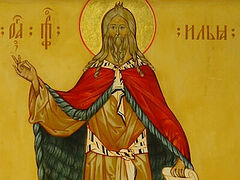
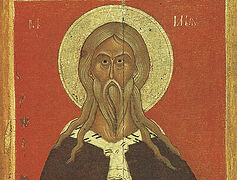
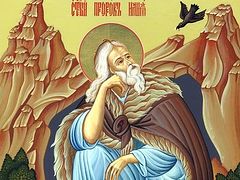
Icon of the Prophet Elias. St. Catherine’s Monastery on Mt. Sinai In the name of the Father, and of the Son, and of the Holy Spirit!
Probably, the Prophet of God Elias is the most venerated Old Testament righteous one in Russia. Who does not know the name of the holy Prophet Elias? Not only believers know about him and remember that the Prophet Elias is associated with the start of the harvest and with the things most necessary for life. First of all, with the fertility of the soil and the rain that waters our land.
And indeed, in Russia, a huge number of churches have always been dedicated to the Prophet Elias. Needless to say, the very first known church in Kievan Rus’ was dedicated to this saint. It was built in the early tenth century—many decades before Prince Vladimir Equal-to-the-Apostles baptized Russia. This church was built in Kiev. Christian believers, Greeks, and those Russians who had already embraced Christ prayed in it. And this church was dedicated precisely in honor of the holy Prophet Elias. And since then, of course, the veneration of this saint of God has never waned in Russia. And today we remember St. Elias with special warmth and look forward to his feast day. But what kind of life did the Prophet Elias have?
He lived 900 years before the Birth of Jesus Christ. The time of his life did not fall durimg the period of prosperity of the Jewish people and their state—the Kingdom of Israel—but rather the period of its decline. The era of King David and his son King Solomon, when the unified Kingdom of Israel, guided by Divine Providence, truly flourished, had passed. The Kingdom of Israel had split into the Northern and Southern Kingdoms, and the lands where the Prophet Elias preached had turned to wickedness and idolatry. And he, a prophet of God, saw no one among his people, among his compatriots, who shared his faithful devotion to God.
King Ahab of the Kingdom of Israel married Jezebel, a Phoenician woman, and worshipped the pagan gods she had brought with her: Baal, Astarte, and others. The entire people of Israel fell away into idolatry as well. And the Prophet Elias remained one of the few genuine righteous men in the Kingdom of Israel who preached the True God. His life’s path was extremely difficult, although God was always with him and never forsook him. God called St. Elias to the prophetic ministry that he performed for many, many years, and this path was very difficult and far from cloudless for him.
On this path, the prophet had to endure hunger, privation, and exile. He had to go through despair and even thoughts of death. St. Elias saw the wickedness of the people as so overwhelming and his own preaching as so futile, because the people would not reform, that he despondently thought of death, wishing that the Lord would take his life and deliver him from physical and mental suffering and from the anguish over his own people who were perishing and whom he could not help. And yet, through the Prophet Elias, the Lord worked His power, performing miracles, healings, and raising the son of the widow of Zarephath from the dead, granting St. Elias that grace and power through which He acted to confirm that the Lord is the One True God on earth and no other pagan gods have the slightest power in His presence, because They are demons and enemies of the human race.
Indeed, we honor the Prophet Elias. We pray to him when the weather is bad, we ask him for rain, for help when we are sick, and for many other things. But what is the true veneration of a saint? After all, it is not only knowing his Life, not only reading canons and akathists and attending church on the feast days of the saints we love. First and foremost, to venerate a saint means to imitate his life. St. John Chrysostom tells us about it: “Honoring the saints is imitating their lives.”
Let’s look at the Prophet Elias. His life’s path was joyless and very difficult; he was an outcast in his own homeland and he had to flee into the desert to escape the persecution of a wicked king. The saint was constantly on the brink of death. And yet, faith in God never ceased to live within him. St. Elias went through severe trials and spiritual distress. It was very hard for him, but he passed through all this with God, without abandoning the ministry entrusted to him. And we know that the holy prophet was taken up alive into Heaven in a whirlwind on a chariot of fire. And we need to imitate his life to the same degree.
 Icon, The Fiery Ascent of the Prophet Elias. The fourteenth-fifteenth centuries
Why do we pray to the saints? What do we ask of them? Why do we hope for their help? Because they were human beings just like us, at times imperfect; they could make mistakes, and sometimes they despaired and lost heart, but they overcame all of this with God’s help. Our saints, including the Prophet Elias, had all the experience we have, too. They know what it is to suffer, they know what it is to live through adversity, illnesses, and privation. And when we turn to the saints, we turn to them not only as God-pleasers and intercessors, but also as those who understand us and desire to help us. We turn to them as our friends, as those who are now before the Throne of the Heavenly King—having already finished this earthly path—and can help us, whose path has not yet finished here on earth, complete it worthily and never abandon God, never cease to seek Him and trust in His Providence. This is what the true veneration of the saints is about.
May our veneration of the holy Prophet Elias not be reduced merely to tradition, nor solely to the fact that so many churches are dedicated to him, and that we know about him from the Holy Scriptures and remember the miracles he performed. But may this veneration be coupled with our imitation of his life, his example, and his unwavering following of God’s will for himself, no matter how difficult it may be for us now in our earthly life.
If we strive to imitate the lives of the saints, then, God willing, they too will welcome us in their Kingdom as their true friends, prayer companions, and co-workers in the Heavenly Kingdom. Amen.