In the name of the Father, and of the Son, and of the Holy Spirit!
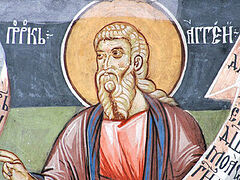
Beloved brothers and sisters in the Lord! Today the Holy Church honors the memory of the great prophet, the son of Buzi (Ezek. 1:3), whom the Lord called to serve among the Jewish exiles on the rivers of Babylon. The Book of the Prophet Ezekiel, written around 593-571 BC, combines prophetic denunciation, liturgical symbolism and profound eschatological hope.
 A miniature from the writings of St. Gregory of Nazianzus. The ninth century One of the most stunningly powerful and vivid parts of the Book of Ezekiel, chapter 37, reveals a prophetic vision of a valley full of dry bones (cf. Ezek. 37:1–14). From the standpoint of literary form, we have a Divine drama before us: Ezekiel not only feels the Lord’s hand on him, but is himself sent down by the Spirit onto the middle of a plain on which lies a multitude of dry bones (verses 1–2). The Lord’s question to the prophet, Can these bones live? (v. 3), introduces the readers to a vital question: Is Divine intervention possible in a situation where obvious death lies before you? At first glance, the picture is one of utter hopelessness: dead bodies that have lost even their flesh, dried up and scattered. Nevertheless, the prophet responds with faith: O Lord GOD, Thou knowest (v. 3). And a miracle occurs: at the word of God, the bones come together, are covered with flesh, and finally, at the Lord’s command, the spirit—the breath of life—enters them.
For St. Ezekiel’s contemporaries, “very dry bones” represented a people in exile, deprived of a king, the Temple, the Promised Land and, consequently, of hope. The Babylonian captives cried out, Our bones are dried, and our hope is lost: we are cut off for our parts (v. 11). Consequently, the immediate interpretation of the Lord’s words addressed to the prophet, Breathe upon these slain, that they may live (v. 9; cf. Job 19:25–26), is linked to the coming restoration of the people and their return from the Babylonian captivity. However, already in the literature of the Second Temple period, this vision was read as a teaching on the future bodily life of the righteous (cf. 1 Enoch 51; 2 Mac. 7). Thus, chapter 37 of the Book of the Prophet Ezekiel became a transitional link in the development of faith from the Old Testament to the New Testament: from the restoration of the nation’s integrity to faith in the resurrection of all people on the “last day.”
In his Dialogue with Trypho the Jew, the holy Martyr Justin the Philosopher argued to his Jewish opponent that the Messiah would bring a “second and eternal resurrection” on the model of that prophesied by St. Ezekiel (Dialogue with Trypho, 81). In early Christian literature, starting with the Hieromartyr Irenaeus of Lyons, we find arguments against those who deny the following part of the Creed: “I look for the resurrection of the dead, and the life of the age to come.” In his work Against Heresies (Lat. Adversus haereses), St. Irenaeus cites the words from the Book of Ezekiel as proof of the future resurrection of the flesh: “He who created Adam from the earth is also able to grant flesh to dry bones” (b. V, ch. XIV, par. 1). For the holy bishop, the prophet’s text served as an argument against the Gnostics who denied the resurrection of the body. Likewise, St. Cyril of Jerusalem addressed the catechumens in his Catechetical Lectures: “If anyone doubts the resurrection of the dead, let him remember the Prophet Ezekiel, who saw the dry bones” (Lecture 18, ch. 14).
The Apostle Paul insists that our Lord Jesus Christ shall judge the quick and the dead at His appearing and His Kingdom (2 Tim. 4:1). Developing the apostle’s thought, St. Justin the Philosopher in his Dialogue with Trypho the Jew proves to his Jewish opponent that the Messiah will bring “the second, eternal resurrection of all people,” which was prophesied by St. Ezekiel, when God clothes the bones with flesh and restores the soul to each person (ch. 81).
Detailed and full of allusions to the Book of Revelation, descriptions of the Last Judgment can be found in the works of the Syrian mystic, St. Ephraim the Syrian. Combining the image of the angelic trumpet with the restoration of human flesh from dust, he wrote in his Homily on the Resurrection of the Dead: “A trumpet sound will go forth to awaken those who are in the graves; and at the voice of the last trumpet all the dead will rise. At the command of the Son of God, swifter than the twinkling of an eye, all the departed will gather at the place of Judgment. Death will be seized with terror and will spew out all its prey, leaving not a single dead person without presenting him before the Judgment. The dust of the earth will be commanded to separate the ashes of the departed, and not a single speck of dust will remain that does not appear before the Judge. Those who were swallowed up by the sea, those whom wild beasts devoured, those whom birds pecked to pieces, those who burned in fire—in the briefest fraction of time all will awaken, rise, and appear” (Works. Vol. 4 (8), homily 137).
 Fresco. The Last Judgment by St. Andrei Rublev. The Dormition Cathedral of Vladimir, 1408
The connection between the prophecies of the resurrection and the liturgical tradition is of great interest. In the Canon of Holy and Great Saturday by St. Cosmas of Maiuma, it is said that, awakening from the night, the Prophet Isaiah exclaims: Thy dead men shall live, together with my dead body shall they arise (Is. 26:19), and all who are on earth will rejoice.
Thus, we stand not merely before a symbol, but before a prophetic promise that has already been partially fulfilled in Christ the Savior, and will be fully fulfilled at His Second Coming.
Let us note that the early Church Fathers freely combine the literal and spiritual meanings of the Biblical message. In cases when it concerns the future resurrection, they discern an important message regarding the present renewal of the Church in the Holy Spirit as well. Thus, St. John Chrysostom, reflecting on the Book of the Prophet Ezekiel, saw in it an image of the spiritual renewal of mankind through the incarnation of the Word and the work of the Holy Spirit. He pointed out that the spirit that entered the bones was a foretelling of Pentecost, when “those dead in sin came to life by the Spirit of Truth.” And Blessed Augustine, in his work The City of God, discerned in the Valley of bones a prefiguration not only of the future resurrection, but also of the present Church, being built up from peoples, “dead in sins” (ch. XX, par. 21). Similarly, Apringius, a sixth-century bishop of Beja, Portugal, saw a veiled spiritual meaning behind historical reality in his Commentary on the Book of Revelations. Relying on the allegorical method of interpreting the Holy Scriptures, he saw in the first resurrection of the righteous (Rev. 20:5) a symbol of birth in faith through the sacrament of Baptism.
The Apostle Paul writes, So many of us as were baptized into Jesus Christ were baptized into His death… Therefore we are buried with Him by Baptism into death: that like as Christ was raised up from the dead by the glory of the Father, even so we also should walk in newness of life (Rom. 6:3, 4). When we enter the “valley of waters” of the baptismal font, we do so in order to emerge “clothed in new flesh” by the grace of the Holy Spirit.
Dear brothers and sisters, Let us ask ourselves: What practical implications does Ezekiel’s prophecy have for us now? Faith in the resurrection of the dead is not only a dogma, but also a source of Christian hope and moral transformation. As the Apostle Paul says: If Christ be not raised, your faith is vain (1 Cor. 15:17). However, if Christ has risen from the dead, then we too will rise, and therefore, our whole lives must be imbued with this faith.
Israel in the Babylonian Captivity seemed already dead. But God said: I will open your graves, and cause you to come up out of your graves (Ezek. 37:12). And there are “valleys of dry bones” in our lives too—times of despondency, spiritual emptiness, and grief over the loss of our loved ones. But even if our spirit is in hell, we must not despair.
 Mikhail Vrubel. The Prophet Ezekiel’s Vision. 1906 The world is full of fears: wars, technological transformations, and the growth of a “culture” of consumerism are frightening in their scale. But we know that the Lord is stronger than death. He said, I am the Resurrection, and the life (Jn. 11:25). And this is not a poetic image, but an ontological reality. Faith in the resurrection of the dead eliminates the fear of death. Christians are free for creative service to the world, knowing that your labor is not in vain in the Lord (1 Cor. 15:58). Today the Lord asks each one of us, “Son of man, can these bones live?” Our answer is not an abstraction from the situation, but repentance, reconciliation with our neighbor, and involvement in the life of the Church community.
The prophecy of St. Ezekiel calls us to be receptive to the breath of the Holy Spirit--to live in prayer, hope, and spiritual unity with one another. The Prophet Ezekiel was entrusted with a life-giving word in relation to the dead. Today, the Lord entrusts each one of us with responsibility for those who have spiritually faded. A word of comfort, help in trouble, and involvement in the lives of others—all this can become that very “spirit” that will quicken our loved ones and ourselves.
The vision of the Prophet Ezekiel was fulfilled partially in the return from Babylon and fully manifested in the Glorious Resurrection of our Lord Jesus Christ. It finds its liturgical performance in every Baptism and every Communion, and one day it will be revealed on a universal scale, when the Lord Himself shall descend from Heaven… and the dead in Christ shall rise first (1 Thess. 4:16).
May the memory of the great prophet strengthen us in hope, so that passing through the valley of the shadow of death (Ps. 22:4) of our time, we may hear the life-giving Word of God, receive the Holy Mysteries and offer praise (Ps. 49:23) to the Risen Lord, to Whom belong all glory and worship forever and ever. Amen.