Diveyevo, Nizhny Novgorod Province, Russia, August 3, 2026
 Photo: patriarchia.ru
The Holy Trinity-St. Seraphim-Diveyevo Convent is marking three anniversaries in 2026: 200 years since the founding of the sisterhood that would become the monastery, 35 years since the second finding of the relics of St. Seraphim of Sarov, and 35 years since monastic life resumed at the convent after the Soviet period, reports Patriarchia.ru.
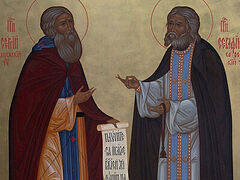
The original sisterhood traces its origin to December 22, 1826, when a mill was built on a site St. Seraphim said had been shown to him by the Mother of God. The saint declared that day that he wished to “found a community” in tandem with the Conception of the Righteous Anna. Sisters lived at the mill itself through the autumn before a cell was completed for them, and St. Seraphim later arranged for additional cells to be built as more women joined the community.
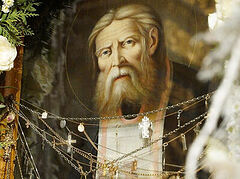
The relics of St. Seraphim were first opened for public veneration on August 1, 1903, in the presence of the Royal Family. They were lost during the Soviet era, but unidentified remains found in the storerooms of the Museum of the History of Religion in Leningrad in the autumn of 1990 were subsequently authenticated by the Church as the saint’s relics. They were transferred to Moscow’s Epiphany Cathedral in January 1991, and on August 1 of that year were carried in procession to Diveyevo, where monastic life was also formally reestablished. Nun Sergia (Konkova) from the Holy Transfiguration Skete in Riga was installed as abbess at that time.
 Photo: patriarchia.ru
On Saturday, August 1, the feast marking the 1903 finding of the relics, His Holiness Patriarch Kirill of Moscow and All Russia visited the convent and celebrated an outdoor Divine Liturgy on the square before the Transfiguration Cathedral.
The Patriarch was joined at the altar by 24 concelebrating hierarchs, along with a number of archimandrites, priests and other clergy from the Nizhny Novgorod Diocese and Moscow.
A group of students from Balamand University in Lebanon (Antiochian Orthodox Church) visiting Russia for a summer institute was also present for the feast. Roughly 7,500 people attended overall.
 Photo: patriarchia.ru
The service was sung by the Diveyevo convent choir and the Holy Protection Choir of the Nizhny Novgorod Diocese’s center for training church specialists.
Following the Liturgy, His Eminence Metropolitan Georgy of Nizhny Novgorod presented the Patriarch with an icon of St. Seraphim containing a piece of his relics, and Abbess Sergia presented an icon depicting the Savior, the Mother of God and John the Baptist, modeled on an icon from St. Seraphim’s cell, along with a prosphora and prayer rope. The Patriarch gave the monastery an icon of the Apostles Peter and Paul, presented Met. Georgy with a cross and Panagia, gave Abbess Sergia a cross, and distributed Gospels to the convent’s sisters and icons of St. Seraphim to the faithful.
In his homily after the service, Pat. Kirill spoke of St. Seraphim’s role during a period when atheism was spreading among the Russian intelligentsia and into the life of the nation, saying the saint’s spiritual force helped weaken “the onslaught of the godless power of the devil.” He said even the proud minds of the 19th century bowed before the saint, and that people who might have hesitated to pray to God elsewhere came to pray to St. Seraphim.
The Patriarch also linked the saint to Sarov’s later history as a center of Soviet nuclear research, saying it was “not accidental” that Soviet scientists developed the Russian atomic bomb in the same place where St. Seraphim had prayed, and that many of the physicists involved were Orthodox believers who understood their work was accomplished “also through the prayers” of the saint.
 Photo: patriarchia.ru
He described Russia’s post-Soviet religious revival as evidence that “the Lord truly works miracles” and is “the Master of history,” contrasting this with the decline of faith in other countries. He closed by asking that the saint’s prayers preserve Russia, its president, its authorities and its armed forces “from every enemy and adversary.”
Follow OrthoChristian on Facebook, Twitter, Vkontakte, Telegram, WhatsApp, and MeWe!