Diveyevo volunteers
The St. Seraphim-Diveyevo Monastery, the Fourth Portion of the Mother of God, is always filled with pilgrims. At any time of the year, tens of thousands of people can be found there. Many arrive with a desire to labor for the monastery.
Not long ago, people of all ages could be seen throughout the monastery grounds wearing sky-blue T-shirts bearing the words: “Be vigilant! Seek salvation, my joys!” These words of St. Seraphim of Sarov sound like a parting exhortation to those who come to serve there as volunteers.
Anyone who has once decided to travel to Diveyevo as a volunteer will surely say that his life became divided into “before” and “after.”
Anyone who has once decided to travel to Diveyevo as a volunteer will surely say that his life was divided into “before” and “after.” It is as though a path out of a hopeless situation had been found, answers had been given to impossible questions, or one had learned how to receive the grace that purifies and softens the heart, leading it toward tenderness and obedience.
Diveyevo volunteers—who are they?
Who is a Diveyevo volunteer, and how do people come to the monastery? Novice Natalia, who is responsible for organizing the life of volunteers at the Seraphim-Diveyevo Monastery, spoke about this.
—Sister Natalia, how long ago did the Diveyevo Monastery begin inviting volunteers, and how do they differ from monastery laborers?
—The volunteer movement at our monastery began in 2023. The idea belonged to one of the senior sisters of the pilgrimage center, because the Diveyevo Monastery receives a great number of pilgrims every month. We have extensive grounds, restoration and construction work is constantly underway, and so we needed helpers.
 Construction of a tool shed
We were inspired by the experience of the Valaam Monastery and the Holy Trinity-St. Sergius Lavra, which had already begun welcoming volunteers to labor for the glory of God. That was when we introduced our own volunteer program as well.
The life of volunteers in our monastery is carefully organized. They gain experience in communal living, learn to renounce things dictated by selfish desires, and discover the joy of doing good.
—How long have you been carrying out the obedience of volunteer coordinator, and what is the easiest—and the most difficult—part of this service?
—This obedience was entrusted to me from the very beginning of the program’s existence. If you do nothing, life seems easy; but once you begin working, all kinds of problems and responsibilities arise, and they must all be resolved together. Perhaps the most difficult thing is discerning who has truly come with the desire to labor in the monastery and who has not.
But there is such joy in seeing how people change after coming here! Many arrive burdened by unresolved problems or sorrows, yet they leave radiant, filled with grace and joy.
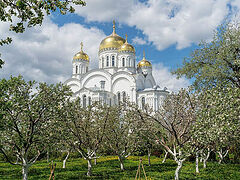
 The Holy Trinity Seraphim-Diveyevo Monastery
—What are the requirements for those who wish to come here as volunteers?
—All the requirements for volunteers are listed on our website. There you can also find additional information about the rules and living conditions on the monastery grounds, as well as fill out an application form.
The most important requirement is a willingness to listen and to obey. In the monastery, everything is built upon this highest virtue, which is connected with bringing one’s own will into harmony with the will of God. Without obedience, it is difficult for a person to labor in the monastery and follow the order of monastic life.
—What schedule do the Diveyevo volunteers follow?
—The minimum stay within the volunteer program is two weeks.
Our mornings always begin with the akathist to St. Seraphim of Sarov in the Holy Trinity Cathedral. Volunteers have the opportunity every day to venerate his uncovered relics. After the akathist, they may go to the Canal of the Most Holy Theotokos to pray there, and then return to their cells for breakfast.
From Monday through Friday, volunteers begin their obediences no later than 9:00 a.m. They work until noon, then have lunch, after which they continue working for several more hours. Sunday is always a day off.
In the evenings, they may visit the holy springs—there are quite a number of them in Diveyevo—and everyone also tries to attend the church services for prayer.
We share dinner together, and in the evening we hold a common meeting where we discuss the day and make plans for the next one. Sometimes we also have evening conversations, since many volunteers have questions concerning spiritual life.
—Do you have volunteers who return more than once?
—Yes, many of them do. They come back again and again. Some even visit five times during the course of a year. We call them our “veterans”.
 Clearing snow at the Diveyevo Monastery — Where do your volunteers come from?
—From every corner of Russia—Kaliningrad, Petropavlovsk-Kamchatsky, Tynda, from Yamal and many other regions. It would be difficult to name a part of the country from which people have not come here. Volunteers have also arrived at Batiushka Seraphim’s monastery from neighboring countries such as Latvia, Moldova, Kazakhstan, and Belarus.
—What do volunteers gain spiritually after laboring in the monastery?
—Most of them are only taking their first steps toward God. Of course, there are deeply religious people among them, but they are relatively few. More often we see people who consider themselves Orthodox because they were baptized, yet who have not truly experienced church life. Many come to the monastery carrying sorrows, hoping to find help or answers to difficult questions, while others arrive in a state of complete despair. But they leave with faith, hope, and love for the Lord.
Below are several stories from our first volunteers that became testimonies to God’s Providence in the lives of people.
Finding purpose in life
A young woman named Olga came to our monastery as part of one of the very first volunteer groups. At first she seemed no different from the others. She filled out the questionnaire, I called her, and we spoke by telephone. Everything appeared entirely normal.
After spending two weeks working and praying, she left us a written testimony in which she revealed that before coming to the monastery she had struggled with suicidal thoughts. By Divine Providence, she found herself in Diveyevo. Glory to God, Olga found the Lord and discovered the meaning of life.
Finding a wife through prayer
Maxim, one of our first volunteers, came to Diveyevo with the intention of laboring diligently for the glory of God and praying that he might find a wife. Two months after returning from the monastery, he met his future bride. Soon afterward, Maxim was married. On February 6, 2025—the feast day of Holy Blessed Xenia of Saint Petersburg—he became a father.
Restoring Order in Family Life
A married couple from Moscow decided to labor for the glory of God in Diveyevo and joined one of our volunteer groups. Later it emerged that they had different surnames, and eventually it also became known that their children bore the mother’s surname.
When we asked why this “little church”—their family—had departed from the proper order of family life, they explained that the wife’s father, after becoming a churchgoing man, had deeply grieved over the thought that his family line would not continue. Wanting to console him, the daughter had given her children her father’s surname.
After many conversations and explanations, the couple agreed to set everything in proper order: The wife and children changed their documents so that the whole family would bear the surname of the head of the household. Later they shared with us that their relationship had improved greatly and that peace and harmony had returned to the family.
***
 Working high up in the church “I was born in Kazakhstan and grew up in an international family—a mixture of Russians, Kazakhs, Ukrainians, and Tatars. In childhood, my abika (my Tatar paternal grandmother) taught me to read the Koran, and I was raised according to Muslim traditions.
When I was very young, I first saw an Orthodox church while riding a bus with my mother through the old part of town. After that encounter, I would eagerly wait for the bus to pass that stop again. As I grew older, I sometimes watched the Divine Liturgy on television. Occasionally I would travel to the church simply to stand outside it and pray, though I did not dare to go inside. During school vacations spent in the aul—a village in the steppes—I began memorizing the ‘Our Father.’ One of my mother’s friends, a Chechen woman by birth, helped me.
At the age of eighteen, I received the Sacrament of Baptism. At first, almost everyone—regardless of religion—tried to dissuade me, saying: ‘God is the same everywhere! Why do you need this?’ My Kazakh mother wept as though I were about to die—or something even worse. My grandmother cried as well, and everyone was afraid to tell my Kazakh grandfather. But little by little the atmosphere in the family began to change. Seeing my determination, they eventually left me in peace.
Gradually, in adulthood, I became a churchgoing Orthodox Christian. More and more often, people began asking me to pray for their children and loved ones. They also sought my advice on matters of faith. Many years later, that same Chechen woman—my second mother—once asked me: ‘How does a person finally decide to do it?’ Fourteen years earlier, she had been the one to support me, saying: ‘Well done, son! If he wants to be baptized, let him. Don’t trouble him—leave the man alone and let him make his own responsible decisions.’”
“If a person takes the first step, God, with open arms, takes three steps toward him.”
“As Mother Sergia, the abbess of the Diveyevo Monastery, says in one of the documentaries on Diveyevo: ‘You must take the first step toward God yourself and have the desire to know Him. If you take that first step, God, with open arms, will take three steps toward you. Then you can only marvel at how everything around you begins to be transformed.’
Once I bought a small bottle of holy oil with an icon of Batiushka Seraphim of Sarov on the label. I prayed: ‘Seraphim of Sarov, help me… if it is pleasing to God, help me venerate your relics.’
A few months later, I came to Diveyevo for the first time with a group of pilgrims. There I saw what the life of monastics was truly like. By their own example they showed what humility, prayerful labor, and love for God and neighbor mean.
 The “special-ops volunteer force” and the shovel nicknamed “Helping Hand” setting out once again on a mission
I prayed at the Holy Canal to the Queen of Heaven, asking for her intercession before the Lord and for His answer. When I returned home, on the feast of the Protection of the Most Holy Theotokos, the rector of our church blessed me to serve as an altar assistant.
At once I remembered a volunteer flyer I had seen at the pilgrimage center, and I decided to return to Diveyevo not with burdens and problems, but with gratitude. As always, our Heavenly Father did not leave my labor without reward. Every moment in the monastery brought some new discovery. I had never experienced such peace and tranquility as I found in Diveyevo.
Over the past year I have visited three monasteries. Previously, I could never even have imagined that I would one day know archdeacons, hieromonks, and nuns personally… In fact, I did not even know such words existed! But now I understand monastic life at least a little more than I did in childhood. And they gave me such wonderful gifts—spiritual books, prosphora, even earth from the crypt of St. Elena of Diveyevo, and candles. I had never before received gifts so touching and meaningful.”
“As for my grandfather, thank God he is already ninety-two years old. After one of my trips to the monastery, he asked me with a smile: ‘So, how are things? Did you find what you were searching for?’”
Healing of the Soul
“My trip to the monastery in Diveyevo, to Batiushka Seraphim of Sarov, was filled with both great and small miracles. I could never have imagined that not only would I labor for the glory of God in various obediences, but that my soul itself would be healed.
I could never have imagined that not only would I labor for the glory of God in various obediences, but that my soul itself would be healed.
Every detail mattered and brought healing through obedience—the work itself, the place, and the people with whom I labored. We performed all kinds of obediences: washing small and large dishes, cleaning large kitchen equipment, tidying guest rooms, preparing and canning tomatoes, weeding strawberry patches, removing weeds in the greenhouses, and much more. In general, these were ordinary farming and household tasks. Yet all of them proved beneficial for the soul.
I especially remembered moments from childhood, such as when my mother taught me how to place tomatoes into jars for canning. Even the scent of tomato plants in the greenhouse brought me joy—I have loved that fragrance ever since childhood.
 Sister volunteers laboring for the benefit of the Diveyevo Monastery On my birthday, I was assigned the obedience of cleaning one of the guest houses. The moment I stepped inside, I noticed the wooden panel walls painted with hypoallergenic paint. Simply seeing those walls warmed my heart, because they immediately reminded me of my apartment in the north, which I missed deeply. I had lovingly renovated that apartment, but just after the repairs were completed, we had to move urgently to the south because my son had begun suffering from asthma. We had painted the walls there with the very same hypoallergenic paint.
At the guest house we were welcomed by a kind attendant who carefully explained everything to us, and it became clear to me that this obedience on my birthday was itself a gift. I began cleaning the rooms, but when I entered the bathroom, I was left speechless: the floor tiles were exactly like those in my former apartment. They even had the same firebird design. I cleaned those rooms with such love, as though I were caring for my own home. In some way, it allowed me to linger a little longer in my old apartment in the north.
The tables were decorated with lace crochet doilies, just like those at the home of my grandmother, who has now departed this life and whom I miss terribly. There too I felt her love and seemed to relive it once more.”
The garden beds are long—but they too have an end
 Volunteers weeding the garden beds
“At first, it was rather frightening to come and work during the summer at the Seraphim-Diveyevo Monastery. I am a solitary person and rarely do manual labor.
My very first obedience was weeding beets! Then my second obedience was beets again! Later I was weeding beets at the St. Nicholas Skete as well! What can I say? The garden beds are long—but even they eventually end! So do not be afraid, especially those whose thoughts about enormous and exhausting obediences keep them from coming to Diveyevo. Even dirty dishes come to an end! Even the huge pots in the monastery kitchen eventually all get washed!
And in the evening, when you immerse yourself in the spring of the Venerable Mother Alexandra of Diveyevo, you feel as though you have been born anew. Or when you walk along the Canal, the Most Holy Theotokos grants such grace and faith that everything seems possible with God’s help.
Batiushka Seraphim rewards dedicated labor with an immense and quiet joy, so that after every obedience all you want to do is embrace the whole world and say: ‘Love one another!’ Once, while working in the greenhouse, I suddenly caught myself saying aloud: ‘What peace there is in my soul!’”