The most outstanding Russian naval commander, who commanded the Black Sea Fleet and stood at its origins, is primarily known to us for his unparalleled tactical and strategic skills. He is an admiral who did not lose a single naval battle and never left a single sailor in captivity. But few people know that in 2001 the Russian Orthodox Church canonized him as a righteous warrior—a truly unique case!

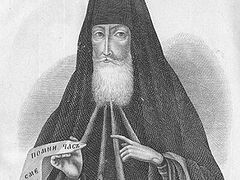
The future admiral Theodore (Fyodor) Fyodorovich Ushakov was born in February 1745 in the small village of Burnakovo, Yaroslavl province (now the Rybinsk district of the Yaroslavl region), to an ancient noble family, which was not rich. His great-great… and many times over great-grandmother was a daughter of the holy Equal-to-the-Apostles Prince Vladimir Svyatoslavich (†1015). His parents gave the boy a good basic education, and his uncle, a monk and the future St. Theodore of Sanaxar (†1791; commorated February 19/March 4 and April 21/May 4), instilled high moral values in him, so that from the earliest age Theodore grew up in an atmosphere of love, mutual respect and trust in God. According to surviving evidence, the boy enjoyed talking with an elderly fellow villager who had once served in Emperor Peter the Great’s Navy. After listening to his stories about everyday life at sea, St. Theodore began carving toy boats out of wood, creating his own little “fleet.”
As a teenager, he suffered a partial aseptic necrosis of the head of his right femur, which is why for the rest of his life he had the habit of tucking up his sore leg when standing. However, this did not prevent him at the age of sixteen from entering the Naval Cadet Corps and successfully completing it. After graduating with the rank of midshipman, Ushakov went to serve in the Baltic Fleet, where he gained excellent practice, and then he was transferred to the Don (Azov) Flotilla, where he became the captain of his first ship and participated in the Russo-Turkish War of 1768-1774. At that time, Russia was winning back access to the Black Sea from the Ottoman Empire, and the Fleet needed young, energetic men capable of accepting this daring challenge. St. Theodore Ushakov became precisely such a person, unhesitatingly devoting his strength and experience to his beloved Fatherland.
It should be noted that even back then, he started implementing a completely new system of interaction with the ship’s crew. When it came to preserving lives, Ushakov did not divide officers and sailors into first and second class, and he did everything possible to conduct any military operation with minimal casualties. Unfortunately, in those years, ordinary men were often sent to the slaughter without a second thought, just to achieve the set goals; it was precisely this system that the future naval commander set out to reform, guided by considerations of faith and mercy.
After the end of the war, in 1775, Catherine II the Great (ruled from 1762 to 1796) decided to create a regular ship-of-the-line battle fleet on the Black Sea. A few years later, the city of Kherson was founded along with a port and an Admiralty located there. In 1783, Ushakov was transferred to the Black Sea Fleet and sent to Kherson. Once he arrived there, he encountered an outbreak of the plague—the very same one that the legendary Generalissimo Alexander Suvorov (†1800) had to fight in the land forces. And just like that great commander, Ushakov coped with the task brilliantly. By Ushakov’s order, the sick were immediately isolated, infected clothing was burned, the sailors were divided into small artel groups living in tents separated from one another by a significant distance, and strict quarantine measures were introduced. Ushakov himself kept a tireless watch over compliance with all regulations, and as a result, any manifestations of the plague in his crew disappeared several months before the epidemic was over. All the members of his crew survived. For this, St. Theodore Ushakov was promoted to the rank of Captain 1st Rank and awarded the Order of St. Vladimir.
Four years later, a new war broke out between Russia and Turkey, with nothing less than the right to possess the Crimea and the entire Northern Black Sea region at stake. In his very first battle, at Fidonisi, Ushakov was assigned to command the vanguard of the Russian squadron. The Turkish fleet significantly outnumbered the Russian one: seventeen battleships and eight frigates, against a mere two battleships and ten frigates. Thanks to St. Theodore Ushakov’s skillful actions, the Russian ships executed several completely unexpected maneuvers, forcing the enemy into an unfavorable position. In the end, the heavily battered Turks took to flight. This victory is especially significant because it was the first time in an open battle that the numerically inferior Russian fleet managed to tactically outplay the enemy and emerge victorious. Prince Potemkin was so impressed by Ushakov’s successes that the following year he promoted him to the rank of rear admiral, and a year after that appointed him commander of the Black Sea Fleet.
 The Battle of Kerch
In this capacity, in July 1790, St. Theodore entered into battle with the Turks, who were heading to Kerch to land their amphibious force. The battle turned out to be difficult and protracted, and Rear Admiral Ushakov showed a remarkable ability for unconventional thinking and extraordinary actions that violated many canons of classical tactics. As a result, the Russian fleet once again defeated the Turkish fleet and prevented it from carrying out its “landing” plan. Later, Prince Potemkin wrote in a report to Catherine II: “The battle was fierce and all the more glorious for us because Rear Admiral Ushakov fiercely and properly attacked an enemy twice his strength… He heavily defeated them and pursued them until nightfall… I am certain that he will make a great naval commander.”
Another significant victory concluded the Battle of Tendra Spit, where Ushakov no longer defended, but attacked, deftly using the element of surprise and the principles of mutual support between ships. The innovative techniques used by the rear admiral in these two battles forever entered the history of naval art. As for the training and education of sailors, Ushakov adopted truly Suvorov-like principles: He paid special attention to the personal skills of each sailor and gunner, training them to navigate any situation. For example, one of the admiral’s well-known methods was this: A gun mounted on rope swings and rocks to simulate the rolling of the sea, and the gunners had to hit a sail floating at sea on a wooden raft with a canon shot. Having undergone such training, Ushakov’s crews subsequently distinguished themselves by the highest accuracy of fire.
On July 31, 1791, a truly legendary battle between the Ottoman and Russian fleets took place off the Bulgarian Cape Kaliakra. Foreseeing a grueling confrontation at sea, the Turkish sultan called on ships from his African domains, led by the Algerian Said Ali, to aid the fleet. Said Ali instantly set sail for the shores of Bulgaria and boastfully promised: “I will teach Ushakov a lesson! I will bring him to Istanbul in chains like a beast!” At the same time, Prince Potemkin wrote the following to the rear admiral: “Pray to God! The Lord will help us, rely on Him; encourage the crew and instill in them the desire for battle. May God’s mercy be with you!” And St. Theodore answered Said Ali’s bravado with action. Although the Russian fleet was still inferior to the Ottoman fleet in its number of ships and guns, Ushakov believed in his brave sailors. Approaching the Turkish ships, he launched a lightning-fast attack to exploit the element of surprise. The Turks, however, recovered fairly quickly and opened fire, but Ushakov still managed to pass in three columns between the shore and the Ottoman vessels, smashing them to splinters and driving them further away from the coastal artillery.
The Turks’ battle order was completely disrupted, and their ships ended up so close to each other that, in the end, they fired at their own vessels instead of the Russian ones. The flagship carrying Ushakov bore the highly symbolic name, Rozhdestvo Khristovo (“The Nativity of Christ”). Noticing that Said Ali’s ship was trying to slip away from the battle, the rear admiral chased it at full sail and attacked it. The Algerian’s ship was badly battered, and Said himself was wounded and took shelter in his cabin. Soon, the remnants of the Turkish fleet were completely scattered and fled from the Russian squadron; only the onset of night and thick gunpowder smoke saved them from total defeat.
The Russian losses, thank God, turned out to be very insignificant, while the Ottomans lost dozens of times more men and almost all of their ships. When only five line-of-battle ships and five smaller vessels, battered and mangled with a mass of casualties on board, entered the Bosporus, the Turks wailed in grief. “Oh, Mighty One! Your fleet is no more!” Said Ali announced to the sultan with sorrow and shame. Since the Ottoman Empire had lost a vast portion of its warships, the sultan, devastated by what had happened, hastened to conclude a peace treaty with Russia. Empress Catherine II, fully aware of whom achieved this victory, awarded St. Theodore Ushakov the Orders of St. George and St. Alexander Nevsky, and a little later promoted him to the rank of vice admiral.
After the war ended, St. Theodore Ushakov was tasked with developing Sevastopol as the main base of the Black Sea Fleet—a task he successfully pursued for the next several years. Curiously enough, he entered his next battle with former enemies—the Ottomans—as allies. Emperor Paul I (ruled from 1796 to 1801) was on the throne at the time; he had joined the anti-French coalition (Russia, Turkey, Britain, and Austria) and sent Ushakov to command the joint Russian-Turkish squadron to clear the Greek islands of the French. “Ushak-Pasha”, as the Turks called him, quite quickly liberated the Ionian Islands from the French and approached Corfu, the most strategically important of them all. The French positions seemed impregnable; however, Ushakov first enlisted the support of the local Greek population, and second, organized the siege in such a way that the French garrison was completely blockaded in the bastions and no other troops could come to its aid.
In February 1799, Napoleon’s troops surrendered. On learning about the victory at Corfu, Field Marshal Alexander Suvorov personally wrote a letter to Admiral Ushakov that contained these words: “I wish I had been at Corfu, if only as a midshipman!” Ushakov, who had always regarded Suvorov as his teacher, was deeply touched by his praise, which became more precious to him than any awards. Another famous statement by Suvorov about the valiant naval commander was made when an Austrian officer called the admiral “von Ushakov.” Alexander Suvorov sharply interrupted the speaker: “Take back your ‘von’ and be so good as to call the Russian admiral, the hero of Kaliakra and Corfu, Theodore Feodorovich Ushakov!” And this was an absolutely correct remark, for the admiral was a true Russian man both by birth and by spirit.
 Vladimir Ilyukhin. The Meeting of A. V. Suvorov and F. F. Ushakov
On all the islands, the Greeks greeted the Russians as liberators, and the inhabitants of Corfu even presented St. Theodore Ushakov with a custom-made gold sword. Working in coordination with local authorities, Ushakov established the Republic of the Seven Islands (the Septinsular Republic)—the first sovereign Greek state after the fall of Byzantium—and drafted a constitution for it. Afterwards, Russian ships were sent to the shores of Italy, where they participated in supporting Suvorov’s troops, the blockade of Genoa, and the liberation of Rome and Naples. A little later, Paul I, driven by new political considerations, ordered our squadron to return to Sevastopol.
Admiral Ushakov made the Black Sea Russian; but in 1801 Emperor Paul I was murdered by conspirators, and his son Alexander I (ruled from 1801 to 1825) ascended to the throne. The new sovereign, instigated by his advisors, decided that Russia did not really need the Navy, unlike the ground forces, and reassigned the great naval commander to command the Baltic Rowing Fleet. A few years later, disillusioned that Alexander I did not use his talents at all, Ushakov resigned. The sixty-two-year-old admiral replied to the Emperor who wondered what the reason for his resignation was: “My spiritual feelings and sorrow, which have exhausted the strength of my body and health, are known to God—may His holy will be done. I accept everything that has happened to me with the deepest reverence.”
St. Theodore Ushakov returned to his estate in the village of Alexeyevka not far from the Sanaxar Monastery where his uncle had once served, devoting the rest of his life to the Church. He regularly attended monastery services, spent much time conversing with the brethren, and during Lent he would even live for a week at the monastery, where he was given a separate cell. During the Patriotic War of 1812 (the French invasion of Russia), Ushakov was invited to head the local people’s militia. He was grateful, but declined, as his age and health no longer allowed him to hold active military positions. However, the retired admiral certainly did not remain on the sidelines, setting up a hospital for wounded soldiers at his own expense. St. Theodore Ushakov passed away on October 2/15, 1817, at the age of seventy-two, having spent the final years of his life in fasting and prayer.
 St. Theodore of Sanaxar and the Righteous Warrior Theodore Ushakov
He never had a family, but many people came to pay their last respects to him. They loved and venerated Ushakov not only for his military merits, but also for his Christian character, merciful help to his neighbor, and modest, almost ascetic life in the depths of the empire; given his valor, he could have shone at the court in St. Petersburg. People carried the coffin with his body in their arms for over seven miles—from the Church of the Transfiguration of the Lord in the nearest town of Temnikov to the Sanaxar Monastery, where the outstanding admiral was laid to rest next to his uncle, the holy Hieromonk Theodore.
More than a century later, during the Second World War, the need arose in the Soviet Union to establish a naval award analogous to the Order of Suvorov for the ground forces. But whose name should it bear? The task of developing this idea was entrusted to Admiral Nikolai Kuznetsov. Having considered the two most suitable candidates, Nakhimov and Ushakov, the admiral ultimately chose the latter. And although Pavel Nakhimov was more famous, it was Ushakov who introduced new principles of naval warfare and, furthermore, never suffered a single defeat in battle. Soon after, the Combat Order of Admiral Ushakov was established as the highest award for Navy servicemen.
Nowadays, many streets in the cities of Russia, as well as a bay in the southeastern part of the Barents Sea and a cape on the northern coast of the Sea of Okhotsk, bear the name of St. Theodore Ushakov. It was also assigned to several ships of the Russian Navy. Monuments have been erected in honor of the holy admiral, and feature films have been made based on his biography. In 1991, after a period of Soviet oblivion, the Sanaxar Monastery was returned to the Russian Orthodox Church; on August 5, 2001 Theodore Ushakov was canonized locally by the Diocese of Saransk as a righteous warrior; and finally, in 2004, the Moscow Patriarchate canonized him for Churchwide veneration. Currently, the tomb of the holy admiral—who exemplified zealous service to the Fatherland, valor and Christian piety—is constantly visited by pilgrims; military sailors also frequently come to pay their respects and pray at his resting place.
From the book, Simple Miracles, published by the Sretensky Monastery’s publishing house, 2025