Oryol, Oryol Province, Russia, August 5, 2026
 Photo: orel-eparhia.ru
Orthodox clergy and forensic specialists uncovered what are believed to be the relics of St. Athanasy the Confessor, a fool-for-Christ who spent decades in Soviet prisons and psychiatric hospitals for his faith, during excavation work at his burial site in Oryol, Russia.
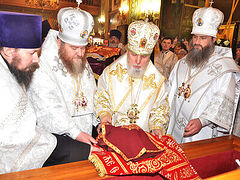
A memorial service preceded the excavation, which began at 4 AM on August 3 and was led by His Eminence Metropolitan Tikhon of Oryol and Bolkhov. Specialists then began work at the grave site of the confessor, and recovered remains believed to be his, reports the Oryol Metropolia.
The effort involved clergy from several dioceses and Church bodies, including a member of the Synodal Commission for Canonization, the abbot of the Guslitsky Transfiguration Monastery, and clergy from the Oryol Diocese, among others.
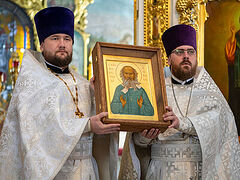
The remains will now undergo historical, archaeological, and other expert examinations before Church authorities issue an official determination confirming their identity. Until that process concludes, the remains are being referred to as presumed relics.
St. Athanasy was canonized in May.
***
 Photo: patriarchia.ru
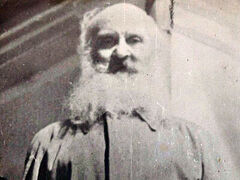
St. Athanasy was born in 1887 in the village of Danichevo, Volyn Province, into a civil servant’s family. From 1905 to 1908, he served in the military.
In July 1920, he was arrested and interned in the city of Oryol in concentration camp No. 1, where he remained until November of the same year. After his release, he settled in the bell tower of the Holy Theophany Cathedral in Oryol and from that moment began the feat of holy foolishness.
In the early 1920s, after being healed from a serious illness, he entered a monastery with his spiritual father’s blessing. From 1926 to 1931, he sang in the choir of the Holy Resurrection Church of the former monastic cemetery in Oryol.
In April 1931, he was arrested again, charged with “conducting agitation among the believing masses against the measures of Soviet power and the party in the countryside.” During interrogation, St. Athanasy confirmed that when people asked him about joining collective farms he answered negatively, but he rejected the other accusations. On October 28, 1931, the criminal case against a number of persons, including St. Athanasy, was closed due to lack of proof of criminal activity.
In 1932, he was placed in the Oryol Psychiatric Hospital, where he spent 9 years. Many believers came to him in the hospital for advice and consolation. From 1941 to 1948, the ascetic lived in Oryol, sang in the church choir, and helped the city’s residents with household tasks. During the war years he strengthened the people, gave spiritual advice, warned of troubles, and told of the fates of soldiers and prisoners.
From 1948 onward, he was arrested several times and placed in psychiatric hospitals, where he spent another 7 years. In the medical records, doctors invariably noted St. Athanasy’s religiosity, calmness, sociability, and kind disposition. Throughout his entire period in the medical facilities, people came to him as before for help and advice.
On May 5, 1967, at the age of 81, St. Athanasy reposed in the Lord. He was buried at Krestitelsky Cemetery in Oryol.
His example of Christian virtues—meekness, gentleness, patience, humility—served as edification for those who came to him. Veneration of the confessor began during his lifetime and continues to this day, more than 55 years after his death. There is evidence of his miraculous help, including cases documented by medical records.
Follow OrthoChristian on Facebook, Twitter, Vkontakte, Telegram, WhatsApp, and MeWe!