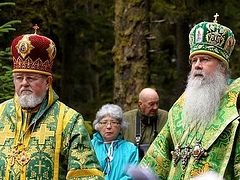
When Vera Andrejuk arrived in Alaska with her new husband, Priest Daniel Andrejuk, she did not even speak English. But six months in Kodiak helping at the St. Herman Seminary was enough to instill great love and admiration for the great saint whose relics rest in the Kodiak cathedral—Holy Monk Herman of Alaska—as well as for his “orphans”, the native people of the northern wilds.
As she and Fr. Daniel served eleven years in Anchorage, Vera dreamed of writing a book for children and young adults about the beloved Spruce Island saint, who came to Alaska from his Russian homeland to serve God. After all, she had also come from Russia, and for the same reason!
In 2025, work on the English translation was complete, and the book was published in Moscow, where she and Fr. Daniel now live and serve at the OCA representation church dedicated to Great Martyr Catherine. For St. Herman’s day, we would like to introduce our readers to this engaging book.
 Illustration to the book, Saint Herman and His Alaska. Artist: Anna Biryukova
Russians Discover Alaska
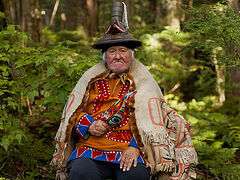
During the summer of 1741, Captain Bering’s expedition reached the coast of Alaska. Between them were snow-covered mountains and a volcano. The discovery of new lands led to the arrival of Russian industrialists and merchants, who found that Alaska was a land of marine crafts and a wealth of animals whose fur was highly prized. When the industrialists arrived at the fishing location, they organized hunting cooperatives where they worked themselves and hired the Aleut natives, who were unsurpassed hunters of timid sea otters and whales. Alaska’s name comes from the comes from the Unangam Tunuu word “alakhskhakh”—“a place where whales are plentiful”. There were several indigenous peoples in Alaska, including Aleuts, Chugach, Yupiks, Inupiat, and Tlingit Indians, but the entire native population is often referred to as Alaska Natives.
Often, local residents performed dangerous work for Russian industrialists. The reason? The Aleuts were very hardy and brave people, and travel across the vast ocean was not a problem for them on tiny single-person kayaks. It’s hard to imagine how these fearless natives designed and constructed light-weight, transparent boats by hand. They constructed the frame of the boat from thin slats-planks in the form of lattice, using seal skin to cover it. While seated in the kayak, the rower tightened the skin around his waist so tightly that even if a wave covered the kayak, no water could find its way inside. As time progressed, kayaks were made to accommodate two or even three passengers. In such a boat, even the waves of the sea were visible through the thin seal skin, which was not able to protect it from sharp stones.
Industrialists from Russia explored the newly discovered land to its very depths. Their equipment helped prepare several successful expeditions to the remotest Aleutian Islands. A key figure in the development of Alaska by Russians is Grigory Ivanovich Shelikhov. Aside from the rich benefits, he was guided by the sense of duty to bring the people of this region to Russian citizenship and teach them about the Orthodox faith. In August 1784, industrialist Shelikhov arrived on Kodiak, the largest island near mainland Alaska, to accomplish this goal. During this year of staying on Kodiak, industrialists built a fortress and decided that Russians could winter there. The famous harbor was opened there and named “Three Saints Bay”. This was the beginning of the first permanent Russian settlement in Alaska. As time passed, the Aleuts became more knowledgeable about Russia, as well as about Orthodox Christianity. It was with this good intention that Shelikhov made every effort to obtain permission to send missionaries to Alaska during his stay in St. Petersburg.
The Spiritual Mission Arrives in Alaska
During 1794, a ship with tired sailors moored to Kodiak Island’s shores. They all expressed their gratitude to God for a long but fascinating journey. Archimandrite Joasaph, the head of the ecclesiastical mission, later told local residents and industrialists:
“Our journey to Alaska began on December 25, 1793, via Moscow. We arrived in Irkutsk on March 16, and stayed until Easter. We left on May 2. It took us 3,000 kilometers to travel to Okhotsk. Our first route lay along the Lena River to Yakutsk. On horseback, we crossed impassable and unsafe terrain and rode through forests and mountains. Overall, we spent time with the brothers... On August 13, we set sail by the ocean, passing Kamchatka and the Aleutian Islands chain. The Lord has provided us with the opportunity to see seals, beavers, killer whales, and whales. Our ship was approached by them and they swam up to it and played on the surface of the water.”
Upon leaving the ship, the missionaries explored Kodiak Island. They were several monks: Archimandrite Joasaph, Hieromonk Yuvenaly, Hieromonk Macarius, Hieromonk Athanasius, Monk Herman, and others traveled with them. Their experience as ascetic monks had won the confidence of Metropolitan Gabriel and Father Nazarius, the abbot of Valaam monastery. They were astonished ·by the beauty of the island that appeared before their eyes. The lakes and coastal waters were teeming with fish, and there were many fur-bearing animals in the dense fir forests—grizzly bears, wolverines, ermines, squirrels, and various birds—white-headed eagles, swans, white partridges.
It was observed by the missionaries that there was no church or chapel on the island. It was decided that the most important and first thing they should do would be to build the first church in Alaska on Kodiak Island—and in fact, the first church in North America.
A First Autumn in Alaska. Building the Church
How hard it was for the brothers in, the far north! Although autumn brought rain and wind to the brethren, the monks could not help but admire the beauty of the land and praise God despite the harsh weather. Snow covered the summits of the mountains and volcanoes, while the foliage of the trees turned bright fall colors, from purples to yellows. Evergreen spruces are the only ones that had not changed color. Wildlife is gathering supplies for the winter at this time. In preparation for hibernation, clumsy bears gather fish and vitamins before heading into the woods. Like cows, they walk through yellow meadows searching for blueberries, cloudberries, highbush cranberries, lingonberries, and even the northern crowberry that grows in abundance here. The red-haired chirping squirrels jump between trees, enjoying themselves since they have already gathered all their winter supplies.
As for the weather, it is determined entirely by the winds. The weather is clear when the winds blow from the west or south, but otherwise it is damp, rain and fog accompany each other continuously. As for winter, it comes to this region with a vengeance.
The brother monks initially lived in a small room allocated by the company administration, where they lived according to the monastic statutes. Fortunately, the monks were used to laboring since the Valaam ·monastery, so they prepared firewood for the long winter. A total of 1,500 rubles were allocated for the construction of the church by Baranov, the company’s manager. The vision of the temple of God inspired not only the monks, but also the industrialists and merchants. The difficulty of being far from one’s relatives, much less the house of God, in a foreign land is not to be underestimated!
Building the church did not occur too quickly, but diligently, and by the end of the year it was completed. This was the first Orthodox church to be constructed in the United States. In honor of the Resurrection of the Lord, this church was consecrated in April 1796. The bells were ·cast by craftsmen, and daily services were conducted. It was such a joy for the Russian people to hear the bells ringing! Thereafter, Aleuts began to be drawn to the church, where monks and priests baptized them and taught them the basics of Christian life. They had already gained a great deal of knowledge from the Russians. This native population proved to be very easy to communicate with. They loved sincerely and with a childlike innocence.
Simple things appealed to Aleuts. The buttons on caftans and dresses especially appealed to them. However, even they did not alter the name of the buttons in their language, but simply added “-kh” to the end, which became “pugovichakh.” There was a great deal of practicality in their own clothes. In the summer, they wore long shirts with narrow sleeves and hoods, which the Russians called “kamleika.” Sea lion, seal, and whale intestines were used to make it. The material was almost transparent and did not absorb water. Winter clothing was referred to as parkas. A similar cut was used, but it was made from animal and bird skins, primarily gopher or seabird skins. In place of pants, the Aleuts wore belts made of seal skins, and hats made of bird skins on their heads. In the course of time, the Russians taught the Aleuts to wear pants, and the Aleuts retained the Russian name “brukakh”. Aleuts wore sealskin shoes only during exceptionally cold weather, and generally went barefoot during the year. In fact, the Russian footwear was stronger and more comfortable, and later the Aleuts began to wear boots as well. Similarly, they retained the Russian word, adding their own ending, resulting in “zapogikakh”…