In the name of the Father, and of the Son, and of the Holy Spirit!
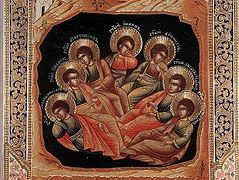
Dear brothers and sisters, today, August 4/17, we prayerfully celebrate the memory of the Seven Holy Youths (or Sleepers) who lived in Ephesus. These were seven young soldiers for whom living meant Christ and dying meant gain (cf. Phil. 1:21). The youths did not renounce their faith in God, for which they were wonderously glorified in the memory of the Church. Maximilian, Iamblichus, Martinian, John, Dionysius, Exakustodianus and Antoninus—such are their names.
They lived in the third century A.D. St. Maximilian was a son of the governor of the city of Ephesus (in modern terms, a mayor’s son). The other six were also of noble birth, the children of respected and distinguished families of this city. Their prospects for career growth and a comfortable life were plain to see, but unlike the so-called “gilded youth”, who existed back then, still exist, and will exist after us, these people came to know the truth, came to know God, renounced everything earthly and superficial, and made their choice in favor of God. With all their hearts and with all their minds they strove to the truth, to the light.
And so the Roman emperor Decius, who ruled for only two years (from 249 to 251), went down in history as a man who wished to restore pagan cults, to restore that system of religious worldview that was already fading into oblivion, giving way to the true faith—the faith of Christ. And on arriving in the city of Ephesus, he commanded that all the inhabitants of this city offer sacrifices to the pagan gods, and those who refused to do so were, by his order, to be executed, including these Seven Youths whom we commemorate today. But their noble origin prevented this plan from being realized. Why? Because one of them was the city governor’s son, and the other six were children from famous and respected families. Therefore, they decided to force them to renounce Christ and make pagan sacrifices. And how? Through psychological pressure. They were soldiers; they were stripped of all the attributes indicating their military service and their belonging to the army, and were disgraced in public.
After that, the Seven Youths left the city of Ephesus, took refuge in a cave near this city and waited for the martyr’s crown, since renouncing the True God was not in their plans. That went against their deep convictions and their faith; they understood that sooner or later everything would end and death would come to them. This was reported to the emperor, and the pagans decided to put them to death in an exquisite and cruel manner: to immure them inside the very cave where they had found shelter, so that they would not die immediately, but gradually—from hunger, thirst and a lack of oxygen, which would run out in that cave over time.
But God is not mocked (Gal. 6:7), and He does not forsake His righteous ones. There are such words in the Psalter: For the rod of the wicked shall not rest upon the lot of the righteous; lest the righteous put forth their hands unto iniquity (Ps. 124:3). So it was in this story. These Seven Holy Youths fell into a deep and sound sleep; they did not die, but rather fell asleep, and they told this story themselves almost two centuries after they were sealed in this cave. How did it come to pass?
Life went on, one generation replaced another, and that piece of land that used to be ownerless suddenly found its owner, who decided to build something on it. And lo and behold, there was a sealed cave there! He ordered the workers to clear its entrance. The first thing that surprised the builders was that someone had placed some tablets into the masonry, on which were written the names of those trapped in this cave, and an indication that they were martyrs—martyrs for the faith. But to the even greater astonishment of the builders, the Seven Youths came out of the cave alive!
And it was decided, as Holy Tradition has it, to send the youngest one to the city so that he could buy some bread. If you remember, the Lord Himself ate food after His Resurrection. It was the same here. And when the youngest came to the city to buy bread, he held out a gold coin from the time of Emperor Decius.
 A trial began, and the Seven Youths were brought to court and charged with finding ancient treasure, hiding it, and using money that had been prohibited from circulation. But when the builders arrived and the matter was sorted out, it became clear that this was an amazing miracle of God.
And why did it happen at that exact moment? Paganism had already faded into the background, but certain heretical views emerged among people who began to trouble Christians, arguing that the laws of nature do not imply a universal resurrection. “How can flesh that has decayed into elementary particles ever rise again, and how can it be restored? It’s impossible.” Yet these Seven Youths demonstrated that the laws of this created world can be overruled by the One Who created these laws. Therefore, if the Lord has said that there will be a universal resurrection, then it will take place, regardless of fundamental science opposing it and claiming that such a thing is impossible.
The relics of these saints of God, who passed away shortly after this miracle, are believed to have been taken by Crusaders from Ephesus to Europe during the Crusades, namely to France where they now rest for the veneration of the faithful.
What can this story teach us? It convinces us of the omnipotence of God’s power provides an example of steadfastness in faith in God, and instills hope for a reward for a Christian life.
I would also like to share my personal feelings and thoughts that arose after reading the story of these saints of God.

Firstly, this earthly life is given for us to prepare for eternal life. Some depart from this earthly life early, and others late. Some die early, having reached the peak of their perfection; when looking at someone’s life we see an utter scoundrel who could only sink lower and never rise higher. And sometimes sinners live very long lives, because the Lord waits for their repentance, which can be offered to God and to those people whom they have hurt; but they may miss this opportunity and die unrepentant. Sometimes our passing can be a kind of example and lesson for those who witness it—and today’s miracle is such a lesson, including for us.
And secondly, the Lord knows how to be grateful. God’s gratitude lies in the fact that these Seven Youths did not die an agonizing death to which the pagans had condemned them. Moreover, they glorified both their martyrdom and, of course, the Lord our God.
Unfortunately, unlike God, we increasingly substitute gratitude with the mere recognition of another person’s merit before us. At the same time, this merit brings no obligations. We can say that it is pleasant for us, that something resonates within us, that we value this person, the words he says, his actions; and we respect that person for his big heart. But gratitude always presupposes a response, a return reaction. And first of all, this response should be our heartfelt warmth. When this heartfelt warmth is absent, we enter the sphere of, as people sometimes say now, commodity-money relations: “service for service”, “you scratch my back and I’ll scratch yours.” But there is not even a whiff of Christianity here. And unfortunately, we really lack this gratitude in our lives.
And let us turn to the Lord our God and Savior, let us turn to those Seven Youths whose memory we celebrate today, that the Lord may open our eyes to our true selves, that we may know how grateful we are, and, having realized it, ask God for this special ability to be truly grateful. And I assure you, this gratitude will make not only the people to whom we show this gratitude happy, but ourselves as well. Happy feast to you all! Amen.