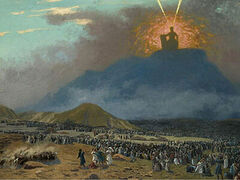
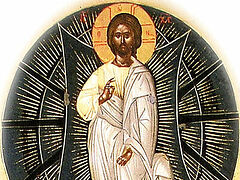
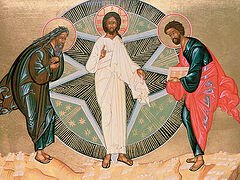
Karl Heinrich Bloch (1834-1890).The Transfiguration of Christ
The well-known Russian bishop and theologian of the twentieth century, Hieromartyr Hilarion Troitsky, states in one of his essays that Western Christian civilization sets progress as its goal, whereas Eastern Christian civilization sets spiritual transformation. Another contemporary Orthodox theologian observes that Western civilization enriches the world with scientific achievements, while Eastern civilization enriches it with saints. Both, in fact, are speaking of the same thing: for Orthodoxy, the fundamental goal is the deification of man, his transformation in Christ, and not anything of this world.
Today, as we celebrate the Feast of the Transfiguration of the Lord, we should remind ourselves that the events of Holy Scripture are not merely historical in character, but also convey a concrete message and instruction for the spiritual transformation of each one of us in every age. As the Gospel passage appointed for today’s feast bears witness, Christ leads three of His disciples up a high mountain and reveals His glory to them through the shining of uncreated light. The Evangelist, therefore, primarily bears witness to the glory of Christ’s divinity, but indirectly also gives us guidance for our own spiritual transformation in the Light of Christ.
The “high mountain” mentioned here is, according to the Tradition of the Church, Mount Tabor. Christ used to pray in deserted and elevated places—and now, too, He chooses a height from which to reveal Himself to His disciples in His glory. Likewise, for our own striving toward the knowledge of God, it is necessary to raise our minds to a spiritual height, above the fleeting and vain thoughts of this world. Let us also remember that the two great prophets, Elias and Moses, who appeared before Christ on Tabor, likewise received the experience of the knowledge of God on high mountain—on the summit of Sinai (cf. Exod. 19:3; 24:12; 1 Kings 19:11-13).
Going to the summit of any mountain necessarily involves the effort of climbing; in the spiritual sense, likewise, one who wishes to attain the experience of the knowledge of God, that is, to reach the summit of the spiritual mountain, must also undertake active ascetic effort, involving the arduous and continual removal of the passions. The three disciples of Christ—Peter, John, and James—who were found worthy to behold Christ’s Transfiguration on Tabor, are also presented in the Tradition of the Orthodox Church as symbols of three virtues: faith, love, and hope. This clearly tells us which virtues a person must abound in if he is to be found worthy of true knowledge of God and of abiding in the Light of Christ.
Someone may perhaps ask: Why is it important to attain noetic knowledge of God at all? Is it not simply enough to be a good person? The Apostle Peter gives us an indirect answer to this question when, in today’s event, he says: “Lord, it is good for us to be here” (Matt. 17:4). Peter feels that, at the moment when he beholds the uncreated light, he has experienced the Kingdom of God toward which every soul strives. Therefore, it is not enough merely to be a good person—that is moralism and pietism—but it is necessary to become a Christ-like person, a person filled with grace who participates in the glory of God’s light already here and now, insofar as this is possible for us in this body. Our goal is Christ and eternal dwelling in His light—anything less than this is unworthy of the Christian name and calling.
In the Middle Ages, there was a very important theological controversy concerning the event of the Transfiguration of the Lord, in which Saint Gregory Palamas held a prominent place as a defender of the true faith. The controversy concerned the question of whether the Taboric light was created or uncreated. Saint Gregory defended the teaching of Holy Tradition concerning the uncreated light of God, thereby defending the Orthodox doctrine that we can partake of the divine life and that God is not infinitely far from us. Although the divine essence is beyond participation, Saint Gregory clearly demonstrated that we can partake of the uncreated energies, that is, that we can participate in the glory of God, as was revealed on Tabor. In this controversy, Palamas was in fact defending the ancient experience of a living communion with the Holy Trinity—an experience that he himself had personally known, unlike the philosophical rationalists with whom he engaged in debate.
 Photo: fotoload.ru
The Kingdom of God is none other than the Lord Christ Himself. Without Him, our soul cannot find rest, either in this age or in the age to come. Therefore, we must give our utmost to make room for Christ in our hearts (cf. Ps. 131:4–5), so that the light of Christ may enter into us and drive out the darkness of ignorance and the passions. Look now, dear brothers and sisters, at the interior of our Church of the Ascension of the Lord [in Zarkovo, Belgrade]. How wonderfully it has been transformed after two years of fresco painting! Those who came here in previous years remember what it looked like, whereas now these frescoes have caused the church to shine with a new light. This is a true image of what our task is with regard to our soul: not merely to remove the soot from it, but to “paint” the image of Christ within ourselves through the virtues and to be ourselves transformed in His Light.
May we be found worthy of attaining this goal through the prayers of Saint Gregory Palamas and of all the holy Hesychasts. Amen.
Liturgical Homily Delivered in 2013 and published in Serbian in the book Praznicne besede (Festal Homilies).