In the name of the Father, and of the Son, and of the Holy Spirit!
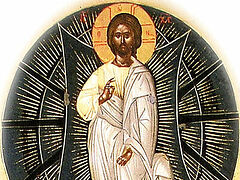
During the Transfiguration, two Old Testament prophets—Moses and Elias—stood next to Christ, conversing with Him. On the pages of the Books written by Moses and in his life we can see some parallels with the event on Mt. Tabor. In general, in the Old Testament we often find images that in the New Testament enter into the reality of the spiritual life of the new man, the Christian.
After leaving the land of Egypt, Moses and his people followed God through the wilderness. At night God showed them the way by means of a column of fire and at daytime by means of a column of cloud. And on Mt. Tabor, the Lord appeared in uncreated light and with the same cloud that reflects the radiant Divine presence. God the Father said from the cloud: Hear ye Him (Mt. 17:5)—that is, follow Christ.
Moses ascended the mountain to meet God, and the disciples with Christ ascended Mt. Tabor. The mountain is a Biblical symbol of meeting with God, a place of Divine revelation.
On icons of the Transfiguration, the Prophet Moses is depicted with the Tablets of the Covenant. After God had given him the Ten Commandments and Moses’ mind was cleansed by Divine laws, he was shown the image of the Temple, the Tabernacle, a likeness of which he was to make on earth (cf. Heb. 8:5). The disciples were prepared to some extent by the words of Christ and His teaching, and on Mt. Tabor they saw the Temple of the Body of Christ in Its glory.
Moses overcame his fear and climbed up the mountain that no other living being could approach. Leaving the world behind him, he entered the Divine darkness—that is, the unknowable, showing us that anyone who wants to be with God must abandon everything visible, abandon the world with its passions and attachments and ascend, as if up a mountain peak, the invisible and unknowable, like the disciples of Christ who entered the cloud.
In Exodus, The Lord said unto Moses, Lo, I come unto thee in a thick cloud, that the people may hear when I speak with thee, and believe thee for ever (Exod. 19:9). Similarly, on Mt. Tabor, God the Father proclaimed in the cloud: This is My beloved Son (Mt. 17:5), so that the disciples would hear that and be convinced of the Divinity of Christ.
 Jean-Leon Jerome. Moses on Mount Sinai. A nineteenth-century painting
Moses entered the Divine darkness, the Divine presence, which “surpasses every knowable understanding and imagination, since it is incomparable with anything knowable.”1 And on Mt. Tabor, the Apostle Peter did not know what to say, having no strength or ability to describe what he had contemplated, which was beyond human understanding and words.
Before his death, Moses ascended the mountain again and beheld from afar the Promised Land that God had prepared for Israel. And after Moses’ death, on Mt. Tabor, God once again showed him the gleam and threshold of the Heavenly Kingdom, which He promised to all mankind. God showed the threshold to eternal life, to which Christ became the door.
Being with God in the light, we participate in eternal life. The Holy Scriptures tell us that with natural changes, time did not spoil the beauty of Moses, did not darken the radiance of his eyes (cf. Deut. 34:7), and did not weaken the grace that illuminated his face.
According to the testimonies of people close to the saints who attained uncreated light of Mt. Tabor, we know what spiritual beauty they possessed. And they themselves were often seen in the radiance of uncreated light. This light descends to human nature, prepared by a virtuous life. Let us recall how St. Seraphim of Sarov shone during a conversation with the pious layman Nicholas Motovilov. When the saint asked him, “Why aren’t you looking at me?” Motovilov replied, “I can't look, father, because your eyes are flashing like lightning. Your face has become brighter than the sun, and my eyes ache with the pain!”2
On Mt. Tabor, Christ’s robes turned white like the light. Not like Moses, for the appearance of his flesh alone shone with splendor, and he covered his face with a veil; but the glory of Christ’s Divinity poured out from Him, so His garments shone as well.
Even before the exodus from Egypt, God appeared to Moses in uncreated light in the Burning Bush in the desert. But then the prophet, who had not yet grown spiritually (as we have not), like the Apostle Peter, was perplexed: “What could it be?”
So that this light might not be taken to be material, it did not shine by itself or from a blank space, but from an earthly bush that was on fire but did not burn up, eclipsing the sunlight with its radiance.
From the Burning Bush God asked Moses to take off His shoes in order to be able to approach Him. To take off your shoes is to abandon the mundane, something that hinders your contact with God. Prayer is a “holy place”, and when we begin it, we must leave everything behind, at least for the time of communion with God and the saints.
And on Mt. Tabor, Godhead appears in the “burning bush” of the human Body of Christ.
In the Transfiguration, the Lord showed us what we can be. He offers us the uncreated light of Godhead. But most of us don’t care about it. What we need from God is a family, a job, good health, housing, to close our loans, and so that our neighbors would stop talking loudly and making noise. But very seldom do we ask for spiritual things, for transformation, for light, and to be closer to God. But the solution to all our problems is precisely in these things. But seek ye first the kingdom of God, and His righteousness; and all these things shall be added unto you (Mt. 6:33). As St. Seraphim said to Motovilov, “Our trouble is that we don't seek this.”

Apostle John the Evangelist writes in the Gospel: And this is the condemnation, that light is come into the world, and men loved darkness rather than light, because their deeds were evil (Jn. 3:19). God offers us the light of Mt. Tabor and invites us to become like Him. If we strive for this light, if we work to acquire it, and if we put on this light, we will abide in it. And if we don't need it, then we will remain in our darkness both in this life and in the life to come. That is what the Judgment is all about—we condemn ourselves, we make our own choices.
Yes, it is necessary to work hard for the sake of transformation, and only those who make efforts will inherit the Heavenly Kingdom. In the same conversation about the goal of Christian life, St. Seraphim says: “Now it is up to us, my son, to add labors to labors in order to go from strength to strength, and to come to the measure of the fullness of Christ."
The event on Mt. Tabor is an example for us, an image of being with God. This is a new page in the book of life for each one of us, for those who love God, long for God and strive to live with Him. The Lord is calling us to the Kingdom of Light. If we want it, we should respond and work hard to the best of our ability. Amen.