History
The Appearance of the Light-Imprinted Image of the Most Holy Theotokos at the Russian St. Panteleimon Monastery on Mt. Athos
September 3, 2026, marks the 123th anniversary of the appearance of the Mother of God at St. Panteleimon Monastery on Mt. Athos. The commemoration of the Light-Imprinted Image was established by the monastery’s Council of Elders on the 100th anniversary of this miraculous event.
On July 27, 2013, at a session of the Holy Synod held at the Kiev Caves Lavra, a decision was made (Journal No. 97) to include in the calendar of the Russian Orthodox Church the commemoration of the appearance of the Light-Imprinted Image of the Most Holy Theotokos, which took place at the Russian St. Panteleimon Monastery on Mt. Athos in 1903.
History of the Event
On August 21/September 3, 1903, while alms were being distributed to impoverished monks at the Great Monastery Gates of St. Panteleimon Monastery, Monk Gabriel took a photograph. When he developed it, to his great astonishment he saw on the black-and-white photograph an image of the Mother of God humbly receiving a blessed piece of bread.
 Photograph of the miraculous appearance of the Mother of God
The monastery archives testify that from the end of the nineteenth to the beginning of the twentieth century, the Russian monks distributed alms to the needy every week. Each week, large and small ships carrying food and essential supplies arrived at the Athonite harbor from the two southern Russian ports of Odessa and Taganrog, where dependencies of St. Panteleimon Monastery were located. These provisions were intended for the 3,000 monks of St. Panteleimon Monastery and the 4,000 Russian-speaking brethren who lived the ascetic life in the various sketes, metochia, cells, and kalivas of the Holy Mountain.
A crowd of poor monks—siromakhi—and pious pilgrims would gather at the Great Gates of the monastery. Records have survived indicating that some 600–800 people received flat loaves of bread known as chereki from the hands of the monks. On the appointed days, however, people who did no work, indulged in drunkenness, and submitted to no authority also began coming to the monastery gates for alms. On August 14, 1903, the monastery received a letter from the Koinot expressing dissatisfaction with what it regarded as the “useless” and “harmful” distribution of alms. The supreme sacred administration of the Holy Mountain demanded that the authorities of St. Panteleimon Monastery discontinue the distribution of alms and find a more appropriate form of assistance that would give no occasion for scandal. The letter stated in particular: “Alms given according to the Gospel are pleasing and acceptable to God only when they are given with discernment—to people who are worthy of alms and truly in need of them. But when they are given to people who unworthily present themselves as beggars, who count solely upon these visits and remain here for this very purpose, then such almsgiving becomes a cause of harm.”
 An enlarged copy of the photograph with the image
of the Mother of God is now displayed at the gates
of the Russian Monastery of St. Panteleimon
on the Holy Mountain
An enlarged copy of the photograph with the image
of the Mother of God is now displayed at the gates
of the Russian Monastery of St. Panteleimon
on the Holy Mountain
On August 21, 1903, exactly one week after receiving the letter from the Koinot, the monks of the Russian monastery decided to observe the tradition one last time and distribute alms, after which they would read the contents of the Koinot’s letter to those present. By that time, as usual, hundreds of needy people and pilgrims had already gathered at the main gate awaiting alms. During the distribution of the chereki, Hieromonk Gabriel took a photograph in which the image of the Mother of God appeared, humbly receiving the blessed alms together with the other supplicants. Upon seeing the extraordinary photograph, the monks immediately recalled the account of Monk Sebastian, who had heard from the gatekeepers that “a certain hermit had several times seen a woman during the distribution of the chereki.” Some of the ascetics, who had likewise seen the Wondrous Maiden with their own eyes among the poor monks and those seeking alms, had wanted to tell the gatekeeper about it; yet on the very day the photograph was taken, no one saw Her.
The Mother of God had unfailingly cared for those who labored in asceticism in Her earthly domain. At the command of the Queen of Heaven, the monastery continued to provide for the needs of the poor brethren: after the brethren’s meals, meals were served at the monastery for the poor, while the cellarer distributed food to them from the monastery’s stores.
History of the Veneration
In the late 1980s, with the beginning of the restoration of the monastery, copies of the miraculous photograph were made, accompanied by a brief account of the event, and distributed among pilgrims. For a new generation of Russian people who had suffered under atheistic propaganda, the photograph served as a confirmation of the reality of the spiritual world, as pilgrims who visited the monastery repeatedly testified.
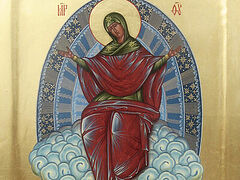
The commemoration of the Light-Imprinted Image was established by the monastery’s Council of Elders in 2003, with the blessing of the abbot, Archimandrite Jeremiah, on the 100th anniversary of the appearance, in order to perpetuate the memory of the miraculous event liturgically. The name “Light-Imprinted Image” arose during the composition of the liturgical service (the word “light-imprinting” is a literal translation of the Greek word “photography”). At the same time, an iconographic depiction of the appearance was created for liturgical use. On the basis of chronicle records and oral recollections that had been preserved, the historical circumstances of the event were reconstructed.
The text of the service was approved by the Synodal Liturgical Commission.
In 2011, a commemorative chapel was erected on the site of the appearance of the Mother of God, and water from a spring was channeled into it for the celebration of services for the blessing of water. Cases have been recorded of relief from bodily and spiritual afflictions through the use of water from this spring.
That same year, a church-paraclis dedicated to the Light-Imprinted Icon was constructed and consecrated on the ground floor of the brethren’s Protection of the Mother of God building.
In 2011, a depiction of the historic photograph on a marble plaque was installed at the Monastery of the Athonite Icon of the Mother of God in the village of Chopovichi, Zhytomyr Region.
A similar marble plaque bearing the photographic image was installed in 2012 at the parish of the Feodorovsky Cathedral in Tsarskoye Selo.
On July 27, 2013, at a regular session of the Holy Synod held at the Kiev Caves Lavra, a decision was made (Journal No. 97) to include in the calendar of the Russian Orthodox Church the commemoration of the appearance of the Light-Imprinted Image of the Most Holy Theotokos, which took place at the Russian St. Panteleimon Monastery on Mt. Athos in 1903.