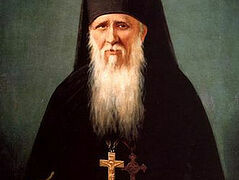
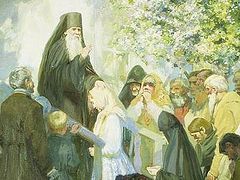
This icon reflects the deep and childlike faith in the Mother of God of St. Ambrose of Optina, a great Russian saint who lived in the nineteenth century and was canonized by the Russian Orthodox Church in 1988. Elder Ambrose did not miss a single feast of the Most Holy Theotokos, holding Vigils in front of an icon of the Mother of God in his cell.
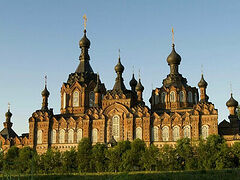
The history of the creation of the Icon, the “Multiplier of Wheat”, is connected with the final years of the life of Elder Ambrose of Optina. The saint fell asleep in the Lord on October 10/23, 1891, at the Shamordino Convent in honor of the Kazan Icon of the Mother of God founded by him close to the Optina Monastery.
The idea of painting the Icon, the “Multiplier of Wheat”, appeared when Elder Ambrose stayed for a long time at the Shamordino Convent, which he had organized for destitute women and girls. Contemplating a picturesque valley with wheat fields and distant villages from the high hill on which the convent was built, St. Ambrose prayed to the Mother of God for protection and intercession. The elder made a sketch of an icon, which was based on his beloved Shamordino landscape with an image of the Mother of God above it.
St. Ambrose wanted to create an icon of the Theotokos through which She would help all the destitute and hungry, would protect peasants and give hope for the harvest, which was especially relevant in 1890 when famine struck the Kaluga province where both Optina and Shamordino were situated.
In the early summer of 1889, Elder Ambrose commissioned a special copy of the icon of All Saints from the Convent of the Mother of God and All Saints in Bolkhov (now a town in the Orel region). The copy was ready by February 1890 and delivered to the elder at the Optina Monastery’s skete.
Documented testimony concerning the reason for painting the icon and belongs to Hieromonk Erast (Vytropsky; 1829–1913), Elder Ambrose’s secretary, who later compiled the Historical Description of the Optina Monastery in Kozelsk and St. John the Baptist’s Skete (1902). He gave the following reason for painting the icon: “Seeing wheat fields in Russia’s fertile black soil regions for the first time in his life, a resident of a northern province was struck by the sight of a vast, undulating space like the sea, filled with innumerable reaped sheaves of wheat.1
 The Icon of the Mother of God, the “Multiplier of Wheat”, painted with the blessing of Fr. Ambrose “The question arose in his mind: How did the national religious consciousness express its gratitude for the abundance of harvest to Divine Providence and especially to the Patroness of all Christians—the Queen of Heaven? There is the icon of the Protecting Veil of the Theotokos, but it is of Byzantine origin and its idea is the deliverance from evil. Meanwhile, every Russian peasant woman constantly prays for her crop to grow fast and strong. In October 1889, he came to the elder with these thoughts, but the elder forestalled him with his question: ‘Many ask me for an icon of the Mother of God for a blessing. Which one do you think should be painted—of the Holy Protection or another one?’ After telling the elder his travel impressions, the northerner reminded him that in Russia, a predominantly agricultural country, there was no icon expressing the blessing of the Mother of God for the harvest of bread. ‘True, there is no such icon,’ said the elder. ‘We could depict the Mother of God in the clouds, blessing sheaves in the fields. And this icon could be given the name, the “Multiplier of Wheat”.’”2
The icon, brought from the convent in Bolkhov, depicted the Sovereign Lady Theotokos sitting on clouds, with a reaped field below. Elder Ambrose gave the new icon the significant name the “Multiplier of Wheat”, indicating that the Mother of God is the main Helper of people in their efforts to obtain daily bread. The elder himself prayed in front of this icon and taught his spiritual daughters, the nuns of the community of the future Shamordino Convent of the Kazan Icon, to pray in front of it. In the final year of his life, he distributed and sent out lithographs of the Icon, the “Multiplier of Wheat”, to the laypeople who loved him.
Before St. Ambrose’s death, the sisters in his cell sang an akathist with a special refrain composed by the holy elder: “Rejoice, O Gracious One, the Lord is with thee! Grant even to us unworthy ones the dew of thy grace and show thy mercy!”3
Fr. Ambrose blessed the faithful to commemorate the icon on October 15, the very day when the elder, who died on October 10, was buried. With this coincidence it was as if he had pointed out to his spiritual children Who he had entrusted them to.
The first miracle that was performed through this icon happened when famine broke out in Russia in 1891 and the areas around the Kaluga province were suffering from poor harvest, while there was an abundant harvest of wheat around Kaluga and in the Shamordino fields.
In the summer of 1892, already after the elder’s repose, Ivan Fyodorovich Cherepanov sent the Icon, the “Multiplier of Wheat”, to the new community of nuns in Pyatnitskoye of the Voronezh province.4 There was a drought and a threat of famine there. When a prayer service was celebrated in front of the icon, it soon began to rain, and the fields of the convent and the surrounding area recovered.
An Unconventional Iconography
In a short span of time, the icon, the “Multiplier of Wheat”, began to be venerated by the faithful. Its fame was becoming nationwide, and information about it was appearing in newspapers and magazines.
After Fr. Ambrose’s repose, the Consistory paid attention to this fact. It was concerned that “the icon is being treated as if it were a newly revealed or wonderworking one.”5
In 1892, the Consistory ordered that “this icon be given to the cathedral and be kept in its sacristy, which order was fulfilled.” According to the decision of the Synod of May 30–July 30, 1892, “the distribution of images of the Mother of God, with a name that is unknown in the Orthodox Church, is prohibited.”6
 In early 1896, Bishop Seraphim of Vyatka and Slobodskoy (Serafimov; 1836–1902) again appealed to the Holy Synod with a request for instructions on the veneration of the icon, the “Multiplier of Wheat”. In the decision of the Holy Synod dated February 29, 1896, No. 671, the previously adopted decision of 1892 was confirmed, the censor, who had allowed the icon to be printed in the Odessa chromolithography firm of E. Fesenko, was reprimanded, and the Minister of Internal Affairs Ivan Goremykin was informed about those decisions. Based on this, on June 22, 1896, Goremykin issued Decree No. 3990 “On the prohibition of the painting of images of the Mother of God, the ‘Multiplier of Wheat’, in printing houses, chromolithography shops and other establishments in the future.”
The Holy Synod’s prohibition to venerate the icon blessed by Elder Ambrose himself was due to the unconventional iconography and name of this image of the Mother of God, as well as the ambiguous attitude of the Church authorities towards the personality of Elder Ambrose. The local diocesan authorities did not understand the essence of eldership and therefore were suspicious of Fr. Ambrose.
However, this decision of the Holy Synod to prevent “inappropriate and undesirable talk among the people” can partly be understood if we recall that even the Orthodox theologian, philosopher and art critic Fr. Pavel Florensky wrote: “After all, what is this ‘Multiplier of Wheat’, if not a vision of the Mother of God in the image and canonical form of Demeter—the ‘mother of cereal grains’?”7
However, despite the prohibition by the Holy Synod, copies of the Icon, the “Multiplier of Wheat”, continued to spread throughout Russia; both pictorial copies and lithographs of this icon were made.
Love for and confidence in Elder Ambrose, and boundless faith in the intercession of the Mother of God made this icon truly national in Russia, a predominantly agrarian country.
But the spiritual meaning of the Icon of the Mother of God, the “Multiplier of Wheat”, is much broader: not only feeding those who are hungry physically, but, most importantly, the nourishment of all those who thirst for spiritual food. Our principal prayer, “Our Father”, given to us by the Lord Himself—contains the words: “Give us this day our daily bread.” Here we must remember that, in addition to earthly food, bread is a symbol of life. The living Bread, the Heavenly and All-Holy Body of the Living Word. This is our daily bread, because it strengthens and sanctifies soul and body, and Except ye eat the flesh of the Son of man…, ye have no life in you. Whoso eateth My flesh…, hath eternal life (Jn. 6:53-54). And Christ used this symbol when He told the Jews about Himself: Moses gave you not that bread from Heaven; but My Father giveth you the true bread from Heaven. For the bread of God is he which cometh down from Heaven, and giveth life unto the world… I am the bread of life: he that cometh to Me shall never hunger… I am that bread of life... I am the living bread which came down from Heaven: if any man eat of this bread, he shall live for ever (Jn. 6: 32, 33, 35, 48, 51).

Glory to God: time sorted everything out. Almost 100 years later, the Russian Church canonized Elder Ambrose in 1988 (the millennium of the Baptism of Russia), and in November 1993, His Holiness Patriarch Alexei II (Ridiger; 1929–2008) decided to include the feast of the Icon of the Mother of God, the “Multiplier of Wheat”, in the calendar of the Russian Orthodox Church.
St. Ambrose’s holy relics rest at the Cathedral of the Entry of the Mother of God into the Temple of the Optina Monastery—in its north aisle, dedicated to him. The Icon of the Mother of God, the “Multiplier of Wheat”, is beside the shrine with his relics.
And at the Church of the Vladimir Icon of the Optina Monastery, where the relics of seven Optina Elders rest, there is an icon depicting St. Ambrose of Optina against the background of the Optina Monastery, prayerfully stretching his arms skyward towards the image of the Mother of God, the “Multiplier of Wheat.”
To Console the Faithful
The destiny of Fr. Ambrose’s famous icon, which was taken away from the Shamordino Convent in 1892 on the instructions of the Synod, is sadly unknown. Its lithographic image, made from a pictorial image, was published in Elder Ambrose’s biography, compiled by Fr. Agapit (Belovidov; 1842–1922) and published in 1900. It gives a true idea of the original icon that St. Ambrose used to keep in his cell.
There was information going back to the message of Bishop Anatoly (Kuznetsov) of Ufa and Sterlitamak (the future Archbishop of Kerch, Vicar of the Diocese of Sourozh; 1930–2024) in January 1988 in Bergamo, Italy that the icon in question was supposedly located in the Lithuanian village of Michnovo (Mikniškės) near Vilnius. However, researchers V. V. Kashirina and G. P. Cherkasova write that “in the Church of the Icon, ‘Joy of All Who Sorrow’, in Michnovo, around eighteen miles away from Vilnius, there is an Icon of the Mother of God, the ‘Multiplier of Wheat’, but neither the history of the church nor its icon’s iconography confirm this opinion. There is no doubt that it is not Elder Ambrose’s private icon, just as there is no doubt that the blessing of St. Nectarius of Optina, by the grace of God, preserved the community that had formed around the church.”8
Indeed, the Church of the Icon, “Joy of All Who Sorrow”, belongs to a Christian community with an amazing history. The community, which was founded in 1921, has survived to this day, being an example of a genuinely Christian attitude to life and work. The community was formed in the ancient estate of the Koretsky noble family, around their house church in honor of the Icon, “Joy of All Who Sorrow”, built in 1915–1917.
After the death of the head of the family, Nikolai Osipovich Koretsky, his widow Anastasia Dementievna, together with her children, visited the Optina Monastery. Elder Nectarius (1853–1928) blessed the construction of a church in the graveyard over the family’s burial vault, which Anastasia Dementievna had done by the summer of 1915. At the same time, she commissioned an Icon, the “Multiplier of Wheat”, from the nuns of the Shamordino Convent, since the Lithuanian landowner had been so stunned by the icon. To this day, this icon can be found in a glass case to the left of the iconostasis, being the main relic of the Church of the Icon, “Joy of All Who Sorrow”.
In February 1921, Archpriest Pontius (Rupyshev; 1877–1939) came to the Koretsky estate at the invitation of Anastasia Dementievna to give spiritual guidance to her three daughters, and for many years he became the spiritual father of the community. Fr. Pontius was a spiritual child of St. John of Kronstadt. The wise spiritual guidance of Fr. Pontius allowed the community to survive the turbulent twentieth century, when, in March 1922, the Vilna region became part of Poland, then of the USSR, and during the Second World War there was a clash of different political interests in these parts. In the post-war years, the Soviet Government tried to close the community. But the community survived, and since Lithuania became independet in 1990, the Michnovo Agricultural Christian community acquired legal rights. Part of the land that once belonged to the Koretsky family was given to the community members. This land has remained common land—it is plowed and seeded, and the field feeds its members.9
 The Icon of the Mother of God, the “Multiplier of Wheat” at the Church of the Icon, “Joy of All Who Sorrow”, in Michnovo, 1912–1915 An interesting observation was shared by the art historians V. V. Kashirina and G. P. Cherkasova. They write that over time, the iconography of the Icon of the Mother of God, the “Multiplier of Wheat”, underwent changes: “Each iconographer saw both the wheat field and the sky in his own way. A striking example of this is the icon from the Church of the Icon, ‘Joy of All Who Sorrow’, in Michnovo. The icon, painted in Shamordino a few years before the 1917 Revolution, conveys a thunderstorm premonition on earth: a dark leaden cloud hanging over a golden wheat field, dark trees, and a church, barely visible in the distance... And above all this is a serene, blessing image of the Mother of God. What an acute premonition of a thunderstorm that will sweep over the golden field!”10
As was stated above, contemporary icons of the Theotokos, the “Multiplier of Wheat”, are very different from those that were painted in the early twentieth century.
The Icon of the Mother of God, the “Multiplier of Wheat”, in the iconostasis of St. Ambrose’s Church of the revived Shamordino Convent, is notable for a special iconography. It was painted by the sisters of the convent in 1996. We see the entrance to a rock cave, and there are three angels in a ripened wheat field carefully gathering ears of wheat into sheaves and bringing them to the feet of the Mother of God. Perhaps the contemporary iconographer has slightly revealed to us the future fate of the Church of Christ on earth, the preparation for the Liturgy of the end times? Two so different icons were painted at the same convent: the pre-revolutionary one, where there was only a premonition of a thunderstorm; and the modern one, in which an eschatological sense of time is shown so clearly…
Some other contemporary icons stand out as well: for example, at the Optina Monastery, at the Lesna Convent in Provemont (France), and at the Church of the Icon of the Mother of God, the “Multiplier of Wheat”, in the town of Dolgoprudny near Moscow.
Most contemporary icons of this depiction stand out in that the Mother of God, sitting on a cloud with Her arms raised in prayer over a wheat field, is usually surrounded by an oval mandorla, shone through with rays and adorned with stars on the outer edge.
To be continued…