Photo: saratov-eparhia.ru
An incorrect attitude toward Baptism
During catechetical discussions, one often encounters a misconception about the Sacrament of Baptism, and therefore about the Church, faith, and the Christian life. After all, Baptism is the seed from which a person’s Christianity either grows or does not grow.
Why does it not grow? Because people, having accepted the seed of baptismal grace, do not cooperate with it. Why do they not cooperate? Because they do not want to. Why do they not want to? Because they initially approach Baptism with a false, un‑Christian motivation.
Many people expect Baptism to provide help and protection; they view it either as a guarantee of safety and well‑being, or as a means of belonging to their family, their people, or as both. “Now I am baptized, just like most people around me.” This thought makes one feel better. Here, Baptism is a means of organizing earthly life, completely devoid of its heavenly, salvific purpose.
When they come to Baptism, many people do not even think about being saved from sin, decay, death, and bondage to the devil
When coming to Baptism, many people do not even think about salvation from sin, decay, death, or bondage to the devil. Baptism is not associated with any of this in their minds. They come to be baptized because they want to be baptized like their parents, their grandparents, their ancestors. Baptism here is a tribute to the memory of their ancestors. “They were Orthodox, and I must be Orthodox,” the person thinks. When you ask, “What does it mean to be Orthodox?”, the answer is: “To be baptized in the Orthodox Church.” The circle is complete. This is more than enough for them. Any further action to improve oneself or one’s soul is simply not considered.
Therefore, at the beginning of the first conversation, the catechizer must identify the true motivation of those being catechized, so that he can then strive to reveal to them the true meaning of Baptism, its purpose, and the full extent of the responsibility that the person being baptized and the godparents assume.
The danger of a pagan approach
If Baptism is viewed as a means of producing ready‑made Christians, then everything begins with it and ends with it. After it, one can safely call oneself a baptized Christian and do nothing. Such people are like a newborn who has stopped developing and growing because they have decided that being born is enough to become a fully formed person. But Baptism is a spiritual birth that implies further spiritual growth.
As newborn babes, desire the sincere milk of the word, that ye may grow thereby (1 Pet. 2:2).
Or they are like a soldier who has taken an oath and left the battlefield. On earth, this is called desertion and is punished very severely. In Baptism, a person takes an oath of allegiance to Christ and becomes His warrior in the spiritual battle. If, after taking the oath, he shirks fulfilling God’s commandments, he becomes a traitor to Christ, risking not only his temporal life but also his eternal life.
No man, having put his hand to the plough, and looking back, is fit for the Kingdom of God. (Luke 9:62).
The true meaning: union with Christ
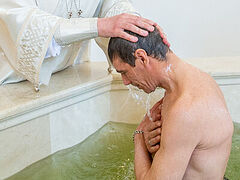
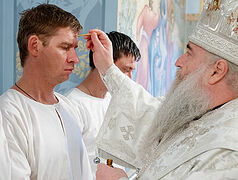
Baptism is the sacrament of entering the Church as a community of disciples and followers of Christ. In this sacrament, a person voluntarily renounces evil, satan, and all his works, and takes an oath of allegiance to Christ, accepting faith in Him as his Lord, Savior, and Teacher.
If thou shalt confess with thy mouth the Lord Jesus, and shalt believe in thine heart that God hath raised him from the dead, thou shalt be saved (Rom. 10:9).
In Baptism, a person does not simply receive a “set of benefits” or become a member of a religious organization—he personally and experientially becomes united with Christ Himself
In response to this, the Church baptizes him in the name of the Father, the Son, and the Holy Spirit and anoints him with chrism, thereby cleansing him from the defilement of sin, imparting to him a new, spiritual, eternal, grace‑filled life, and making him a Christian. But here it is important to understand the most essential thing: in Baptism, a person does not simply receive a “set of benefits” or become a member of a religious organization—he personally and experientially becomes united with Christ Himself. The Apostle Paul speaks about this with utmost clarity:
I am crucified with Christ: nevertheless I live; yet not I, but Christ liveth in me (Gal. 2:20).
Baptism is a meeting, not a negotiation
Baptism is a meeting. Not a ritual, not a magical act, but a meeting between a living person and the living God. Therefore, it is impossible to treat it in a consumerist manner, according to the pagan principle: “You give to me, I give to you.” A pagan comes to his idol with a clear, pragmatic request: I make a sacrifice, I get a harvest; I perform a ritual, I gain protection. But such bargaining is impossible with Christ. If the attitude is consumerist, the meeting will not take place, and Baptism will not achieve its purpose. The grace that will be communicated through him will not be accepted in a person’s heart, because it is already occupied by false expectations and sentiments alien to Christ—the very pagan attitude that turns the Sacrament into magic.
Baptism is not performed so that a person will have everything “going well for him” in the worldly sense later on. It is a sacred rite so that, together with Christ, endowed with His grace and using all the saving means of the Church, he may take up and bear his cross, overcoming temptations and fulfilling the commandments.
Know ye not, that so many of us as were baptized into Jesus Christ were baptized into his death? Therefore we are buried with Him by baptism into death: that like as Christ was raised up from the dead by the glory of the Father, even so we also should walk in newness of life. (Rom. 6:3–4).
Life in Christ: the Path of Crucifixion and Resurrection
A person’s life is a path of bearing his cross, following the Crucified Christ with one’s own cross along the path He has already walked—to Golgotha and to the Resurrection.
Whosoever will come after Me, let him deny himself, and take up his cross, and follow Me. (Mark 8:34).
There is no need to indulge in illusions about Baptism among worldly, non‑churchgoing people. We need to explain to them that their worldly expectations regarding Baptism are false, and to open their eyes to the true state of affairs. Baptism does not deliver from suffering. It gives the strength to overcome it, to endure in the image and likeness of Christ.
We must through much tribulation enter into the Kingdom of God (Acts 14:22).
We are baptized in order to enter the Church, into the community of faithful disciples, and to follow Him together—: first to Golgotha, then to the Resurrection and Ascension. In order to seek first and foremost the Kingdom of God, disregarding the good things of this vain world, which lies in evil.
But seek ye first the Kingdom of God, and His righteousness; and all these things shall be added unto you (Matthew 6:33).
The sacrament of Baptism is not a magical rite of “protection.” It is entering into battle under the banner of Christ
Thus, the sacrament of Baptism is not a magical rite of “protection” and not a formal act of registering in the “community of the baptized.” It is the death of the old man and the birth of the new;, it is entering into battle under the banner of Christ, which requires from a person a struggle of faith and loyalty to the end. As the Apostle Paul says: For ye are bought with a price (1 Cor. 6:20), and this price is the Blood of Christ, which obliges us to an active, sacrificial life in Him.