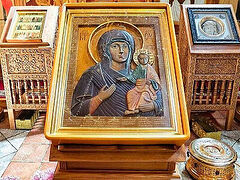
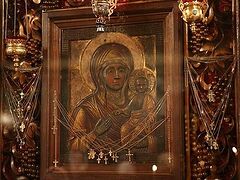
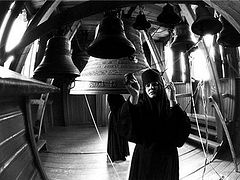
St. Parasekva of Christ the Savior-Blachernae Convent (center)
The prayer of Mother Paraskeva: “O Lord, grant me purity, simplicity, humility of heart, and teach me to do Thy will.”
The Lord rewarded St. Paraskeva (Matieshina) of Christ the Savior-Blachernae Convent (1888–1953) with many rich gifts, faith, and fervent love for God and neighbor, in accordance with the commandment of Christ: By this shall all men know that ye are My disciples, if ye have love one to another (Jn. 13:35). She was also known for the active fulfillment of God’s will, always and in all her actions, desires, thoughts, and labors.
Our dear and beloved Mother Paraskeva was born on October 28, 1888, in the village of Peschanoe, Kamenets-Podolsky County, Podolia Governorate, in the peasant family of Theodore and Matrona Matieshin. The family was religious, pious, and patriarchal. “Our every evening was spent reading Holy Scripture or the lives of the saints, and we couldn’t even imagine doing anything else,” St. Paraskeva recalls. She was three when her parents started habituating her to fasting. Around the same age, she developed a love for the services and Church singing.
Once, during Holy Week, her mother took her to church, and she was struck by the singing of “Alleluia.” Mother Paraskeva remembered this spiritual event her entire life. This hymn became central to her future ministry. Coming home, young Paraskeva sang the melody perfectly, and it was then that a gift from God, unknown to anyone until that moment, was revealed. St. Paraskeva had a very beautiful voice and a gift for feeling music and conveying it to the listener.
With this gift, she served Christ our God her whole life, glorifying Christ, the Most Holy Theotokos, and all the saints. Her mother died early, when St. Paraskeva was eight years old, but the All-Loving and All-Good God never left the orphan. The Most Holy Theotokos always protected, shielded, comforted, and helped her. Christ knew whom to give the cross of orphanhood, for such a cross isn’t given to many, as it says in Isaiah: Fear thou not; for I am with thee: be not dismayed; for I am thy God: I will strengthen thee; yea, I will help thee; yea, I will uphold thee with the right hand of My righteousness. Behold, all they that were incensed against thee shall be ashamed and confounded: they shall be as nothing; and they that strive with thee shall perish (Is. 41:10–11).
Only those who are strong in spirit can worthily carry this cross throughout their entire lives, praising Christ for sorrows and for joys, for misfortunes and difficulties, for temptations, and for everything saying to Christ: “Glory to God for all things. God gives and God takes away. Blessed be His name unto the ages of ages.” Mother Paraskeva preserved her heart and soul in kindness, love, and meekness, and multiplied the gifts bestowed upon her by God, that Christ might be glorified even more through all these good and God-pleasing deeds, as is written in the Sermon on the Mount in the Gospel of Matthew: Let your light so shine before men, that they may see your good works, and glorify your Father Which is in Heaven (Mt. 5:16); and in the Proverbs of Solomon: I love them that love Me; and those that seek Me early shall find Me (Prov. 8:17).
 The relics of St. Paraskeva
St. Paraskeva knew long prayers by heart, taught to her by her grandfather Ambrose. She learned to read by reading the Bible, so she knew Scripture well from a young age. She especially loved the holy Apostle John the Theologian. She called him the invisible, chief guide in her spiritual life. St. John is often called the Apostle of Love, the preacher of the most important virtue for every Christian.
As a child, Mother Paraskeva’s soul often fed on spiritual food more than physical food, so she often forgot to eat. She was always thinking about life with God and how to attain it even here on earth. Mother Paraskeva’s beloved grandfather Ambrose died, and soon after, her younger sister. She became the woman of the house for her father. When she would go to work with her father, they loved to sing the Psalms along the way, and the All-loving God gave her comfort, joy, and spiritual strength.
At the age of thirteen, God fulfilled her childhood dream to visit Kronstadt. Her desire was very great; even an illness proved no obstacle, as God granted her healing. During the long-awaited trip, Mother Paraskeva was overjoyed to meet the great St. John of Kronstadt. She was at his church for General Confession and communed from the hands of St. John himself, and also attended a moleben with the blessing of water.
This wonderful trip left an indelible mark on her soul for the rest of her life. She left to join a monastery at seventeen. She wasn’t intimidated by the difficult and laborious monastic life—she had prepared since childhood and dreamed of becoming a nun, to serve God, the Most Holy Theotokos, and all the saints. This fervent desire and strong faith gave her strength to overcome the difficulties, hardships, and deprivations in her earthly life. The All-Wise God prepared Mother Paraskeva for monasticism and the long path of confession.
Her first monastery was the Holy Transfiguration Monastery in Teolin, which she entered in 1907. Even before going there, she had prayed fervently for the Lord to show her the place where she was to live. And then one day she saw in a dream an icon of the Mother of God, adorned with a blue ribbon, on which was written: “In this monastery you shall live.” There was no such icon in the Teolin Convent. However, in 1912, having stopped by providential circumstance at the Turkovich Monastery in the Diocese of Warsaw and Chełm (where she had to remain due to her weakened health), she found that very same wonderworking icon of the Most Holy Theotokos. She became a novice at this monastery.
During the First World War, the monastery was evacuated to the city of Dmitrov in the Moscow Province. The Novice Paraskeva remained in Dmitrov and began to serve at the Church of the Kazan Icon of the Mother of God in the village of Podlipiche.
One day, a peasant asked the Novice Paraskeva to teach her daughter Church singing, knowing of her great talent. The girls’ choir was beginning to grow rapidly. When there were sixty students, the group was divided into two children’s choirs. St. Paraskeva taught singing and instructed her students in the Law of God, explaining how live in a Christian manner.
 St. Paraskeva with her spiritual father, St. Seraphim (Zvezdinsky)
In 1920, because of her great love for monasticism, God granted her an important encounter in her life—she met the great Holy Hierarch Seraphim (Zvezdinsky) of Dmitrov, and became his closest spiritual daughter, whom he spiritually led, as she said, along the thorny path to attaining dispassion, and to spiritual transfiguration and perfection of life in Christ. St. Paraskeva loved her spiritual father Vladyka Seraphim with all her heart and soul. She trusted him even in life’s hardest moments, knowing and believing that his prayers would always be with her and that his episcopal prayerful protection would be like a spiritual shield to her. She carried this devotion and obedience to him throughout her entire life.
Many noticed that Vladyka guided her strictly in her spiritual life, but he always spoke to others about her with great respect. Vladyka Seraphim possessed the gift of clairvoyance and saw that his spiritual child would endure much for Christ, but would become one of the greatest spiritual diamonds during the years of the godless regime, shining with the truth of Christ and love for all men, and that she would be granted sanctity during her lifetime for her obedience, humility, and many other virtues.
On May 7, 1921, the feast of the Holy Apostle John the Theologian, Vladyka Seraphim tonsured the Novice Paraskeva as a riassaphore nun, with the same name, and gave her his great blessing, which she carried throughout her life as the cross of monasticism. He also consecrated her into the ancient order of deaconesses (altar attendants). Deaconess is a special category of women in the ancient Church of the first to eighth centuries who were consecrated and carried out a specific ministry within the Church. Vladyka Seraphim sent her to the Blachernae Convent, but he soon received a petition from the parishioners of the Kazan Church in the village of Podlipiche, asking him to return Mother Paraskeva to Dmitrov to continue teaching the children Church singing and the Law of God.
Mother Paraskeva devoted much effort to her work in Podlipiche, forming a choir of sixty girls. The Church of the Kazan Icon of the Mother of God would become her home, and she labored greatly there until her blessed and righteous repose. She bore many obediences, but the most important one for her was the inner content and state of her soul, as blessed by Vladyka Seraphim. She always had the fear of God and love in her soul, which is why her spiritual labors stood out and were distinguished from those of all the other sisters.
Vladyka Seraphim often told Mother Paraskeva: “Remember Friday, the day of the holy sufferings of the Lord” (the name Paraskeva means Friday). Many events in her spiritual life took place on Fridays.
Mother Paraskeva had a good memory, and her speech was always articulate. She often spoke at church gatherings. She generously and humbly shared her rich experience, understanding that God gives various gifts and talents, and man is only an instrument in the hands of God. She had love for everyone, mercy, meekness, and kindness. She always had respect in her soul for both the small and the great, for those who came to her and for those to whom she herself turned to for help. This trait and virtue were ingrained in her from childhood.
Mother Paraskeva treated all people with special understanding and respect—even those who didn’t love or understand her, or who had done her harm. She lived with a special sense of inner attention to her heart and soul, fearing to sin before God, whether in deed or thought, fulfilling the covenant of Christ: Love your enemies, do good to them which hate you, Bless them that curse you, and pray for them which despitefully use you (Lk. 6:27–28). For many people, this commandment is completely outside the bounds of ordinary human logic, but for Mother Paraskeva, it was the first and most important rule of her entire life.
She was an example of fulfilling the Gospel commandments. How can we attain dispassion and mercy, and perfect Christ-like love in its fullness? Mother Paraskeva fulfilled this when the cross-bearing struggle of confession came upon her. In 1924, the godless authorities ordered her to cease her activities. But she never stopped caring for the children from the choir; she helped them however she could—through prayer, words of comfort, and acts of love and mercy.
 The relics of St. Paraskeva are housed in the monastery’s Church of St. Demetrios of Thessaloniki
On May 27, 1931, Mother Paraskeva was arrested, and her path of suffering began. She was sentenced to five years in exile in Alma-Ata, Kazakhstan. She would prepare food for the prisoners, among whom were many criminals. But they saw her life and labors and were amazed by her generosity, good nature, immense love and kindness, mercy, and her patience with their sinful infirmities, and for this they lovingly called her Pashenka.
In Alma-Ata, she was able to see her spiritual father, St. Seraphim, who was also exiled to Kazakhstan.
Having endured exile, war, famine, and a serious lung abscess, Mother Paraskeva began preparing for death. But one night, she was granted a vision of the Holy Apostles Peter and Paul. The Apostle Peter promised her healing, and handing her some keys, said: “You will yet use these keys to open the doors of the church in Podlipiche.”
Mother Paraskeva knew and believed and awaited the fulfillment of this prophecy. The Holy Apostles didn’t abandon her and granted her a miraculous healing. From that day on, contrary to the doctors’ prognosis, she began to recover.
After her exile ended, Mother Paraskeva turned to St. Seraphim for advice about where to go and what to do. St. Seraphim, having prayed, blessed her with words from the book of Job (ch. 28, v. 23): God understandeth the way thereof, and he knoweth the place thereof (Job 28:23). This was the last time she saw him. In 1937, the Hieromartyr Seraphim (Zvezdinsky) was shot in Omsk.
After her exile, she initially lived in Astrakhan, where she experienced the war, but later returned to Dmitrov, to labor at the Kazan Church in Podlipiche, receiving people, strengthening them in their faith, and providing help and comfort. Thanks to her, people found joy and hope for the better. Her wise instruction in the spiritual life taught people how to properly save their souls.
Over time, Mother Paraskeva’s health deteriorated—her lung abscess recurred, and she developed arthritis and furunculosis as well. Soon after, she suffered a stroke. Mother’s sufferings were very great. Confined to her bed, she endured everything with humility, saying, “Glory to God for all things.” But she continued to receive suffering people who came to her for counsel and help. She encouraged and called people to prayer.
During her earthly life and even now, Mother Paraskeva is a bright guiding star, illuming everyone around her and giving an example of a righteous and virtuous life.
A faithful child, beloved of God and the Most Holy Theotokos, she was called to the Heavenly mansions, to the Kingdom of Heaven on the great feast of the Entrance of the Theotokos into the Temple, November 21/December 4, 1953. She was buried in the Dmitrov city cemetery.
 The uncovering of St. Paraskeva’s relics
On September 11, 2001, by the mercy of God, her holy relics were uncovered.
Her feast is celebrated on November 22/December 5.
Holy Nun Confessor Paraskeva, pray to God for us!
Troparion, Tone 3
Emulating the angelic life, thou didst offer praise to God on earth; despising the beauty of the world, thou didst confess the true faith amid persecutions, venerable Mother Paraskeva. Now, singing to the Lord in the Heavenly courts, remember us who honor thee with love.
Kontakion, Tone 4
Having firmly received the commandment of love into thy heart, thou didst cling to God alone from thy youth; and having purified thy soul through sorrows and afflictions, thou wast enriched with many gifts. Therefore the Lord loved thee and granted thee the crown of eternal life, venerable Mother Paraskeva.
Come visit the Christ the Savior-Blachernae Convent—you’re always welcome here!
 Christ the Savior-Blachernae Convent