The Christ the Savior-Blachernae Convent is a monastery of the Sergiev Posad Diocese of the Russian Orthodox Church, in the village of Dedenevo, Moscow Province. It’s named in honor of the Blachernae Icon of the Mother of God and the monastery’s Christ the Savior Cathedral.
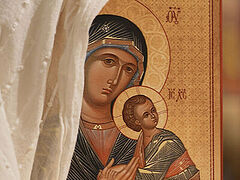
The Blachernae Icon of the Most Holy Theotokos from Christ the Savior-Blachernae Monastery is of the Hodegitria (“Guide,” “She Who Shows the Way”) type of icons. It’s also known as Phioskepastos (“God-Protected”), which is quite rare. A very interesting technique was used to create the icon—a relief image made of wax mastic. It is both an icon and a reliquary—that is, the icon is filled with holy relics.
It’s believed that the Blachernae Icon was painted in the fourth century in Nicomedia and was later transferred to Constantinople. There it was kept in the Blachernae Church, from which it took its name. It was considered the patroness of the city, protecting it from enemies. It was especially revered by the emperors. In 626, during a siege of the city by Avars, Slavs, and Persians, Patriarch Sergius walked along the walls of the city with it and the enemy retreated, seeing the Theotokos herself walking with him.
Thus began the tradition of transferring the icon every Great Lent from the church to the imperial palace, where it remained throughout the Fast. A similar tradition later developed in the Golovin family, who would temporarily transfer the icon from the Christ the Savior Cathedral in Dedenevo to their home in Moscow.
The famous kontakion to the Theotokos, “To Thee the Champion Leader” and the original Akathist to the Theotokos were also written in honor of this miraculous event in Constantinople, which led to the tradition of reading the Akathist to the Mother of God on the fifth Saturday of Great Lent.
Another miracle associated with the Blachernae Icon occurred during the era of Iconoclasm. At that time, the icon, along with the lampada burning before it, was walled up inside the Pantocrator Monastery. It was discovered there 100 years later, with the lampada still burning.

In 1653, this icon was delivered to Russia as a gift to Tsar Alexei Mikhailovich, together with a document describing its origin and veneration and several copies of the icon. There, it was immediately revered as one of the greatest sacred treasures. It was adorned with an embossed gold frame, a large number of precious stones, and pearls. Gold plates were attached to it, on which its tradition was recorded. The Blachernae Icon was kept in the Dormition Cathedral of the Moscow Kremlin, from where the tsar always took it with him on military campaigns.
Until the end of the eighteenth century, there was a tradition of placing the Blachernae Icon before the Royal Doors every year on the fifth Saturday of Great Lent and reading the Akathist before it. The procession in Moscow on the feast of Theophany was likewise accompanied by the Blachernae Icon.
The Blachernae Icon that the Christ the Savior-Blachernae Convent is named for is a later copy, made in Russia in 1705 (presumably by craftsmen of the Armory Chamber). It was also executed in the relief technique and is also filled with relics.
Many miracles are associated with the Blachernae Icon from Dedenevo. There’s a well-known case: In 1737, during the “Trinity Fire” in Moscow, the flames were extinguished when they reached the chapel chamber in the Golovin family’s house, where the icon was kept. Thus, the whole of Pokrov Street was saved from the fire. During times of hardship, a procession was held around the monastery, which saved the village from plague in 1770 and from cholera in 1831. In 1802, Vasily Vasilievich Golovin II received healing from the icon. In gratitude, he richly adorned it with silver and precious stones.

The icon also gained fame as a protector against enemies. During the Patriotic War of 1812, Napoleon’s soldiers entered the Blachernae Monastery but didn’t cause any damage there. During World War II, a victorious turning in the battle for Moscow took place a few miles from the village of Dedenevo, at the Peremilovo Heights. The monastery had already been plundered and closed by that point, but the Blachernae Icon was nearby, in the Dmitrov Local History Museum. After the victory over the fascists, the Andrei Rublev Museum of Ancient Rus’ Culture and Art was opened in Moscow, and the Blachernae Icon was sent there from Dmitrov.
By the great mercy and providence of God and the Theotokos, the icon returned home from the Andrei Rublev Museum to the Blachernae Monastery on January 31, 2015. The venerable eighteenth-century icon thus found its rightful place in the monastery, which has thus become a center of special veneration, where many people now feel her maternal protection. The Blachernae Panagia is a constant source of strength and Divine grace for all Christians. People sense her invisible presence in their heart and soul as they traverse the difficult path to God. The Theotokos prays and intercedes for the whole world.
A local news report from the time shows scenes from the monastery during the return of the icon:
Our monastery of the Theotokos, dedicated to the Blachernae Mother of God, has the special blessing of giving people the chance to come and, as in ancient times, pray and lovingly praise God and the Most Pure Lady of Blachernae before this wonderworking icon and receiving all kinds of help and support, joy, and comfort from God and the Heavenly Queen. People feel the miraculous intervention of God and the Theotokos in their lives, having her maternal patronage and protection through prayer. Even today, they receive the consolation that’s so necessary for our souls, because the Theotokos has maternal boldness before her Son and God. After prayer, a healing power is sent from God to our body and soul, and many miracles are worked, our problems are resolved in trials, and our soul is filled with joy and consolation.
God and the Most Holy Theotokos have once again chosen this monastery, where the icon of the Most Pure Mother of God of Blachernae now manifests, through her visible holy image, her divine, saving grace to all children of God, as the chief and common Mother of all Christians. She is our guide and source of strength in our earthly affairs and spiritual life. All who turn to her for help experience abundant love, care, and mercy. She alone, after God, can help us. Let us pray with fervent faith and hope, and we shall not be put to shame. As the prayer says: “For no one who takes refuge in her departs ashamed, but asks for grace and receives a gift suited to a beneficial petition.”
Every Sunday after Liturgy, a moleben with an akathist is served before the Blachernae Icon of the Mother of God at the Blachernae Convent. The sisters also read the akathist to the Blachernae Icon of the Mother of God daily.
The feast of the Blachernae Icon of the Mother of God is celebrated annually on July 7/20.
***
On the Akathist to the Blachernae Theotokos
 Θεοτόκος των Βлаχερνών
We know the Akathist to the Most Holy Theotokos, which serves as the model for all other akathists, from our prayer books. It was written more than 1,000 years ago in honor of the deliverance of Constantinople from enemy hordes, and thus it begins with the words, “To Thee, the Champion Leader.”
Initially, the term “akathist,” meaning “a hymn sung while standing,” referred only to the Akathist to the Theotokos. Later on, this term came to refer to a separate genre of Church hymns, composed according to the model of original Akathist, which was at the time the only one of its kind.
There are two versions of the Akathist to the Blachernae Theotokos.
The first is simply this original Akathist to the Most Holy Theotokos, which is read on the Saturday of the Akathist in Great Lent. The well-known refrain “Rejoice, O Unwedded Bride” comes from this original Akathist.
The second is the Akathist to the Blachernae Icon of the Theotokos, which was written later, in the spring of 2016, in Russia. Its refrain reads: “Rejoice, O Glory of the Church in Heaven and on earth, O Blessed Mother of God of Blachernae!”
In 2021, this second akathist was translated into Romanian.
Every Sunday at the Blachernae Convent, after the Divine Liturgy, the priest serves a moleben with an akathist to the Blachernae Mother of God before her wonderworking, eighteenth-century icon. Come pray with us.