In the name of the Father, and of the Son, and of the Holy Spirit!
Dear brothers and sisters, each one of us has a mother who gave us birth—someone we try our best to remember, love, and care for, and whom we truly consider one of the greatest treasures in our lives. We thank God for giving her to us. She is the one who gave us life and, with God’s help, brought us into this created world. Thanks to her, we now have the opportunity not only to live, but also to come to know the truth.
We also use the word “mother” to refer to the Mother Church, in which we are born in the font of Baptism. We call the Motherland we live in our “mother”. And, of course, by the grace of adoption on Golgotha, through Christ’s blessing given through St. John the Theologian, His disciple and apostle, our mother is the Most Holy Theotokos. She loves us more than anyone living on earth and strives more than anyone for each of us to be saved, doing everything necessary to achieve this. That is why She is called “the hope of the hopeless.”
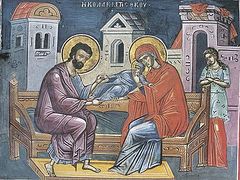
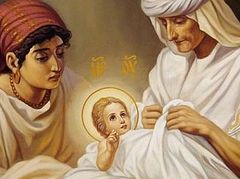
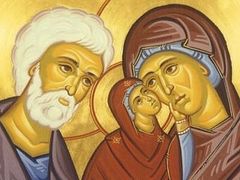
And today we celebrate a feast known as the Nativity of the Most Holy Theotokos and called a day of “universal joy.” The whole world, all creation of the universe—not only man, but every living thing created in this world—rejoices on this day. Why? In Byzantium (from the seventh century) and in Rus’ (from the late fifteenth century), The New Year used to begin on September 1, because people believed that the very beginning of autumn was the moment God created our world.
The very first feast of the Church year following the celebration of the September New Year (the Indiction)—which glorifies the Creator for the world He made—is precisely the great feast of the Nativity of the Most Holy Theotokos. The Holy Fathers drew a parallel here: it was at this very moment, the instant of the Nativity of the Most Pure Virgin, that the beginning of our salvation was established, and the path opened towards a swift victory over sin and death, leading to grace-filled communion in the coming Christ. Indeed, along with the future Mother of God, hope was born into this world for mankind’s imminent deliverance from bondage of sin and death, and a premonition of our union with God Himself.
According to St. Andrew of Crete, this feast is the final and most significant milestone of Old Testament history—its culmination and, at the same time, the threshold and the gateway to the New Testament. The Old Testament Law was incapable of bringing humanity into a life of grace in God, lacked the power to unite man with the Creator, and did not grant freedom from the dominion of sin, the devil, and death. The Old Testament Law could only expose a sinner’s guilt before God and awaken a thirst for communion with God, but it was unable to quench it. The time was not yet ripe.
The Mother of God, being born under the dominion of the Law but subsequently giving birth to Christ, the Giver of New Testament grace, thereby became the Mediatrix between the Old Testament Law and New Testament grace. As St. Andrew of Crete says: “Through Her the Law was abolished and grace shone forth... The beginning of all feasts.”
St. John Damascene teaches that this feast is “the beginning of the salvation of the world, and the foundation for salvation is laid by it; for it is not the Virgin Herself, Who is born today, who saves man, but the Son destined to be born of Her in the flesh, the Son of God—Jesus Christ, the Redeemer of sin.”
St. Andrew of Crete wrote that the Son of God performed the wondrous miracle of His Incarnation through the medium of another wondrous miracle: the Nativity of the Mother of God from elderly parents who were already incapable of conceiving. By His grace-filled power, Christ restores this ability to them so that the conception and birth of the Most Holy Theotokos might take place. All those who hoped for salvation can at last offer up a solemn and joyful thanksgiving to God for the fulfillment of His promise.
The Holy Fathers, in connection with the image of Christ as the New Adam, understand the Paradise into which the First Adam was placed not merely as the ancient dwelling of the first humans located in the Garden of Eden. Furthermore, St. Gregory Palamas names the Most Pure Theotokos Herself as the Paradise intended for the New Adam. It is Her womb that became a new Garden of Eden for the Lord, serving as the place of His dwelling and the maternal home of the Divine Infant Christ. Throughout Her life, the New Eve, the Most Pure Virgin, did not commit any personal sin, not even in Her thoughts.
The New Eve, the Theotokos, as the One Who carried in Her womb and gave birth to Christ, also becomes a gracious Helper for the New Adam, Her Divine Son, in His Providence for our salvation. St. George of Nicomedia, a ninth-century bishop, theologian and hymnographer, teaches: “This day of the Virgin’s birth foreshadowed the rebirth of mankind; it predestined the recall from error and the renewal of corrupt Adam; it prefigured the transformation of the barrenness of our ignorance into our bearing the fruits of the Knowledge of God; it set for us the path to our ascent into grace; it opened beforehand the door of salvation; and it laid the foundation for the reconciliation of man with God.”
St. Gregory the Theologian solemnly proclaims: “If anyone does not confess the Holy Virgin as the Theotokos, he is severed from the Godhead. Those who confess Thee as the Theotokos are blessed, and those who do not acknowledge Thee are subject to damnation.”
St. Photius, Patriarch of Constantinople, explains that the miraculous and husbandless conception of Christ and His Birth from the Virgin proved salvific for the human race precisely because the Lord, being conceived and born without seed, avoided inheriting ancestral sin. Being thus free from the dominion of sin, He was able to deliver from it all those who believed in Him. Her womb bore Him Whom the entire vast universe in its boundless limits cannot contain—God Himself.
Is it possible to unite with God? Let’s try to unite with the sun—what a crazy idea! How can a human being unite with the sun? On a bright day, you cannot even look at it without sunglasses! Then how can anyone unite with the One Who created billions of suns and the entire universe? No one comprehends this, not even the angels. Yet, it came to pass, brought to fulfillment through the Most Holy Theotokos. What greatness must She possess to have gone through this! As St. John Damascene points out, by becoming the Mother of the Son of God, the Theotokos became more precious in the eyes of the Lord than all the rest of creation.
All of creation is as nothing compared to Her. According to St. Andrew of Crete, She received from Him, the Son of God, the ultimate fullness of His own Divine glory as a gift, attaining the absolute limit of theosis that a human being can receive. The Incarnation of the Son of God in the womb of the Most Pure Virgin—as the union of the uncreated and the created accomplished in Christ—carried a saving significance not only for the human race. It changed and transfigured the very nature of existence for the entire universe around us, for Christ is not only the Savior of mankind, but also the Savior of the world, of the whole cosmos.
Why, then, was it so important for Him, the Son of God, to be born in the flesh and specifically of a sinless Mother, we may ask? St. Nicholas Cabasilas, a Byzantine theologian and mystic who lived in the fourteenth century, explains that the Son of God Himself could not have become incarnate if there had been a spiritual barrier of sin—ruling over Her—between Him and the One Who was to become His Mother; not only a sinful deed, but even the slightest sinful thought. For God is Holiness and Truth, and therefore He never enters into union with sin, with spiritual impurity, or with falsehood. He never unites with it.
Addressing the Mother of God, St. Theodore the Studite exclaims: “Of all women, Thou alone art worthy for God to dwell within Thee.”
St. John Damascene says: “Through Thee, the ancient council of God regarding the Incarnation of the Word and our deification has been fulfilled.” Already then, at the Pre-Eternal Council of the Most Holy Trinity (let us recall St. Andrei Rublev’s icon The Trinity), when the creative Divine plan for the creation of the world and mankind was revealed, the entire life of the Mother of God was foreknown and predestined by God.
In His omniscience, the Lord certainly knew the future sinful destiny of Adam and his descendants, and that a need would arise to save humanity from sin and death. The Lord also foreknew His Own future Incarnation, necessary for the salvation of the human race, and already then, at the Pre-Eternal Council before the creation of the world, He predetermined the events of the Nativity of the Most Pure and Holy Virgin, of Whom He was to be born.
St. John Damascene marvels at the fact that She became higher than even the seraphim. “More honorable than the Cherubim and more glorious beyond compare than the Seraphim,” She stands closest to God, the first after God, and abounds in the grace of God more than all others. She not only surpasses the angelic powers with Her personal perfections but also reigns over the entire angelic host.
The path of the Most Holy Theotokos’s accomplishment is unique and inimitable, for God will never have a second Mother; and no one alive, except Her, will ever again be granted this wondrous gift of Divine motherhood. Yet, at the same time, each one of us is called to walk the path of the Mother of God in our own lives, emulating the Most Pure Virgin in Her personal holiness and spiritual purity.
St. Justin (Popovic) of Celije testifies that the Mother of God gave us the remedy for death, for She gave birth to the Conqueror of death. St. Theodore the Studite writes: “She, Her Nativity, is the starting point in the history of our salvation, the beginning of the New Year according to the Church calendar, and the dawn of healing by Christ.” And St. John Damascene calls Her “a Rose grown among the Jewish thorns.”
New Hieromartyr Sergei Mechev states that the Nativity of the Mother of God resolved not only the physical barrenness of the Righteous Joachim and Anna, but primarily the spiritual barrenness of the entire human race, which was a direct consequence of the power of sin.
Now I would like to share an example that might not be widely known—it is a very simple, yet deeply edifying story told by Elder Paisios the Hagiorite. The year was 1830 on Holy Mount Athos. The Turks were conquering the territory and occupied the Iveron Monastery. Soldiers flooded the grounds, forcing the monks to leave. Only one monk remained behind to maintain general order, light the icon lamps, and sweep the courtyard. One day, as he was sweeping the yard, the Queen of Heaven approached him and said, “Give me the broom! You are doing a poor job—I will do it better!” And She began to sweep the courtyard. Three days later, under unexpected circumstances, the Turks left Iveron for good. The monks then gathered to offer a prayer of thanksgiving to the Most Holy Theotokos before Her Iveron Icon.
If possessing such grace and majesty the Mother of God does not disdain to work as a cleaner in church, then should we disdain to help the church in all its needs? This is not our duty, but an honor available to us. Look what a Mother God has given to each one of us standing here! Therefore, on this day, let us magnify Her, glorify Her, and thank God that we have the opportunity to be numbered among those who regard Her as their Mother, to pray to Her, to trust in Her intercession, and to hope that through Her mediation we too will attain salvation in this world.
As St. John of Kronstadt used to say, “Let us radiantly celebrate the feast of the Nativity of the Most Holy Theotokos Mary, adorning ourselves with every virtue.”
Glory be to our God always, now and ever, and unto the ages of ages. Amen.