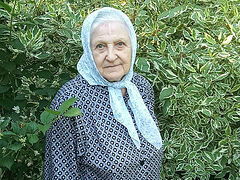
On September 9/22, the Russian Orthodox Church celebrates the Synaxis of the Glinsk Elders. Let us turn to the brief Life and spiritual wisdom of one of these saints—St. Seraphim (Romantsov).
 St. Seraphim (Romantsov)
The future elder was born on June 28, 1885, into a peasant family in the Kursk governorate. As a child, he graduated from a parish school. After his parents’ death, he became a novice at the Glinsk Monastery.1 In 1914, he went to the front lines of the First World War. He was wounded and returned to the monastery in 1916. Three years later, he was tonsured a monk with the name Juvenal. His spiritual father was Hieromonk Aristocles (Veter), who was known for his ascetic life. The elder taught his novice to lead an attentive inner life.
During his stay at the Glinsk Monastery, the humble monk Juvenal developed a profound love for prayer. In 1922, he was ordained hierodeacon. That same year, together with Hieromonk Zenobius (Mazhuga), the future St. Zenobius, he moved to the Holy Dormition Dranda Monastery near Sukhumi.2 Three years later, this monastery was also shut down by the Soviet authorities. Fr. Juvenal became hieromonk and received the great schema with the name Seraphim. He set up a monastic community in the Caucasus Mountains and lived with hermits for a time, but was eventually arrested and sent to a concentration camp to work on the construction of the White Sea-Baltic Canal.
Following a four-year exile (1930–1934), Fr. Seraphim lived in Kyrgyzstan until 1946. There he would retreat into the mountains for prayer, divine contemplation, and ascetic practices. During the winter, he stayed with pious laypeople, where he celebrated secret services and heard confessions at night. For a period of time, he served at the cathedral in Tashkent, the capital of Uzbekistan. His spiritual daughter recalled: “In Tashkent, I lived under the spiritual guidance of Fr. Seraphim (Romantsov), an elder of the Glinsk Monastery. He left the forced labor camp utterly exhausted and without a passport, so our family hid him for twelve years. He would alternate between staying with us in Tashkent and being taken to my father’s brother in Kyrgyzstan.”
In 1947, Fr. Seraphim returned to the newly reopened Glinsk Monastery. There, he settled on the upper floor of a two-storied tower, which earned him the nickname “the Stylite.” Fr. Seraphim was appointed the father-confessor of the Glinsk Monastery and, later, its abbot. He served selflessly at the monastery until its second closure in 1961. Following this, he moved back to Sukhumi, where he was elevated to the rank of archimandrite and continued his arduous ministry as an elder, receiving spiritual gifts from God. The ascetic and spiritual author Archimandrite Raphael (Karelin) described Fr. Seraphim with these words: “There was an extraordinary simplicity and love in this elder, although I later witnessed many times how he concealed this love beneath an outward strictness toward his spiritual children. At times, he seemed angry with them, but when he saw that they sincerely repented and asked God’s forgiveness, he hastened to encourage and comfort them. It was as if the sun had gone behind a storm cloud, only to shine forth again.” In 1966, Fr. Seraphim ordained his spiritual son, Hierodeacon John (Krestiankin), hieromonk. On January 1, 1976, the blessed Elder Seraphim peacefully fell asleep in the Lord. He was glorified by the Russian Orthodox Church in December 2017.
Let us delve in the spiritual teachings of St. Seraphim:
Begin to lay a good foundation each day in the morning, praying with the words of St. John Chrysostom: “Lord, vouchsafe me to love Thee.”
*
The circumstances we are placed in by the wise providence of God are our cross and a school in which we must learn and discern good and evil. This knowledge is necessary on the path of our salvation.
*
Work out your salvation in the name of Christ to be worthy of Heavenly blessings. While there is still time and the Lord accepts us, let us seek salvation through the mercy of God.
*
 Without humility, a person is poor and can never find peace of mind. Only true, heartfelt humility is immune to the devil’s snares, shattering all his nets.
Pray, and the Lord will not forsake those who cry out to Him day and night for their salvation.
*
The fear of God will consume all self-reliance and pride, humbling you and making you tremble at His words. That is why the Lord says, But to this man will I look, even to him that is poor and of a contrite spirit, and trembleth at My word (Is. 66:2).
*
Even the saints of God, of whom the whole world was not worthy, were subjected to such sorrows as we, sinners, cannot even conceive. Remember the Righteous Job, weeping on the ash-heap; St. John the Forerunner, hungering in the wilderness; the Apostle Peter, crucified on the Cross; and the Most Blessed Mother of our Savior, standing at the Cross of her Divine Son. Is it for us to complain and murmur against our sorrows, which are trifling compared to theirs? Yet, there are many people who suffer, seemingly for no reason at all. Why do they suffer? Why, for instance, do innocent and sinless infants suffer, among others? The answer to this question is the same that Jesus Christ gave to the disciples when they asked Him about the blind man, Neither hath this man sinned, nor his parents: but that the works of God should be made manifest in him (Jn. 9:3).
*
We should not waste time trying to find out where, through whom, or how—fairly or unfairly—we have been insulted. Only one thing is vital for us: to accept the insults with gratitude and bear them lightheartedly for God’s sake, overcoming evil with good, turning whatever happens into good as much as possible, and serving the glory of God with all our senses.
*
No matter how much one suffers, with cheerful patience and thanksgiving to God, he receives great benefit from his suffering. He suffers in his body, but he will not suffer in his soul. He suffers for a short time, but he will find eternal bliss.
*
Strive unceasingly to direct your thoughts to God, and He will preserve you amidst the raging sea of passions.
*
We must keep in mind that on the path to God, perfect meekness, grace-filled humility, and obedience are essential. In every matter, we should be guided by the Word of God.

Nowadays, amidst all the hustle and worldly cares, it is difficult to pray. Therefore, we must learn to pray with short prayers (such as the Jesus Prayer), reciting them aloud whenever possible—but always attentively, without rushing, and not mechanically.
*
Guard your peace of mind, for it is higher than fasting and prayer.
*
Take comfort in God’s mercy. Rest assured that, no matter where you are, God never abandons anyone who turns to Him with a contrite heart.
*
Remember the examples of God’s boundless mercy even toward notorious sinners. Most importantly—do not judge, do not envy, know yourself, and be with God.
*
Wherever you are, you cannot avoid sorrows. Arm yourself with patience.
*
You must transform the cross of your sorrows into the Cross of Christ. The Lord accepted it from the Father, not blaming the Jews, Caiaphas, or Pilate, but said, The cup which My Father hath given Me… (Jn. 18:11). Be lenient toward the weaknesses of others; do so without causing grief, without reproaching, and without murmuring.
*
Everyone has sorrows. They take the place of elders, as the Lord allows them, knowing the heart of each person. No one can help or change you unless you change yourself. We must begin by watching over our tongue and our mind. And we must constantly strive to blame ourselves rather than others.
*
Protecting the soul from trouble, it is better to give way in whatever we can—so long as it does not contradict God’s commandments—while watching over ourselves so as not to leave irritation, anger and resentment in our souls.
*
What really matters is not how much you read, but that you read attentively, immersing yourself in the meaning of the holy prayers like a fish diving deep into the safety of the water.
*
Learn to accept the pleasant with thanksgiving, the unpleasant with a prayer of repentance, and everything in general with devotion to God and gratitude, repeating: “Glory to God for all things!”
*
Do not lose heart, do not despond, but commend yourself to the will of God.
*
It is hard to bear the cross of befalling sorrows, but this is our lot. Therefore, if you wish to be among Christ’s flock, accept all sorrowful circumstances you encounter as coming from the hand of God.
*
What is most necessary for salvation is genuine humility—an inner conviction that you are worse and more sinful than everyone and everything else. However, this is one of the greatest gifts of God, and it is acquired through much effort. Then a Christian feels such tranquility in his soul that no human words can explain. Truly humble people, if they possess any gifts from God—such as prayer, tears, or fasting—carefully conceal them all, for human praise, like a moth, eats away at everything.
*
The spiritual life is driven by faith, and faith is witnessed by deeds. When you wish to conquer demons, you must give way to men. If anyone insults you, give way to him, and a peaceful silence will ensue, delivering the soul from trouble. In the spiritual life, evil is not repaid with evil, but evil is conquered through righteousness.
*
 Spiritual wealth is acquired through patience. And patience is sought through unceasing prayer: “O Lord Jesus Christ, Son of God, have mercy on me”—and He will grant it.
Guard yourself against idle and corrupting conversations. He who seeks God, yet at the same time loves the carnal will of the heart and is guided by fleshly wisdom, defiles the temple of his soul.<…> Is it not from a single spark, sometimes so small and barely noticeable, that great fires arise, and from a tiny seed that a great tree grows over time? So it is with us: do not all evil thoughts come from the heart, followed by words and conversations, and then by deeds? Therefore, you must strive by all means to beware of sinful thoughts and fantasies, and of careless words and talk.
*
Do not judge or condemn anyone, lest you condemn yourself. Do not dissect the thoughts, deeds, grievances, and gossip of others. This is the enemy trying to scatter your mind and distract you from prayer. <…> Judging or condemning your neighbor is a weakness. To many of us, this seems minor, but this is actually a grave matter that subjects us to heavy condemnation before God.
*
Illnesses are allowed when we are incapable of spiritual labors. Our tragedy is that we are very impatient and fainthearted.
*
When you notice that you did not manage to do everything you wanted, say, “Lord, have mercy!” If you ought to force yourself, but laziness overcomes you—“Lord, forgive me.” If in a moment of forgetfulness you judge someone, repent quickly; if you break a commandment or rule, do the same. Having repented, strive not to sin again, but do not dwell on what has been done, so that you may always have a peaceful spirit and not be resentful toward anything or anyone.
*
Work out your salvation in the Lord with fear and zeal for the sake of eternal bliss. Burn always like a candle before God.
*
Rejoice in the Lord, and be not dismayed. You know yourselves that there is no salvation in despondency—it clouds the soul and weakens the senses. Why despair? Away with despondency! Let your souls rejoice in the Lord and put their hope in Him. Pray, work, sing, read—do everything for the glory of God, comfort yourselves, and speak of whatever edifies the soul and leads to the Kingdom of God. Then you will see for yourselves how your whole souls are filled with peace and your hearts rejoice, embraced by an unspeakable joy in Christ Jesus.
Venerable Father Seraphim, pray to God for us!