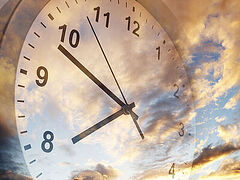
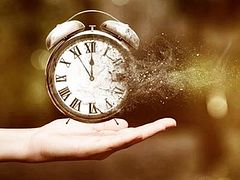
Time is both the most familiar and the most mysterious gift that we receive at birth. We cannot see it, hold it in our hands, stop it, or turn it back. Yet it is time that measures our lives: through childhood and old age, waiting and meeting, work and rest, prayer and distraction, hope and memory.
 Salvador Dali. The Persistence of Memory, 1931
Every one of us has money, health, energy, knowledge, and… time. Yet this strange resource is the only one that cannot be stored up for later, saved for a rainy day, borrowed from the future, or recovered from the past. We can save money, restore our health, and acquire new skills, but a past hour never returns. In this sense, time is a resource far more precious than anything we are used to calling a resource.
At the same time, time is not a ruthless counter ticking life away. It is a space where we meet God, make choices, learn to love, and become who we are destined to be.
Time As a Gift and Responsibility
In the Holy Scriptures, time is never presented as a random flow of events. It has a beginning, a direction, and a purpose. In the beginning God created the heaven and the earth (Gen. 1:1). With these words, the Bible reveals not only the narrative of creation but the very mystery of human existence. The world did not emerge from meaningless chaos―it has a Source. History is not an endless wandering: it moves toward the fulfillment of God’s plan.
Yet man is given to live within time without fully possessing it. We are capable of planning our days, building cities, writing books, and creating technologies. But no plan can guarantee us tomorrow morning. We can calculate the duration of a journey, but we do not know the length of our own lives. From this, not fear is born, but sober mindfulness. The Apostle Paul calls on us: [Redeem] the time, because the days are evil (Eph. 5:16). To value time does not mean turning life into an endless race of achievements. On the contrary, it means learning to distinguish the essential from the secondary. Sometimes, a single hour at a sick person’s bedside is more significant than decades spent building a career. A single word of comfort can prove more important than a lengthy speech, and one sincere prayer deeper than thousands of pages written about faith. Time becomes valuable not in itself, but because of what we fill it with.
Why Clocks Tick Differently
Everyone is familiar with this strange property of time: it seems to shift speeds. Spending five minutes in a queue can feel like an eternity, whereas an entire day of traveling or doing what you love passes in the blink of an eye. In childhood, summer felt endless—packed with trips, new books, discoveries, and adventures. As we grow older, the years begin to shrink, turning into a brief blur of familiar dates and the endless cycle of routine.
Physical clocks tick at a steady pace, but the human mind perceives time differently. When we wait, suffer, or feel afraid, our attention focuses on every single second. Time becomes almost tangible. Yet, when deeply immersed in work, creativity, conversation, or prayer, we stop constantly measuring what is happening. The clock keeps ticking, but the inner observer seems to step aside.

There is another reason: new experiences are remembered in detail, making a given period feel longer. In contrast, monotonous, identical days leave almost no distinct traces in our memory. Looking back, we see a few vivid episodes separated by vast blanks rather than a multitude of lived days, which makes it feel as though time has sped up.
Time does not always drag because it is empty, and it does not always fly because it is full. Sometimes, we are simply running away from ourselves, drowning out our inner anxiety with busyness, entertainment, and an endless stream of information. The day goes by quickly, but you are left with a feeling that nothing really happened.
However, prayer sometimes restores our sense of the present. In the presence of God, we cease to be merely executors of tasks. We remember that life is not a checklist of urgent matters, but a journey. And each day can become not just a calendar unit, but a meeting place with eternity.
Does Time Really Exist?
Philosophers and physicists have long wondered whether time is an independent reality or merely a form of perception―a way for humans to organize changes in the world. In some scientific and philosophical theories, time is not viewed as an absolute flow, but as part of a unified structure of space and events. In a more radical formulation, we might even hear that time does not actually exist.
The Orthodox Church has never reduced time to the mere movement of clock hands. Theology distinguishes between the time of this world—mutable, corruptible, and bound to birth and death―and God’s eternity, which is not an infinitely long stretch of time. Eternity is not an immeasurably extended past, present, and future, but a different mode of being, free from the destructive power of succession.
God does not “live” in time the way we do. For Him, there is no unexpected tomorrow or irrevocable yesterday, yet this does not mean that human history holds no significance for the Creator. On the contrary, Christianity asserts that the Eternal entered into time. The Incarnation of the Son of God became the greatest mystery of eternity meeting history. Christ was born in a specific era, lived among a particular people, spoke a human language, suffered under a specific ruler, and was resurrected at a concrete point in human history.
If time did not exist in any sense, it would be impossible to speak of creation, the Incarnation, or the Resurrection. Therefore, the statement “time does not exist” may be useful as a philosophical challenge to our habitual perception, but it does not negate the reality of the human journey. For us, time exists as a sequence of gifts and decisions. We cannot live through everything all at once. We are given only the present day, and that is precisely where its unique value lies.
The End of Time Is the End of History
Reflecting on time, it is impossible not to think of its end. In the Christian tradition, history is not infinite: it has a beginning and an end, which the Holy Scriptures reveal through Apocalyptic language.
 Albrecht Durer. The engraving, The Four Horsemen of the Apocalypse The Apocalypse is often perceived as a book of catastrophes, wars, monsters, and cosmic upheavals. Yet, at its very center stands not horror, but Christ. The final Book of the Bible does not contain a script of hopelessness, but a testament that evil will not achieve ultimate victory. History may seem chaotic, terrifying, and uncontrollable; however, its final chapter is not in the hands of empires, dictators, markets, or technologies. The last word belongs to God.
The “end of time” marks the conclusion of the world’s current, broken state. Time as we know it is bound to corruption: everything is born, changes, and dies. In Christian hope, the end does not signify the annihilation of existence, but its transfiguration. The Apocalyptic vision does not culminate in emptiness, but in the image of a new Heaven and a new earth―the New Jerusalem, where there shall be no more death (Rev. 21:4).
The Christian anticipation of the end should not devolve into a nervous calculation of dates. Christ Himself warned that the day and the hour are hidden. When people attempt to pinpoint the exact date of the end of history, they more often than not replace spiritual watchfulness with curiosity and fear.
A far more important question is this: if this day turns out to be my last, who will I be in it? Whom will I manage to forgive? Whom will I speak the truth to? Whom will I help? What will I pray for? The “end of history” begins for each human being not only in the cosmic future, but also at the moment of a personal encounter with God.
To Live Not Against Time, But With It
Modern people often perceive time as an enemy. We complain about its scarcity as we rush, run late, get annoyed, and try to be in multiple places at once. Even leisure often turns into just another item on our schedule. We want to do it all, yet we gradually lose sight of what we are rushing for.
The Christian perspective offers a different rhythm. It does not call for inaction or a rejection of responsibility. On the contrary, it teaches us to work hard, fulfill our duties, and care for our neighbors. Yet it reminds us: we are not defined by our calendar. Our worth is not determined by the number of completed tasks or the speed at which we finish them.
Sometimes, the most spiritual act is simply to pause: a morning sign of the Cross before the day begins, a few minutes of focused prayer, a conversation with a loved one without a cellphone in hand, a visit to the sick, or the restraint of not meeting irritation with irritation. In these small actions, time ceases to be a consumable resource and becomes an offering of love.
We often feel like we are wasting time when we pray, read the Gospel, help someone, or listen to an elderly person or a child. But it is precisely these moments that may turn out to be the true meaning of life. According to the Apostle Paul, love never faileth (1 Cor. 13:8). Everything else―money, fame, anxieties, and arguments―will one day be left behind.
Conclusion
We do not know how much time we have been given. But we do know what it is given for: to learn to be with God and with one another. We are not promised power over the future, but we are granted the opportunity to sanctify the present. The past cannot be changed, but it can be brought to God in repentance. The future is hidden, but it can be met with hope. The present seems ordinary, yet it is precisely here that our eternal destiny is being fulfilled.

Time is running out… But this is not only a reason for anxiety. For Christians, the end of time means the drawing near of fullness, when the division between hope and fulfillment, between prayer and answer, between faith and vision disappears. Until then, we are given today.
We do not need to demand the impossible of ourselves―it is enough to live this day honestly, mindfully, and with love: to pray, to do good, to ask forgiveness, to support the weak, and not to allow the heart to harden completely.
Time is not a void between birth and death. It is a road on which we can find eternity. And if we accept every hour as a gift, and not as a random trifle, then even the briefest moment becomes a space of God’s presence.