Photo: Facebook
In May 2026, an evening in memory of St. Ephraim the Wonderworker of Nea Makri was held at the Moscow dependency of the Holy Trinity-St. Sergius Lavra. The organizers, the staff of the Thabor Orthodox Cultural Center, dedicated it to the 600th anniversary of the martyrdom of the Venerable Martyr Ephraim (1426).
St. Ephraim was canonized by the Patriarchate of Constantinople on March 2, 2011, and was added to the calendar of the Russian Orthodox Church on December 28 that year. In the fifteen years since, he has gained recognition and love among Orthodox Russians, and St. Ephraim now lives in the hearts of many believers who turn to him for help, protection, and healing. This is evidenced by the large number of guests at the commemorative event and their many accounts of his grace-filled intercession.
The first spiritual contribution to the glorification and recognition of St. Ephraim in Russia was made by Archpriest Andrei Pirogov. Since 2004, he has served as rector of the Holy Theophany Church in Khimki, outside Moscow, where on January 16, 2013, the commemoration of the uncovering of St. Ephraim’s relics, sacred items were received as a gift from the Holy Annunciation Monastery in Nea Makri: an icon of St. Ephraim, his skufia and slipper, a fragment of the tree on which St. Ephraim was tortured, and soil from the site of his martyrdom. With the blessing of Metropolitan Juvenaly of Krutitsy and Kolomna, Fr. Andrei printed icons of St. Ephraim , as well as two books in Russian.
St. Ephraim is especially venerated at Christ the Savior-Blachernae Convent in the village of Dedenevo, just north of Moscow. Nun Alexandra (Markova) reads an akathist to St. Ephraim with the people every day there, carries out educational activities, and collects testimonies about his life and miracles, for the glorification of such a great saint in the Russian land. People go there from all over Russia to pray before the icon of St. Ephraim, to venerate his slipper, to entreat the wonderworker’s holy prayers before God, that St. Ephraim might give them his blessing, help, protection, healing, and mercy. They thank St. Ephraim as their special patron and the comforter of souls and bodies.
 Christ the Savior-Blachernae Convent
Konstantin Morphis, later the Venerable Martyr Ephraim, was born to simple and pious parents in a large family on September 14, 1384, on the feast of the Elevation of the Precious Cross of the Lord in the Greek city of Trikala, in northwestern Thessaly. Near their house there was a small church dedicated to the Archdeacon and First Martyr Stephen, where Konstantin was baptized. The land with the fragments of the walls of this house hasn’t been built up with modern buildings, but serves as a place of pilgrimage for the faithful. Services for the feasts of St. Ephraim are celebrated in the pilgrimage Church of St. Stephen, which was consecrated in 2022.
Konstantin and his siblings lost their father early, so care for the children fell to their mother, who was a role model for them all. The whole family always went to church and lived a Church life. From childhood, Konstantin had fervent love and strong faith in God, the Theotokos, and the saints. Frequent prayer was the foundation of his spiritual life.
When the city fell under the Turkish yoke, and the Turks began forcibly conscripting young men into the army in Thessaloniki, Konstantin wanted his life to remain pure and virtuous. He longed with all his soul for the Heavenly mansions, to attain union with Christ while still on earth, so at the age of fourteen, he left for a monastery, having received the blessing and farewell of his dearly beloved mother. She set her child on a long journey to monastic asceticism, to serve our great God and our Theotokos, knowing and believing that her son was chosen by the all-good and loving God, and that the good Christ would take care of him all the days of his life and grant him to become an heir to the eternal life of Paradise.
Konstantin arrived at the Monastery of the Holy Annunciation of the Most Holy Theotokos and devoted himself to the monastic life with fervent zeal. This monastery had existed since the tenth century in the Nea Makri area on Mt. Amomon. The Greek word amomos means “pure” and “immaculate,” and Mt. Amomon means the mountain of the “Immaculate.” Many ascetic fathers labored there, devoting their souls and lives to God; this gave the mountain its name.
At eighteen years of age, Konstantin was tonsured into monasticism with the name Ephraim, and was counted worthy of the great gift of the priesthood. St. Ephraim spent the twenty-eight years of his ascetic life in the monastery like an angel. Living with other ascetic fathers, he strove to emulate their labors, and without sparing himself, he labored for God’s sake for the entire monastic brotherhood and for ordinary people.
 The author, Nun Alexandra, by the icon of St. Ephraim at Christ the Savior-Blachernae Convent With the blessing of his abbot and his elder, he would periodically leave the monastery, going higher up on Mt. Amomon, where he gave himself over to prolonged prayer and more rigorous asceticism in a small cave. Thus he grew spiritually, and the grace of God abode with him.
The All-Good God, seeing his labor, gave him a special path to achieve even greater holiness and divine glory through a martyr’s crown. Fr. Ephraim prepared himself for this particular asceticism. He knew that martyrdom is the voluntary acceptance of sufferings and death for faith in Christ. Martyrdom is of great importance to Christianity. It reminds us that faith demands sacrifice and perseverance. Martyrdom is the most ancient feat of the Church of Christ, laid down by the Savior Himself.
In 1424, the Turks raided the sacred Holy Annunciation Monastery, destroyed it, and fell upon the abbot and the whole brotherhood with their usual fury, mercilessly torturing and killing them. St. Ephraim was in his cave at that time and didn’t return to the monastery until the next day. Finding a river of blood and the bodies of all the slaughtered fathers in the courtyard, he served the funeral and burial of his fellow monks.
Fr. Ephraim wasn’t afraid of anything and continued to live there alone, but a year after the great massacre, the Ottoman soldiers returned to the monastery and captured the sole monk. On his birthday, September 14, they began to torment him for his faith in Christ withmerciless and terrible tortures. It’s not possible to list and describe in words all the horrors that the executioners invented to try to force St. Ephraim to renounce the faith of Christ. For eight and a half long months, experiencing terrible physical pain, St. Ephraim prayed to God to grant him courage and steadfastness. In order to endure everything for the love of Christ, he repeated the Gospel words: Who shall separate us from the love of Christ? shall tribulation, or distress, or persecution, or famine, or nakedness, or peril, or sword?... Nay, in all these things we are more than conquerors through Him that loved us (Rom. 8:35, 37).
His unshakable faith in Jesus Christ put the infidel tormentors in a rage. In their demonic rage, realizing that he would never renounce the Orthodox faith and devotion to the Savior of the world, they came up with a new and most terrible torture: To make St. Ephraim’s death more painful, the executioners decided to hang him upside down from a tree, which has been preserved to our day, and continually pierced his tortured body with sabers. The saint prayed incessantly and endured this terrible pain, as the all-powerful and great grace of the Lord and the Theotokos gave him the strength to withstand all the bodily sufferings to which he was subjected by the Ottomans.
 The tree that St. Ephraim was hung from His blood was poured out for Christ at the hands of the infidel and blasphemous Hagarenes, who nailed his arms and legs to the thick trunk of a mulberry tree and plunged a sharp burning stick into his stomach. His bloody body began to burn, and he surrendered his spirit to the Lord his God, Whom he had been devoted to since childhood.
600 years ago, on Tuesday, May 5, 1426, at 9 AM, the holy Venerable Martyr Ephraim closed his bodily eyes and surrendered his holy soul to the Lord Jesus Christ. He was forty-two years old. St. Ephraim endured the longest and most terrible tortures known in the history of the Church, as emphasized in Greek sources.
And then followed five centuries of silence, until the day when Gerontissa Makaria (Desipri) (proposed for canonization by the Church of Greece in 2024) revived the holy monastery and miraculously discovered his holy relics, which “became medicine for every suffering person” in all corners of the world.
In 1945, the Lord miraculously led Nun Makaria to the Nea Makri monastery of the Theotokos. The situation was depressing, but among these lamentable ruins, Mother Makaria felt the great grace of God and the special sanctity of this prayerful place. She settled in a ruined building and remained among these holy ruins forever. Mother Makaria had many different trials and difficulties, but God protected her with His mercy. She wanted to revive the ruined monastery and constantly prayed about it. She tearfully entreated God, saying: “Lord, grant me, who am unworthy, the honor of seeing the relics of one of the fathers who used to live here.”
One day, as she was cleaning the ruins of the monastery, she heard in her heart a revelation from the Holy Spirit: “Dig in this place and you’ll find what you seek. You’ll find one of the brothers of this monastery.” This is how the holy place was spiritually revealed to her. At 9 AM on Tuesday, January 3, 1950, God revealed the relics to the world as a shining sun of faith and love for Christ. At that moment, an unusually strong fragrance spread over the entire monastery. Mother recalled that she reverently fell to her knees, embraced the saint’s remains, deeply felt with her whole soul the severity of his martyric trials, his great and unbearable tortures and torments. She tearfully praised God for his great gift, and that she found a great treasure—relics of a great new saint, and rejoiced in infinite grace and glorified Christ.
The body of St. Ephraim was six feet underground for more than 500 years yet remained amazingly incorrupt. Mother gradually removed the dirt from the holy relics, but had to stop because of the rain. Evening came. She went to read the evening service by herself, when suddenly she heard clear and rhythmic footsteps, coming from the newly uncovered grave. The footsteps went through the whole monastery courtyard, and suddenly someone invisible stopped at the door of the ruined church.
 The site of the discovery of St. Ephraim’s relics
Mother recalls: “I felt with all my heart that this man had a strong character and great spiritual strength.” As she says, her blood froze in her veins. And then a voice was heard: “How long will you keep me there?” She turned around and saw the saint. In his left hand he held a bright light and he blessed her with his right. Mother’s soul was overflowing with great joy and consolation. Her fear completely disappeared, and she said: “Forgive me, holy father. Tomorrow, as soon as God sends the dawn, I’ll take care of your holy relics.” Then the saint immediately disappeared.
In the morning, she reverently placed the relics in a special niche in the holy altar and lit a perpetual lamp in front of them. That same day, she saw the same monk in a dream, in church. He was standing to the left of the holy relics, holding a silver, full-length icon with one hand. There was a large candlestand there, and Mother Makaria lit a candle—the best and most beautiful. Just then, she heard the saint’s voice: “Thank you very much. My name is Ephraim.”
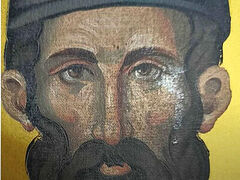
Mother Makaria later spoke about this vision with Photios Kontoglou, an iconographer and restorer known throughout the Orthodox world, whose work is associated with the revival of Byzantine painting in Greece. In 1964, he painted the first icon of St. Ephraim. The icon was executed in a distinctive technique—in charcoal. The image was created based on the personal account of Mother Makaria, following an appearance of St. Ephraim in which he specified in detail exactly how his image should be depicted.
 The first icon of St. Ephraim, painted by Photios Kontoglou During the construction of the monastery, St. Ephraim appeared to Mother Makaria many times in dreams and visions, revealing to her the details of her life, asceticism, torments, and her earthly demise. He later appeared to several other nuns who surrounded Gerontissa Makaria after 1950 and formed the monastic sisterhood of the revived Monastery of the Most Holy Theotokos in Nea Makri. He also appeared to many Christians and children of the monastery orphanage—both to those who knew about him and those who knew nothing about the existence of this new saint. Fr. Ephraim spoke about himself, and so gradually the main biographical details and various facts about his sufferings and righteous martyrdom became known. The stories from many different people completely coincide in their details.
For his asceticism, St. Ephraim received various spiritual gifts from the greatly generous God and now has great boldness and intercession for us all. As a speedy helper, he immediately responds to all our requests and petitions—in illnesses, in various everyday troubles, in sorrows and trials. St. Ephraim has become for many a great wonderworker, and through his martyrdom he testified to the power of Christ and has become the glory of the Orthodox Church of Christ. Now he’s known as Venerable Martyr Ephraim, the New Wonderworker of Nea Makri.
Over the past sixty years, St. Ephraim has become one of the most beloved and revered saints for all Orthodox people. Hundreds of believers visit his monastery every day. Before his holy relics, people entreat his holy prayers before God; they ask him to give them his blessing, help, defense, healing, and mercy. The wondrous treasure and “splendor” of Mt. Amomon—the Holy Great Martyr Ephraim the Wonderworker, by the grace of God and through the tireless labors of Blessed Abbess Makaria, has now become known almost everywhere on our earth, and, like a modern-day Pool of Siloam, the saint grants healing and manifold help to all who ask.
By the mercy of God, St. Ephraim has already worked several thousand miracles for everyone who prays to him with faith and love. Mother Makaria collected and recorded information about the miracles and appearances of St. Ephraim, which she published in ten volumes. The books, called Visions and Miracles, have since reached twenty-six volumes. According to the venerated Abbess Makaria, it was the desire of St. Ephraim himself: “Don’t hide my miracles—tell people about them!” He has often severely scolded all those who don’t fulfill his blessing and hid the help and mercy he gave them in various miracles and healings. “I work many miracles so many would believe and be saved,” he has said.
 Inside the church where St. Ephraim’s relics are located
At the Christ the Savior-Blachernae Convent, personal testimonies of help and healings received from St. Ephraim are likewise carefully collected. Over the course of two years, more than eighty such testimonies have been collected. Many believers note that when coming to pray and to get icons and oil from St. Ephraim, they feel his help and a need for his grace-filled intercession and pleading before God on their behalf. People come to understand that a remarkable saint has entered their lives, and after becoming acquainted with him, they cannot and do not wish to end this spiritual bond.
Holy Venerable Martyr Ephraim, bless and intercede for us.