Serpukhov, Moscow Province, Russia, September 28, 2026
 Photo: patriarchia.ru
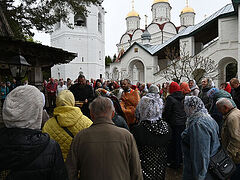
The Vysotsky Monastery in Serpukhov, founded by St. Sergius of Radonezh over six centuries ago, is marking 35 years since monastic life returned to its walls after decades of Soviet closure.
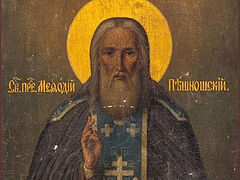
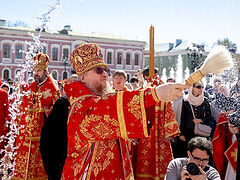
His Eminence Metropolitan Theognost of Kashira, who chairs the Synodal Department for Monasteries and Monasticism, celebrated the Divine Liturgy at the Vysotsky Monastery on September 25, the feast day of St. Athanasius the Wonderworker of Vysotsky and Serpukhov, reports Patriarchia.ru.
His Grace Bishop Roman of Serpukhov, abbot of the monastery, concelebrated along with the monastery’s hieromonks, and the monastery choir sang the liturgical hymns.
After the Liturgy, the clergy sang hymns of praise for the feast of the leave-taking of the Nativity of the Most Holy Theotokos and for the monastery’s founders, St. Athanasius the Elder and St. Athanasius the Younger of Vysotsky. Metropolitan Theognost read a prayer before the reliquary holding the relics of St. Athanasius the Younger.
 Photo: monasterium.ru
The Metropolitan concluded the service by reading out a greeting from His Holiness Patriarch Kirill of Moscow and All Russia marking the monastery’s 35th anniversary:
The ancient Vysotsky Monastery, founded by St. Sergius of Radonezh, served for centuries as an important spiritual center of the Serpukhov land and was known throughout Russia. In the sorrowful years of the 20th century, in the times of godless upheaval, it was closed, its churches desecrated, its holy objects destroyed, its monks driven out, and many made to suffer for their faith. It seemed that prayer at this place had been extinguished forever. Yet by God’s mercy, the monastery’s revival began in 1991, and a new page opened in its history.
Much has been accomplished over the past 35 years. Through the intercession of the Queen of Heaven, the efforts of the brethren, and the care of concerned people, the outward beauty of the monastery has been restored, and the ancient tradition of monastic labor established by the first abbots, St. Athanasius the Elder and St. Athanasius the Younger, has been revived. Today many pilgrims flock here for spiritual comfort, pastoral guidance, and grace-filled support in resisting passions and afflictions.
***
 Photo: visotskymonastir.ru
The Vysotsky Monastery is one of nine monasteries founded by St. Sergius of Radonezh. Prince Vladimir Andreyevich the Brave of Serpukhov, a cousin of St. Dimitri Donskoy, asked St. Sergius to help him establish a monastery in his city, and the elderly St. Sergius walked to Serpukhov with his disciple Athanasius to choose a site on a hill by the Nara River. The monastery was founded on December 2, 1374, and took its name, Vysotsky, from the hill on which it stood. St. Athanasius the Elder became its first abbot, and in 1374 St. Nikon of Radonezh became the first monk tonsured there.
After the Russian army’s victory over the Golden Horde at Kulikovo Field in 1380, Prince Vladimir buried the remains of fallen Serpukhov soldiers at the monastery, and a white-stone cathedral was built there in honor of the Conception of St. Anna, consecrated together with a refectory church built by Metropolitan Cyprian in 1381.
St. Athanasius the Elder left for Constantinople in 1387 to compile a unified rule for the Russian Church, dying there in 1401. He was succeeded by St. Athanasius the Younger, who died at 33 and was venerated as a wonderworker; in 1571, he was said to have appeared as a fierce horseman defending the city during a Tatar raid, and has since been venerated as Serpukhov’s Heavenly protector. St. Nikita, a relative and disciple of St. Sergius, led the monastery for 19 years afterward before moving on to found the Theophany Monastery in Kostroma.
The monastery was plundered and burned during Khan Devlet Giray’s raid on Serpukhov in 1571 and suffered further during the Time of Troubles, but it revived under Tsars Mikhail Fyodorovich and Alexei Mikhailovich, receiving generous donations from the Naryshkin family and Tsaritsa Natalia Kirillovna, mother of Peter the Great. By the mid-18th century, it held seven stone churches and a major cathedral, though the 1764 secularization decree stripped it of its landholdings. A bell tower was added around 1840, and new churches went up through the late 19th century, including the Church of All Saints, built in 1896 in the Byzantine style.
Soviet authorities closed the monastery in 1928, and it ceased operating entirely by 1931. The Holy Synod voted to reopen it on March 25, 1991, and the relics of St. Athanasius the Younger were rediscovered in 1994. His Holiness Patriarch Alexei II visited the following year for the 600th anniversary of the saint’s repose, and the main cathedral was fully consecrated in 2002.
Follow OrthoChristian on Facebook, Twitter, Vkontakte, Telegram, WhatsApp, and MeWe!