On June 14/27, the Russian Orthodox Church honors the memory of St. Methodius of Peshnosha. According to tradition, he was one of the favorite disciples of the “Abbot of the Russian land”—St. Sergius of Radonezh. As the akathist to St. Methodius says, “Thou didst come into the monastery of Venerable Sergius, and clothed in the monastic rank by him, thou wast a zealous imitator of his ascetic labors.”
 St. Methodius of Peshnosha
Having matured spiritually, he wished to find a secluded place for his ascetic labors. In 1361, he went in search of such a place with the blessing of his mentor. Across the Yakhroma River, not far from the town of Dmitrov,1 in the midst of swamps and forests, St. Methodius built himself a cell where he lived for some time in prayer and fasting. But his holy life could not remain unnoticed, and monks began to gather around him. St. Sergius blessed his disciple to build a monastery, but in a drier place—at the mouth of a small river. And the saint obeyed him.
St. Methodius carried logs for the monastery on foot across the river—hence the name, St. Nicholas-Peshnosha2 Monastery, which he founded. St. Methodius built the monastery on his own, “performing great labors”, as the prayer to the saint says. He set up a wooden church of St. Nicholas the Wonderworker. In 1391, he became abbot of the monastery, setting a good example in virtues to the brethren. Those in need and sorrow flocked to him for comfort. He welcomed everyone, consoled them in their sorrows, and, as the kontakion to him says, “healed those who came to him with faith.” He was a humble and quiet ascetic of the Russian land. He introduced the rule in his monastery following the example of the Holy Trinity-St. Sergius Monastery.3
Occasionally, he went to a secluded spot not far from the monastery to meet with St. Sergius, which is why this area was named Beseda (“Conversation” in Russian). Earlier, when the Battle of Kulikovo4 took place on September 8, 1380, St. Methodius came to the Holy Trinity-St. Sergius Monastery and prayed together with the brethren for the victory of the Russian army. The saint reposed in the Lord in 1392—less than a year after his holy mentor, and was buried at the Peshnosha Monastery. In 1549, he was canonized by the Russian Church, and his relics remained intact.
 Icon on the wall of St. Nicholas-Peshnosha Monastery It is known that St. Nicholas-Peshnosha Monastery was regularly visited by a number of princes and tsars of Muscovy in the Middle Ages. Among them were Peter, a son of Grand Prince Dmitry Donskoy, and Tsar Ivan IV the Terrible (ruled 1547–1584) who donated the Tsar’s estate village and twenty-five villages to the monastery.
The monastery especially flourished under the holy Abbot Barsanuphius of Kazan.5 His favorite handiwork was “knitting klobouks6 for monks.” During his abbacy, the monastery even had ships carrying bread for sale, as it grew a lot of grain. It was Abbot Barsanuphius who contributed to the canonization of St. Methodius in the sixteenth century. In the same century, many monastic buildings burned down in a devastating fire, but the monastery was rebuilt.
Tsar Alexei Mikhailovich Romanov (ruled 1645–1676) regarded the Peshnosha Monastery as his “favorite royal pilgrimage site.” In the early seventeenth century, the monastery was ravaged by Polish invaders. There is a record of the murdered brethren of that time in the monastery commemoration list. As a result of the Time of Troubles,7 the monastery fell into decay.
From 1700, under Peter I the Great (ruled 1682–1725), the Peshnosha Monastery was affiliated with the Holy Trinity-St. Sergius Monastery, leading to its even greater decline. Eventually, there was no one to celebrate services there.
In 1788, Archimandrite Macarius (Bryushkov), a disciple of St. Theodore of Sanaxar (†1791; feast: February 19/March 4), became the abbot of the monastery. With the blessing of Metropolitan Platon (Levshin; metropolitan from 1775 to 1812) of Moscow, he arrived at the desolate monastery and regretted having agreed to become abbot there. But Sts. Sergius of Radonezh and Methodius appeared to him and said, “Don’t leave—and everything will be in abundance here.”
Consoled by this vision, Archimandrite Macarius set about reviving the monastery. During his abbacy, the monastery reached its peak of prosperity. As Metropolitan Platon said, “In my diocese, the Peshnosha Monastery is the second Lavra.” Archimandrite Macarius corresponded with St. Paisius (Velichkovsky; feast: November 15/28), who presented him with an abbot’s staff. He introduced the Athonite rule in his monastery. According to the brethren, their monastery was thus taken under the Protection of the Most Holy Theotokos. Archimandrite Macarius also actively performed the Jesus Prayer.
At the same time, several more monasteries were transferred to his administration, including the Moscow Sretensky Monastery (where the rule of the Peshnosha Monastery was adopted as well). Archimandrite Macarius also influenced the foundation of the Optina Monastery by sending several monks there. As Elder Macarius of Optina (†1860; feast: September 7/20) later wrote about him, “indefatigable and well-versed in the monastery’s temporal affairs, he was even more tireless in labors of spiritual life. His appearance seemed stern, but his soul was full of paternal love.” One of those hesychast monks trained the first Optina elders, which marked the beginning of the tradition of Optina eldership.
In 1812, when Napoleon attacked Russia (this period is known in Russia as the Patriotic War), the monastery feared the invasion of the French. Some of the precious rizas (metal coverings) for icons were removed to a safer place, and many of the brethren were scattered. Only twenty were left—the elderly and those who were not afraid of possible disaster. However, the French never reached the monastery.
In the nineteenth century, Hieromonk Maxim (Pogudkin) was one of the abbots of the monastery. He was a humble and grace-filled man, endowed with the gift of clairvoyance. The local peasants were in awe of him. He also corresponded with Elder Leo of Optina (†1841; feast: October 11/24).
 St. Nicholas-Peshnosha Monastery, late nineteenth century
As St. Pimen of Ugresh,8 a disciple of St. Ignatius (Bryanchaninov), wrote about the Peshnosha Monastery: “I found the monastery in the following condition: the service was celebrated by the Typicon, they sang Stolpovoy chant,9 its churches are well-kept, and the monastery is maintained properly. The spirit of the former eldership is still partly preserved among the older brethren, but, unfortunately, modern rationalism is superseding everything that was before.”
One of the visitors to the monastery left the following memories: “The Vigil began at seven in the evening and lasted until midnight; there are probably as many monks and novices in this monastery as there are in the Holy Trinity-St. Sergius Lavra, but I have never seen so many elders in any monastery as here. It seemed that all the monks without exception were adorned with gray hair.”
It is known that in 1895, with the blessing of the abbot, the inventor Alexander Popov conducted the first experiments on the passage of radio waves within the walls of the Peshnosha Monastery. A transmitter was installed inside the monastery, and the receiver—in the estate of the great chemist Dmitry Mendeleev nearby. The experiments were successful—the signal was heard.
By the end of the nineteenth century, the Peshnosha Monastery was one of the best organized Russian monasteries, with six churches, wonderworking icons and shrines. Before the 1917 Revolution, a wonderworking icon of St. John the Baptist was kept there. There was a cemetery on the territory of the monastery, where representatives of many princely and boyar families were buried. The number of brethren was about 150.
The twentieth century came. From 1901 to 1914, the monastery was under the omophorion of Bishop (future metropolitan) Tryphon (Turkestanov; 1861–1934) of Dmitrov, a celebrated archpastor, spiritual writer, preacher and a spiritual child of St. Ambrose of Optina. After the Revolution of 1917, some buildings of the monastery were transferred to the Dmitrov Museum, but the monastery was not closed yet. The new bishop of Dmitrov, Hieromartyr Seraphim (Zvezdinsky; feast: August 13/26), loved to come to the Peshnosha Monastery. His beautiful sermon, delivered after the monastery service in 1921, has survived: “Greetings to you, my friends, because today is the day of St. Methodius, our patron-saint. People from everywhere have gathered here to pray—from the north and south, east and west of our region. Neither the long journey nor other inconveniences stopped those whose hearts are full of love for the saint; and now that so many people have gathered here, I recall who was at St. Methodius’ name day in that distant time when he still lived on earth. Then St. Sergius, his teacher, came to him to greet his disciple and converse with him, along with wild animals, with whom the saint shared pieces of bread; and angels of God came to him too, because St. Methodius is known as a companion of the angels.
“And now you’ve come to celebrate his name day. When I was coming here to offer the Bloodless Sacrifice and proclaim, ‘Thine own of Thine own!’, I went to St. Methodius’ tomb, and he told me about your gifts. Like the Magi to Christ, you have brought three gifts to St. Methodius: bright gold—your faith; fragrant frankincense—your prayers; and the wondrous and most precious of the gifts—the aromatic myrrh of your love. And St. Methodius has also shown me other gifts of yours: I saw them everywhere—they are showered all over his shrine, sparkle on its steps, on the floor, and around the tomb—these wonderful sparkling gifts, these wondrous diamonds are your tears. There are many, many of them. These are the tears of mothers, orphans, the poor, and the destitute. The saint has shown me all these resplendent diamonds and ordered me, ‘Go and tell all of them, my children, that I have seen their gifts, accepted them, and am sending my peace both to them and their homes.’ My children, beloved children of Father Methodius! Today, through my hands, St. Methodius himself is giving you his blessing. He has comforted all those who came to his tomb, not fearing the labor.”
 St. Nicholas-Peshnosha Monastery. Photo from the mid-1950s
In 1918, soldiers came to the monastery and removed rizas from the icons, tying red bows to them. Until 1922, Hieromonk Xenophon, a man of prayer and ascetic who cast out demons, was the monastery abbot. When one day Hieromartyr Seraphim came to the monastery, he complained about the numerous bedbugs in it. Abbot Xenophon replied, “Vladyka, we have no bedbugs. The elders have forbidden them to stay in our cells!” He read the prayers of prohibition and added, “Not a single bedbug will come and disturb you.” Indeed, Vladyka was never bothered by bedbugs again.
The last elder of the Peshnosha Monastery before its closure was a man of holy life, Schema-Hierodeacon Alexander (Zhemkov). He was Abbot Xenophon’s cell-attendant. Before being tonsured into the great schema, the latter said to the future elder, “Just as I have accepted everyone, so you must accept everyone—don’t turn anyone away.”
In 1922, Bishop Seraphim of Dmitrov appointed Hieromonk Barnabas (Zhukov) the monastery abbot. Foreseeing the severity of his cross, he said to him, “Take the staff. Accept it. The storm raises waves, the sea is agitated, and the Lord is giving you His ship—the Peshnosha Monastery. Steer it as a good helmsman. There are pitfalls here; take care lest your ship run aground and crash. The pitfalls are the hearts of the brethren of the monastery entrusted to you. Watch closely, stay alert… Oh, if you knew what awaits you at your post, you would give me the staff back now, but you mustn’t do that. Accept it and steer this ship to a quiet harbor.” Later, Fr. Barnabas was repressed.
In 1927, the monastery, like almost all monasteries in the Russian land, was shut down, and its church property was plundered. Elder Alexander was secretly taken away in a cart under the hay, otherwise he could have been arrested. Subsequently, the elder received people in conditions of the strictest secrecy. The remaining brethren opened a “general labor cooperative” (artel), which was dispersed two years later. Some of the monastery brethren of that period were later canonized as New Martyrs of Russia.
In the late 1920s, the museum’s branch and the monastery were closed. The former monastery area was occupied by a Home for the Disabled. In 1941, the monastery buildings were damaged by bombing during the Second World War. Between the mid-1960s and 2014, the monastery housed a mental hospital.

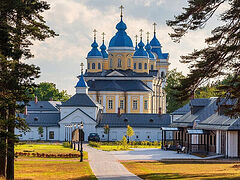
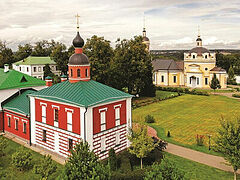
In 2007, after many decades, a service was celebrated again in the Theophany Church of the monastery. Gradually, the monastery buildings were returned to the Russian Orthodox Church. On August 24, 2014, after the renovation work, the whole territory of St. Nicholas-Peshnosha Monastery was opened to the delight of the faithful. This is just a brief history of the glorious Peshnosha Monastery.
Let us pray to St. Methodius with the words of the troparion to him: “Inflamed by Divine love from thy youth and having scorned all that is beautiful in the world, thou didst love Christ alone; and for His sake having come to dwell in the wilderness, thou didst found a monastery there; and, having gathered a multitude of monks, thou didst receive from God the gift of working miracles, O Father Methodius; and thou didst converse with Christ and fast with the Venerable Sergius, together with whom beseech Christ our God to grant good health and salvation to Orthodox Christians, and great mercy upon our souls.”