Photo: foma.ru During the reign of Diocletian, Priscus was governor of Chalcedon. Wishing on one occasion to hold a festival in honor of the pagan god Mars, he sent proclamations throughout the surrounding towns and villages, summoning everyone in the emperor’s name to come to Chalcedon for the celebration; those who disobeyed the command were threatened with torture.
The time of the festival arrived, and a great multitude gathered in Chalcedon. The pagans celebrated their feast noisily and with great pomp, while the persecuted Christians secretly assembled at night to pray together to the true God, thereby placing their lives in the greatest danger. Since the Christians did not participate in the pagan festivities, they were deemed guilty of disobeying the imperial command. The governor therefore ordered that they be sought out and brought before him for torture.
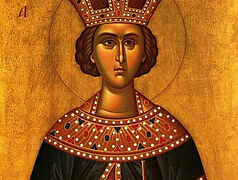
Thus, forty-nine Christians were discovered in one house. Among them was a beautiful young maiden named Euphemia, the daughter of noble and distinguished parents—her father was a senator. The Christians who had been discovered were brought before Priscus, the governor of the city.
The proud governor angrily asked them:
“Are you the ones who defy the commands of the emperor and of myself?”
The Christians replied:
“The command of the emperor and yours ought to be obeyed if it does not contradict the will of God. But if it is contrary to God, then we must not only refuse to obey it, but even resist your command. Your command that we honor the creature instead of the Creator, that we worship idols instead of the true God, is madness. We are worshippers of the true God Who dwells in heaven.”
The governor began to flatter the Christians, promising them gifts and honors if they would renounce Christ. But they were not enticed by his promises, regarding earthly blessings as worthless in comparison with heavenly ones. The governor then ordered them to be tortured and deprived of food and water. Their sufferings continued for twelve days, which the Christians endured courageously and with serenity.
On the twelfth day they were once again brought before the governor for judgment. This time Priscus’s attention was drawn to the young Euphemia, whose beauty captivated him. Thinking that a young and inexperienced Christian woman could easily be swayed either by flattering promises or by terrible threats, the governor employed both means in an attempt to incline the young maiden toward pagan impiety. But neither achieved its purpose. St. Euphemia said:
“Do not imagine that by flattery or fear you can incline me toward impiety. I am a woman, weak in body and young in years, but my heart is more courageous than yours. I firmly believe in Christ; in Him are all my life, my hope, and my joy.”
Confronted with such steadfastness on Euphemia’s part, the governor subjected her to torture. She was bound to a wheel beneath which lay a board studded with sharp nails and knives pointing upward. The servants began turning the wheel, so that as the martyr’s body passed over the points of the nails and knives, her flesh was cut and her joints were crushed.
In the midst of her sufferings, the saint cried out to God for help, saying:
“Lord Jesus Christ, Light of my soul and Fountain of life! Thou grantest salvation to those who hope in Thee. Come now to my aid, that Thy holy name may be glorified among men.”
Suddenly, through the action of an invisible power, the wheel stopped. The servants, overwhelmed by this wondrous event, fell down in fear, while the saint was healed of her wounds and restored to health.
This miracle astonished the governor but did not bring him to his senses. At his command, the saint’s body was raked with iron combs, she was struck on the cheeks with rods, and she was cast first into fire and then into a pit filled with all manner of venomous creatures. Yet with God’s help, the holy maiden courageously and steadfastly endured all these grievous sufferings and remained unharmed.
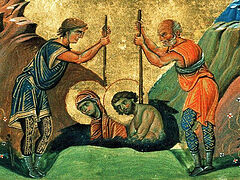
Many who witnessed the holy maiden’s torments abandoned the pagan faith and turned to Christ. Thus, two soldiers, Victor and Sosthenes, who had taken part in the tortures, were so struck by St. Euphemia’s miraculous endurance that, before all the assembled people, they openly declared that they were abandoning the pagan faith and wished to suffer together with Euphemia for the faith of Christ. The soldiers were thrown to wild beasts to be devoured.
Having tried every kind of torture in vain to induce Euphemia to return to paganism, Priscus ordered that she too be cast to the wild beasts. A she-bear approached the holy martyr and inflicted a slight wound upon her foot, after which the saint quietly departed to the blessed habitations.
Her parents buried her holy body not far from Chalcedon.
A magnificent church was soon built over the place of her burial. The Fourth Ecumenical Council held its sessions in her church, where through her a miracle confirmed the Orthodox confession of faith.
St. Asterius, Bishop of Amasea, while still a young man—and therefore in the second half of the fourth century—described an icon of St. Euphemia that had been painted with great skill by a certain devout artist and hung near her shrine. This description by Asterius was read twice at the Seventh Ecumenical Council in defense of the holy icons.
The historian Evagrius, after describing the church of St. Euphemia in Chalcedon, writes:
“It is known to all Christians that the saint sometimes works miracles there as well… There, before the eyes of all, the Bishop of Constantinople together with his priests enters the basilica in which rests the all-holy body I have mentioned. On the left side of this tomb there is a small opening closed by a little door. Into this opening, reaching as far as the holy remains, they insert a long iron rod with a sponge attached to its end; and after turning the sponge there, they draw it out together with the rod, filled with blood. What is brought forth by means of the sponge is in such abundance that it is generously distributed to the pious emperors, to all the assembled priests, and to all the people who have gathered there; it is even sent throughout the whole inhabited world to those among the faithful who desire it… And the all-holy blood never changes its appearance.”
Theophylact Simocatta, the historian and contemporary of Emperor Maurice, relates that in the twelfth year of his reign the emperor began to doubt this miracle and took precautions to ensure that no deception was involved. Yet on the appointed day blood flowed from the relics in great abundance and with a wondrous fragrance, so that the emperor shed copious tears.
After Chalcedon was captured by the Persians, the holy relics of Euphemia were transferred to Constantinople, and to this day they remain incorrupt at the Patriarchate of Constantinople.
Protopopov, D. I. Lives of the Saints Venerated by the Russian Orthodox Church, as well as Those Venerated by the Greek Church, the South Slavic and Georgian Saints, and Saints Locally Venerated in Russia. September. Moscow: D. I. Presnov, 1885. 552 pp.