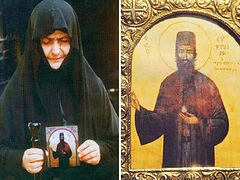
Gerontissa Makria with an icon of St. Ephraim of Nea Makri In all times, God adorns His Church with spiritual personalities who shine and radiate the grace of the Holy Spirit like precious gems in a necklace reflecting sunlight. One such shining spiritual figure was the unforgettable Abbess Makaria (Desipri), abbess of the Monastery of the Annunciation of the Most Holy Theotokos and St Ephraim, which she recreated completely from ruins and spiritually founded on Mt. Amomon in Attica.
Gerontissa Makaria was full of grace and blessing. She dedicated her life to Christ and the ascetic ideal from an early age, striving for the angelic life, and her entire life was led by the Scriptural word Ye shall be holy; for I am holy (Lev. 11:44). Her heart and soul thirsted to find and glorify a new saint. God and the Theotokos heard her prayer and deemed her worthy of the honor of the appearance and finding of the holy relics of the glorious Venerable Martyr Ephraim the New, Wonderworker of Nea Makri. She served this saint for more than fifty years with the aim that his glory would forever shine upon the entire Orthodox Church world to help suffering people find spiritual rebirth and salvation. May our venerable Abbess Makaria’s memory be eternal and may she be remembered with gratitude for her labors and boundless love.
Mother Makaria was born on March 12, 1911, in the village of Phalatado on the island of Tinos, named Margarita Desipri in the world. She came from a large family and was raised in the spirit of Orthodoxy by her pious parents Maria and George. Especially important for her spiritual development was her relationship with her grandfather, a priest named Anthony, whom she dearly loved. Her mother had the honor of dedicating two daughters to the Lord—Nun Pelagia and the future Abbess Makaria—and her son, Andreas, who became a priest and later an archimandrite at St. John the Baptist Church in Canada, where he served for many years until his repose on November 6, 2019, at the age of ninety-seven. This church was founded in 1985, and it has the great blessing of a large icon of St. Ephraim of Nea Makri, his slipper, and part of his arm. These relics were given to the parish by Gerontissa Makaria herself.
Makaria was chosen by God from her very childhood, as confirmed by the facts of her childhood. For example, at one point she became seriously ill and the doctors were completely unable to help her, but Great Martyr Minas saved her from certain death. One day, near the Church of St. Margarita, she saw St. Spyridon of Tremythous, who took her by the hand and said: “Your name has been written in Heaven, Makaria.” He called her by her future name in monasticism and immediately disappeared.
At the age of nineteen, Margarita joined a monastery. She was immediately accepted into the novitiate and two years later was tonsured into monasticism, receiving the name Nun Makaria. On June 29, 1935, Mother Makaria received the great schema at St. Hierotheos Monastery in Megara.
During the occupation, she lovingly cared for prisoners at the Averof women’s prison in Athens and their children. And when she had finished her ministry to people in the world, God and the Theotokos gave her a Divine sign. Mother Makaria recalled that somewhere around 1944–1945, God’s will for the rest of her life was manifested in a most vivid and unexpected way. She was at one of the ancient Byzantine churches in the center of Athens when suddenly she saw a radiant woman in long robes in front of the church. It was the Most Holy Theotokos herself, who told her: “I want you to go to my house and serve me on the Mount of the Immaculate—on Mt. Amomon.” Then she disappeared. Mother Makaria told her spiritual father about it, and he said: “God will arrange everything, my child.” This is how the story of St. Ephraim the New, Wonderworker of Nea Makri, unexpectedly began.
In the summer of 1945, the Lord miraculously led Nun Makaria to the Theotokos Monastery in Nea Makri, where she remained until her repose. The monastery was in a depressing and mournful state at that time, with the whole territory in ruins. She settled in a dilapidated building and lived there in great poverty and unimaginable hardships. She knitted socks at night to earn a living, and in the morning she “dug up” the ruins of the small Church of the Annunciation because she wanted to find the foundation laid by the fathers and rebuild the church and monastic cells on it.
Mother Makaria had many trials and tribulations in these post-war years, but the mercy of God protected her from every evil and healed her of all sicknesses. One winter she had such a bad fever that she nearly died, but a traveler passing by her dwelling noticed this poor, sick person living amongst the ruins and showed her mercy—he threw his cloak over her to protect her from the cold. Thus the all-loving God upheld her in her infirmities and accompanied her in all her various labors.
 Discovery of the relics of St. Ephraim. Photo: Instagram For her many years of great ascetic labors, God and the Theotokos prepared her for the highest honor and mercy, to the joy of the entire Orthodox world—the discovery of the fragrant relics of the Great Martyr Ephraim the Wonderworker amidst the ruins of the ancient monastery, after 500 years of being hidden in the ground.
Living by Divine design amid the ruined old Monastery of the Annunciation, Mother Makaria often found herself carried back in spirit to that distant age when in 1424 the holy fathers there suffered martyrdom at the hands of the blasphemous, godless Hagarenes, their bones left scattered everywhere. One day, as she was clearing the sacred monastery, she suddenly felt the great grace of God and the special sanctity of this prayerful place, where God and the Mother of God had led her. She began to pray: “My God, make me, Your unworthy servant, worthy to see one of the fathers who lived here.” After some time, she heard a voice inside her saying: “Dig here and you’ll find what you’re looking for.” Mother Makaria understood this was the Holy Spirit informing her that the relics of a saint were located at a certain spot in the monastery courtyard. It was a sign from God.
She immediately called a worker who had previously done some minor repairs in the old abbot’s building. Mother showed him the holy place, but the worker didn’t want to dig there. He was ready to dig anywhere else, only not where Mother showed him. The worker went around the entire monastery, but constantly ran into obstacles. While he was rummaging through piles of rocks everywhere, Mother Makaria remained at the holy spot shown to her, humbly waiting and praying. There were no rocks where she was standing, but the worker eventually came over to her anyway, and before long, they’d dug up a hearth, three small windows, and a half-collapsed wall—signs that a monastic cell had once stood there.
Mother recalled: “When we cleared the rocks away, the worker started digging, but he seemed nervous and angry. I was worried and said to him: ‘Please, be careful to not damage any remains. Take your time; dig slower.’ He said: ‘You really think there’s a human body there?’ We continued this sacred work, and when we reached the depth of five and a half feet, the first miracle suddenly happened. When the pickaxe touched the head of the man of God, an inexpressible, strong fragrance spread throughout the whole area. The worker turned pale, fell silent, and realizing the error of his thoughts and actions, he repented.”
 The church where St. Ephraim appeared to Mother Makaria Mother Makaria asked the worker to leave her alone. She reverently fell to her knees, venerated the saint’s relics, and deeply felt the full weight of his martyrdom. Her soul was filled with sacred joy at finding such a great healing treasure. As she brushed the dirt from the holy relics, she realized it was a clergyman. When she got to his hands, she saw the hem of the sleeve of his cassock—completely clean, without a speck of dust, coarsely woven on an old-style loom, the thread more than a millimeter thick. Moving down to his feet, she saw that his soles had left a deep impression in the earth. There were no signs of decay anywhere on his body, which had lain in the ground for more than 500 years. She rejoiced with tears and tried to carefully clean the dirt off the holy bones. Suddenly it started to rain and filled the entire grave with water. Mother Makaria finished clearing the relics and placed them in a niche that was above the grave.
Later, as she recalls:
It was late in the evening. I was alone in the ruined Church of the Annunciation and I read Vespers. Suddenly I heard footsteps, which began from the depths of the newly opened grave and moved through the whole courtyard to the doors of the church. The saint’s footsteps were rather loud, and I felt it was someone with strong faith and a strong character. I became frightened, and the blood froze in my veins.
Suddenly I heard a voice saying to me: “How long will you keep me in that niche?” I turned and saw the saint—he was tall, with small round eyes with light wrinkles at their edges, his beard slightly wavy and black. He was in full monastic vestments. In his left hand he held uncreated light, and with his right hand he blessed me. My soul was filled with warm love and joy. I said to him: “Forgive me, holy father, tomorrow at dawn I’ll take care of you and do as you said,” and he immediately disappeared.
 The church where St. Ephraim’s relics are kept In the morning, after the service, I took the holy bones, again cleared any dirt off them, placed them in the holy altar, and lit a perpetual lampada. That evening, I saw the saint standing in church to the left of his holy relics. Next to him, I saw a most radiant and lovely full-length icon of him, which he pressed to himself with one hand. It was made of old silver, handmade. There was a candlestand next to him, and I placed a lighted candle made of pure wax for him. Then I heard his voice saying to me: “Thank you very much. My name is Ephraim.”
Sometime later, another event occurred. One day, after Vespers, as I reached out to close the church door, I heard three strikes, as if from amber prayer beads. I understood that this was St. Ephraim calling for me. I immediately went into the altar, lit a candle, and venerated his holy relics. It’s impossible to describe the Heavenly fragrance that was coming from his holy relics! The powerful flow of the fragrance filled my entire being; I felt the onset of the delights of Paradise within me, both physically and spiritually. I humbly thanked God for His mercy in allowing me to participate in this great spiritual event.
To be continued…