Artist: Viktor Bychkov
Here is a polished version, preserving the theological meaning and sermonic tone:
In the name of the Father, and of the Son, and of the Holy Spirit!
On the Sunday before the Exaltation and on the Sunday after the Exaltation, the Holy Church directs our attention to the meaning of the Lord’s Cross—and also to the cross that each of us must bear, whether we want to or not.
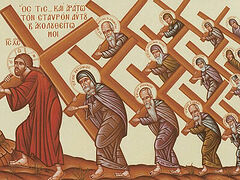
In the Gospel reading at the Liturgy on the Sunday after the Exaltation, the Holy Church reveals to us the meaning of Christian podvig: Whosoever will come after me, let him deny himself, and take up his cross, and follow me (Mk. 8:34).
Taking up our cross, denying our sinful selves, and following the Lord are the foundation of Christian podvig, which the Church reveals to us today and which, on this day of the apodosis, she deems it necessary to impress upon us once again.
In what does our spiritual labor consist? First and foremost, in taking up our own cross. If you want to follow this path in earnest, then take up the cross that the Lord has given you. Yet almost all of us are dissatisfied with our own cross. How often do we complain about it and say to ourselves, “I’ll do anything—just not that!” The person who has no family complains that it is hard to live alone, while another longs to escape his family situation; the sick complain about their health, while the healthy may sometimes say, “Wouldn’t it be good to get sick!”
This happens because, in most cases, we do not live a true Christian life, but rather an “ideological” Christianity—which cannot help us bear our cross.
In order to acquire a true Christian life, we must come to Christ, follow Him, and learn from Him: Take my yoke upon you, and learn of me; for I am meek and lowly in heart: and ye shall find rest unto your souls (Matt. 11:29). Then the yoke will be easy, the burden of the cross will become light, and we will set out upon the path of true spiritual labor. For, as one holy father tells us: “By cleaving to those who live this life, you yourself will cease merely thinking about it or preaching it, and will begin actually living it.”
Here is the proofread version, keeping the same theological register and ascetical terminology as the previous section:
If our spiritual labor consists in taking up our cross, then it is not enough for us simply to know that a Christian needs a cross. We must also bear it and walk with it along the path of the Lord.
How should we bear our cross? The holy fathers say that, first of all, we should arm ourselves with patience; and in the words of St. John Climacus, patience “is consigning ourselves to expect daily sorrows.” Such a disposition of soul is a guarantee that a person will struggle and not fall. Like a man going forth to battle, we must be ready to walk the narrow path and endure all manner of hardships.
But it is not enough for us to know that patience means expecting all manner of sorrows, that patience means walking the narrow path. We must also understand the sources of the sorrows we encounter along the path of life. Patience can teach us this as well, for it is the “cutting off of self-justification and the beginning of self-accusation.” If some sorrow befalls me, I should not blame others for it or justify myself by supposing that, were it not for this or that person, I would not be suffering. “Accept everything that happens as your own fault,” say the holy fathers. And we must have patience not merely in words or as an idea, but in life; we must make it a guiding rule of our lives.
Patience is a necessary condition without which we cannot bear the cross the Lord has given us. But in what does this cross of ours consist? Not, of course, in frequent church attendance or in standing through long services. After all, the Church is the “earthly heaven”; it is the place where we prepare ourselves for heavenly life. But there is also the earth to which God has sent us—and which we so often forget.
And if at times it is difficult for us to pray, and if, while standing in church, we do not feel that we are in the earthly heaven, it is because we have not prepared ourselves for it in our daily lives; because, on the earth to which the Lord has sent us, we have not truly borne the cross He has given us.
Where, then, is our true cross? First of all, it lies in the humble recognition of our sins and—in cooperation with grace, but also through our own effort—in overcoming them. Secondly, it lies in bearing with the anger, envy, and sins of those close to us and of the other people around us.
Our struggle unto death is precisely this true bearing of our cross.
This struggle begins with what dwells within us, in our own souls. For if the Kingdom of Heaven is within us, then every sinful abomination is also within us. Do not look from side to side, but attend to your own soul. To crucify the soul with its passions and lusts and ceaselessly to purify ourselves before the Lord—this is one side of our cross. The other consists in overcoming the sins we encounter in the people around us. When we see their sins, we should regard them as people suffering from illnesses who require healing; and we should apply that healing with meekness and patience.
The holy fathers said: “If you think to pluck the splinter out of your neighbor’s eye, do not use a log to do it, but heal him with meekness and longsuffering” (St. John Climacus). The log is harsh treatment and sharp words.
It sometimes happens that we ourselves do not carry our cross, and by our rudeness we enable those around us to cast off their own crosses. This relates first of all to our families, to our brothers and sisters according to the flesh, and our brothers and sisters according to salvation in our church. How often have we seen those very logs! We can answer a log with iron, and iron with verbal murder. And we ourselves are to blame for our neighbors’ casting off their crosses.
But the Lord requires of us a completely different relationship to our neighbors. So what if another person has sinned—don’t you also sin? Why are you beating him and not pitying him? After all, he has already done great harm to himself. If we truly believe in Christ and His cross, then these are not ordinary words: Take up your own cross and help those around you to carry theirs. St. John Climacus says that one wolf with the help of a demon can disturb a whole flock, and one brother with the help of an angel can safely guide a whole ship.
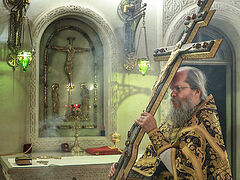
This instruction was not spoken only in order for you to hear it, tell your neighbor about it, and end it there. That would be empty talk. But let us right now, as we bow down before the Cross, look around us, look into our own souls, and little-by-little begin to carry our cross: Whosoever will come after me, let him deny himself, and take up his cross, and follow me.
Let us begin to do if only a little, and not to talk. Let’s begin at least to humble ourselves and be silent when we are offended. Every evening when we read the prayer of St. John Chrysostom, we ask, “Lord, give me humility,” and that means, “send me a person who will humble me.”
Walking the path of carrying the cross, we must take upon ourselves not only our own cross, but also the crosses of those around us.
Carrying our cross with humility and meekness, let us patiently cut off all self-justification and be attentive to ourselves, and then we will understand not only in word but also in deed what the Lord’s great commandment means: Whosoever will come after me, let him deny himself, and take up his cross, and follow me.
From: Bear One Another’s Burdens: the Life and Pastoral Labors of Holy Hieromartyr Sergei Mechev, vol. 2 [Russian].