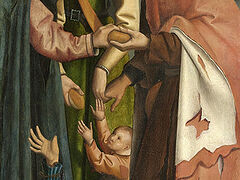
Artist: Y. Averbukh. Photo: eurasia-art.ru
Christ is in our midst, my dear readers!
Today I would like to draw your attention to the words of the Apostle Paul: Every man according as he purposeth in his heart, so let him give; not grudgingly, or of necessity: for God loveth a cheerful giver (2 Cor. 9:7). At first glance, these words concern a collection of money for the poor. Yet in Christianity there is nothing that is “merely material.” Every action becomes a mirror in which the mystery of our salvation is reflected.
Every day requires us to give something of ourselves—our strength, attention, time, and much else. And here what matters is how a man “purposeth in his heart.” The heart is the hidden center of the human person. St. John Chrysostom observes that God seeks not the amount of our offering, but the disposition of our soul. If a person gives alms grudgingly, the gift loses its spiritual power, because there is no freedom in it—and therefore no love.
The Lord calls us to give cheerfully—ἱλαρόν, literally, “joyfully, gladly, with a radiant heart.” God loves the one who gives with joy, because at that moment the person becomes like God. The Creator gives nothing under compulsion. He sends the sun and the rain upon the righteous and the unrighteous alike. He gave His Son for our salvation. By giving joyfully, we overcome our selfishness and become participants in the divine life.
St. Abba Dorotheos observes that alms are given not only in order to feed the hungry, but above all in order to heal the soul of the giver from the passion of avarice. St. Basil the Great, in his homilies, addressed the wealthy of his day with a stern warning: The bread you store away and do not use belongs to the hungry; the clothing hanging in your wardrobe belongs to the naked; the shoes lying unused and rotting belong to the barefoot. And when the Apostle speaks of cheerful giving, he is calling us to unclench the hands that hold on to all these things. True freedom begins when a person ceases to cling to what is “mine” and learns to trust in God.
We live in an age when consumer culture has been elevated into an absolute. We are persuaded that a person’s worth is determined by how much he has accumulated. The world teaches us to live in a state of constant anxiety—in fear of missing out, falling behind, losing what we have, or becoming poor. As a result, acts of mercy become merely formal. We give what we “won’t miss,” or we make charitable giving part of our public image. But it is precisely against such an attitude that the Apostle Paul warns us: “not grudgingly, or of necessity.”
In modern life, the idea of a “gift” extends far beyond money. In a world where everyone is constantly rushing, giving another person a few minutes of your undivided attention can be one of the greatest acts of mercy. Listening to a lonely elderly person, visiting a sick neighbor, sitting beside a weeping friend without glancing at the screen of your phone—these too are acts of mercy. Forgiving an offense, giving up the need to have the last word in an argument, covering another person’s sin with love—these too are forms of giving. Helping with your knowledge someone who cannot afford your services, sharing your experience… There are many ways to give.
But what matters most is the inner quality of our giving. If we help those close to us or perform some good deed while inwardly grumbling, reproaching them, or expecting gratitude in return, then we are giving “grudgingly.” Such “goodness” leaves bitterness both in ourselves and in the person who receives it.
Christianity is a religion of joy. And this joy cannot be bought with money. It is born when one person hastens to meet another. When we give joyfully and freely, we bear witness before the world that our God is alive. We show that our hope rests neither in bank accounts nor in our own strength, but in the living God, Who has promised: But seek ye first the kingdom of God, and his righteousness; and all these things shall be added unto you (Matt. 6:33).
Let us ask ourselves today: With what feeling do we perform good deeds? Is there miserliness in our hearts, a sense of burden, an expectation of praise? Let us pray to the Lord that He may cleanse our hearts of the fear of deprivation and grant us that radiant, childlike joy of giving of which the Apostle Paul speaks. May every good deed we perform, every step we take toward our neighbor, become not a burdensome obligation, but an offering of thanksgiving to God for all that He has given us. And then the mercy of God and His inexhaustible love will fill our souls, for God loveth a cheerful giver.