In the name of the Father, and of the Son, and of the Holy Spirit!
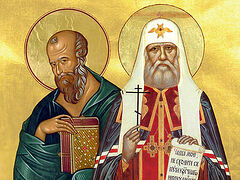
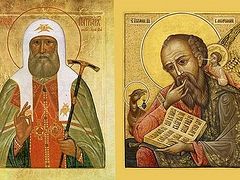
Dear brothers and sisters, today we honor the memory of the holy Apostle and Evangelist John the Theologian and His Holiness Patriarch Tikhon (Belavin). These two men of God, though separated by nearly 2,000 years, both lived through tragic chapters in the life of the Church. St. John stood at the very dawn of the Church, having lived and walked with Christ. He endured the devastating moment when all the disciples fled from the Savior; he alone, alongside the Mother of God, remained at the foot of the Cross. This was a profoundly painful time for Christ’s disciples and for the Savior Himself. It seemed as though they had suffered utter defeat, betrayed by those closest to Him—the very people who had followed Christ, yet deserted Him and scattered in fear.
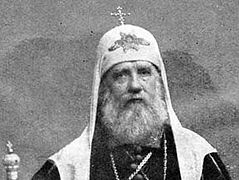
And St. Tikhon ended his life as a hierarch, as a pastor of the Church, in what by the standards of this world was total disgrace. Russia was in a dreadful state. The Russian Church, which for centuries had enjoyed a certain peace and had effectively been a state institution, was suddenly turned into an object of persecution, humiliation, and insult. Everything reverted to the reality of the first centuries of Christianity, when Christians were persecuted and oppressed. It was precisely at that terrible moment that the Lord elevated St. Tikhon to the patriarchate; yet for him, it was not so much a triumph and joy as it was a torment of suffering. And at that moment, very many people betrayed the Church. Highly educated individuals, representatives of various theological academies started tearing the Church apart from within. Everyone began to demand something of their own; everyone sought their own truth, or simply showed cowardice.
Yet at the same time, for us modern Christians who have lived in relative peace over the last few decades, it is difficult to imagine the temptations people in the Church faced back then—the allurements, the pressure, and the choice they had to make between faithfulness to Christ and saving their own lives! All of this fell on the shoulders of His Holiness Patriarch Tikhon, and he bore his cross with dignity, just as St. John the Evangelist, who although the youngest, proved to be a faithful disciple of Christ, and was granted great spiritual gifts.
 Hieromonk Ignaty (Shestakov)
For us as Christians, it is very important to know and immerse ourselves in the legacy left to us by St. John the Evangelist. This includes not only the Gospel, but also his Epistles, and especially the Book of Revelation, or Apocalypse, in which he reveals to us the final destiny of the world. Unfortunately, we somehow neglect this book. Moreover, the word “apocalypse” has acquired a distorted, rather incorrect meaning. Any catastrophe is called by this name; people immediately declare, “It is an apocalypse” about any upheaval, even in their personal lives. In reality, it is a revelation, and we certainly must read this book and study its interpretations in order to understand and be prepared for everything that awaits us in our own age, in our brief lives.
Today we heard the wonderful words of St. John the Evangelist: Perfect love casteth out fear (1 Jn. 4:18). And he who abides in love abides in God. And God abides only in that person who confesses our Lord Jesus Christ as the Son of God. These seem like such simple things, yet they are so necessary for our salvation. A person cannot say that he walks the Divine path and knows God unless he confesses our Lord Jesus Christ as the Son of God. Nor can we be faithful to God if there is no love among us and no love for Him—that perfect love which casts out fear.
If only people today guided their entire lives by love for God and feared losing or offending this love, everything would be different both in the Church and, most importantly, in our own lives. We would not be afraid to speak of Christ, nor would we fear speaking out against the moral vices that torment our lives. We would be closer to the ideal that the Lord expects of us.
Even within Christian society, there is an opinion that we will all somehow be saved in the end, meaning there is no need to say or do anything. This passive spirit was entirely foreign to both the Apostle John the Theologian and to the holy Hieromartyr Tikhon. Because they came to know this love of God for them and filled their hearts with love for the Creator, for God—the kind of love that casts out all fear. May this also visit our hearts and souls, and become the source of our life! Amen.