Pereslavl-Zalessky, Yaroslavl Province, Russia, October 9, 2026
 Photo: pereparhia.ru
Archaeologists digging beside the Holy Transfiguration Cathedral in Pereslavl-Zalessky have found what they believe are the remains of Hieromartyr Konstantin Synatinovsky, a priest killed in 1918.
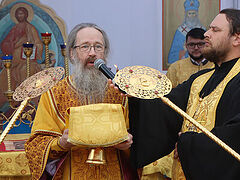
His Grace Bishop Theoktist of Pereslavl and Uglich, together with clergy of the Pereslavl Diocese, served a moleben at the presumed burial site on October 1 before the work began. On October 4, staff of the Russian Academy of Sciences’ Institute of Archaeology, led by archaeologist Vladimir Zeifer, found the remains. Fr. Anthony Zverkov, chairman of the diocesan Commission for the Canonization of Saints, took an active part in the dig, reports the Pereslavl Diocese.
 Photo: preparhia.ru
Anthropological and molecular genetic studies will be carried out soon to confirm whose remains they are.
The dig followed years of research by the diocesan canonization commission, which fully analyzed archival documents on the circumstances of Fr. Konstantin’s death, his burial place, and the history of his veneration.
St. Konstantin served for about thirty years as rector of the Church of St. Peter, Metropolitan of Moscow, in Pereslavl. He was martyred in 1918 and buried behind the altar of the church to which he gave most of his life.
***
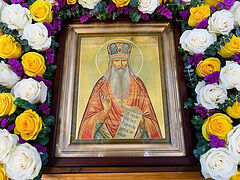
 Photo: preaparhia.ru St. Konstantin was born in 1865 into the family of a deacon in the Vladimir Province. He graduated from the Vladimir Theological School in 1881 and the Vladimir Theological Seminary in 1887. He married Nadezhda Antonovna, a teacher.
In 1889, he was ordained a priest for the Church of St. Peter, Metropolitan of Moscow, in Pereslavl-Zalessky, where he served 29 years until his death. His parishioners were the patients of the city hospital and the residents of a cotton-spinning factory’s workers’ dormitory. He was known to leave money for medicine and funerals when he visited them, and he was respected and popular in the city.
After the Bolshevik takeover in 1918, food supplies ran out in Pereslavl, and workers confronted the local commissar, who fled. The Soviet judged this a revolt and decided to introduce a Red Terror by killing a widely known and respected man. The choice fell on St. Konstantin. His daughters were later told by people who attended the meeting that someone remarked, “His children are all grown, all on their own feet.”
Red Army soldiers in Pereslavl refused to carry out the order to arrest and shoot him out of respect for him. A detachment of Red Guards was summoned by telegraph from Alexandrov that same night, commanded by a man named Khakhaev. They came to his home at night, climbed over the fence and knocked at the door. Fr. Konstantin dressed and went out. His daughter Alexandra begged them to spare her father, and they threatened to shoot her too. “Why shoot her?” St. Konstantin said, and went with them on his own. He was led across the whole city to be shot.
His killers brought his body to the hospital and threw it into the mud. He was dead when it was picked up, and bayonet wounds were noticed on his back. Instead of intimidating the population, the killing outraged the city and turned it against the Soviet. The whole city came to his funeral, along with priests from across Pereslavl County, and he was buried behind the altar of the Church of St. Peter.
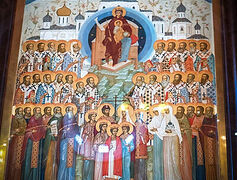
The Holy Synod of the Russian Orthodox Church numbered him among the New Martyrs and Confessors of Russia on October 6, 2001. A wooden memorial cross was erected at his burial site in July 2005.
Follow OrthoChristian on Facebook, Twitter, Vkontakte, Telegram, WhatsApp, and MeWe!