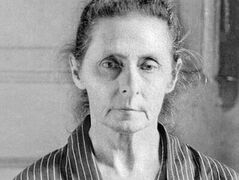
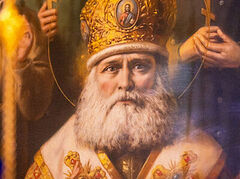
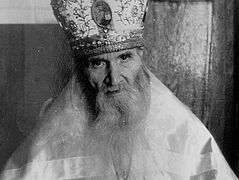
Hieromonk Athanasius (Deryugin)
In the name of the Father, and of the Son, and of the Holy Spirit!
All that will live godly in Christ Jesus shall suffer persecution (2 Tim. 3:12)—we heard these words in the Apostle Paul’s Epistle. This phrase does not directly refer to the holy New Martyrs, but in fact it is very important for understanding what happened in the Russian Church in the twentieth century.
Indeed, just because a person strove to live according to the Divine commandments he could suffer persecutions. And it was typical not only for the 1920s and 1930s, when most of the holy New Martyrs suffered, but also for the whole period of the godless regime in our country.
I was told how as late as the 1970s a professor, a scientist who was also a churchgoer could not reveal to anyone that, for example, he attended the night service in church at Pascha. And after the end of the Liturgy he and his family had to walk around the city for about an hour to the nearest railway station and call a taxi from there so that the taxi driver could not guess that the professor was coming from church and instead think that he had gotten off a train. And the professor had to stop a taxi a few blocks away from his home so that no one could figure out where he lived, and had to walk very quietly so that none of his neighbors living nearby could guess that he was returning from a night service.
And it was the normal reality of the lives of believers at that time. Sometimes it is hard for us, especially for those who did not see that period of Church life, even to imagine how Orthodox people lived then.
I would like to draw your attention to one more point: difficulties in church life several decades ago, when there was a lack of Orthodox literature. People could hardly get even a Bible or a prayer book. They were published in very small editions, and it was very difficult to buy them, not to mention Patristic works, the Lives of Saints and the like. If somebody had pre-revolutionary editions, it was a real blessing. And most believers couldn’t even find anything like that. And if people happened to get their hands on a Patristic book or the Lives of saints, they could stay up all night long, copying them by hand and knowing full well that otherwise they would never get this book.
Now we live in absolutely different conditions, when all the writings of the Holy Fathers and the Lives of the Saints are available to us. For this we don’t even have to go to the library or buy a book; we can take our cellphones and get acquainted with all the treasures of Patristic literature.
But, in a sense, such availability spoils us. When we have all this, we can read it all, and it no longer seems interesting to us. Church people of that era thirsted for this knowledge and longed to touch this Church source. As for us, we very often take everything that we have very coolly and almost indifferently, if not lightly.
 Today in the middle of the church we can see an icon of the New Martyrs and Confessors of the Russian Church, we kiss it with reverence and venerate them. But do we know those who are depicted in this icon? Do we know the names, and even more so the Lives of the holy New Martyrs? After all, these are people who lived not so long ago and who were almost our contemporaries. Externally, those people lived in very similar conditions to ours—that is, they also drove cars and spoke on the phone, and at the same time they became saints. What a treasure, what a wealth of examples for us to strive for holiness! But very often these available examples, about which everybody can read and learn, remain unknown to us simply because for some reason we “have no time” to familiarize ourselves with these Lives of saints, these amazing ascetics of the faith.
May today’s feast, the Synaxis of the New Martyrs and Confessors of the Russian Church, serve to improve the situation a little in order to get acquainted with the biographies of the saints who suffered for the faith and preserved their faith during that difficult period of Church life.
Reading their Lives, reading about how they kept their faith, it is impossible not to love them, and therefore not to come into contact with their souls. In this way, they will pray for us in Heaven and ask God that we will also become worthy descendants and heirs of these great saints.
May God grant that the holy New Martyrs and Confessors pray for us, and that we become their true devotees, imitators of their spiritual labors, and strive as much as we can for the Heavenly Kingdom. Amen.