The name of the holy New Martyr Elizabeth Feodorovna is well known to many. Her life has been thoroughly studied, and her letters, diaries, and her contemporaries’ memoirs have all been published. But why is it that young people are turning to her once again today? What makes her experience so relevant now? Which stereotypes about the Grand Duchess still persist, and what can her example teach modern people?
We discussed these questions with Archpriest Andrei Posternak, a church historian and professor at St. Tikhon’s Orthodox University of the Humanities in Moscow.
 Grand Duchess Elizabeth Feodorovna
—It seems that so much has already been said about St. Elizabeth Feodorovna. But is there a central legend in her biography that warrants reconsideration today?
—The word “legend” itself does not always imply something completely false. In a sense, a legend is part of the tradition of honoring someone who is deeply loved and considered particularly significant. It is a unique illustration of collective memory.
Perhaps one of the most famous traditions is the story that after St. Elizabeth Feodorovna had been thrown into the mineshaft near Alapayevsk, she remained alive and bandaged Prince John’s head wound, while angelic singing could be heard from the depths of the pit. In all likelihood, this is historically inaccurate.
However, what truly matters is that the popular consciousness did not create this image by chance. Throughout her life, St. Elizabeth Feodorovna served the sick, the wounded, and the destitute. Therefore, it seemed only natural to people to imagine that, even in the final moments of her life, she continued her work of mercy.
While historical accuracy is important here, it is even more crucial to understand why this exact tradition arose. It reveals how people remembered her.
 Archpriest Andrei Posternak. Photo: pstgu.ru —Why did Grand Duchess Elizabeth become one of the most prominent figures of Russian Orthodoxy in the early twentieth century?
—I believe the reason lies in the remarkable combination of several qualities.
Firstly, she belonged to the Imperial House. While Russia’s history has seen many holy princes and rulers, not everyone in such a high position managed to transform power into public service.
Secondly, St. Elizabeth Feodorovna converted to Orthodoxy from a completely different cultural and religious background. Raised in the Protestant tradition, she embraced the Orthodox faith and Russian culture so profoundly that she was later willing to share the fate of the Russian people to the very end.
Lastly, she possessed a rare inner courage; she was not afraid to propose solutions that were well ahead of their time. Suffice it to recall her initiative to revive the rank of deaconesses. Although the Holy Synod did not support the idea, the very fact that she raised the question demonstrates the breadth of her church vision.
She did not seek to destroy tradition. On the contrary, she looked for forms that would help the Church fulfill its ministry to the people even more completely.
—It is often said that the community (later convent) of Sts. Martha and Mary in Moscow became a new chapter in the church life of Russia. What did this novelty consist of?
—The community of Sts. Martha and Mary, opened in 1909, indeed became a truly unique phenomenon.
It was established next to Khitrovka—a district considered one of the roughest areas in Moscow at the time. It was precisely there that St. Elizabeth Feodorovna directed her love.
The novelty lay not only in charity and showing mercy to one’s neighbor. The very concept was new: to unite a deep spiritual life with daily, active service to others.
In fact, St. Elizabeth Feodorovna was looking for a new form of women’s church ministry—one that would be reduced neither to a conventional community of volunteer nurses nor to a convent. Unfortunately, this experience did not become widespread across Russia, as she had hoped. But the community of Sts. Martha and Mary itself became a striking testimony that church life can be both prayerful and active.
 The Convent of Sts. Martha and Mary in Moscow. Photo: Ludvig14 / ru.wikipedia.org
—Can we say that St. Elizabeth Feodorovna was ahead of her time?
—I think so. Generally speaking, people of truly great spiritual stature are often misunderstood by their contemporaries.
Much of St. Elizabeth Feodorovna’s behavior caused bewilderment; many did not understand how she could forgive her husband’s assassin, nor could they comprehend her outspoken views on the events unfolding in the country.
Yet she was a deeply independent person at heart. This kind of freedom is born of faith. When someone seeks God’s will above all else, he ceases to fear public opinion.
Moreover, St. Elizabeth Feodorovna clearly recognized that the role of women in church life could be significantly broader than what was customary in the early twentieth century. Her desire to revive the institution of deaconesses was not a struggle for rights, but a wish to open new avenues for women’s ministry in the Church.
In this sense, she truly looked far ahead.
—Today, much is being said about the role of women in the Church. Can Elizabeth the New Martyr’s experience be regarded as an answer to many modern questions?
—I think so, though certainly not to all of them.
St. Elizabeth Feodorovna did not manage to create the system of women’s ministry she dreamed of. However, life itself has shown how in-demand the active participation of women in church life has become.
Today, Orthodox women perform a vast number of obediences: They sing in the choir, teach, bake prosphora, engage in catechization, help with social work, and organize charitable projects.
In many ways, St. Elizabeth Feodorovna foresaw precisely this path. She understood that a woman’s potential in the Church was significantly broader than the framework that existed in her era.
—She did not seek to change the church structure, but she transformed the understanding of what women’s ministry could be. What did this change consist of?
—In my view, the main answer lies not so much in the organization of her ministry, but in the very personality of St. Elizabeth Feodorovna.
She demonstrated that love for God always demands inner freedom and courage.
For the sake of her calling, she left behind her familiar world: her native Germany, her Protestant upbringing, and the entire way of life in which she had grown up. To many of her relatives, this step looked almost like a betrayal of her roots.
Yet she was not guided by human calculations; she followed what she believed to be the will of God.
That is precisely why her life remains so compelling—it shows just how strong a person can be when he trusts God completely.
—Are all documents regarding St. Elizabeth Feodorovna already accessible to researchers, or do unknown pages of her life still remain?
—I believe that, fundamentally, almost no unknown documents are left today. Letters, diaries, and numerous archival materials have been published over the last few decades.
However, this does not mean that the subject is exhausted.
Rather, there are aspects of her work that are spoken of much less. For example, not everyone knows about her many years of service at the head of the Imperial Orthodox Palestine Society.
In this position, St. Elizabeth Feodorovna did a great deal to support Orthodoxy in the Holy Land—developing schools in Syria and Palestine, and preserving the Russian spiritual presence in the Middle East.
In my judgment, this area of her activity still awaits a deeper understanding.
—What personality trait of the holy New Martyr Elizabeth Feodorovna strikes you the most as a researcher?
—Probably, first and foremost, her courage. The kind I mentioned earlier. It is not just about her martyrdom—she was not afraid to make decisions that left those around her bewildered. After her husband’s tragic death, she sold her jewels and purchased a plot of land to establish the community of Sts. Martha and Mary. She consciously walked away from her accustomed lifestyle, wealth, and high social status. That kind of fortitude always inspires deep respect.
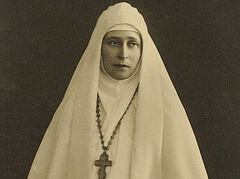
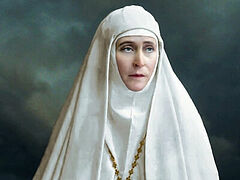
Even the clothes she wore were unique—they were designed by the artist Mikhail Nesterov. Many mistook these garments for monastic robes, which gave rise to another widespread myth—that St. Elizabeth Feodorovna was a nun. In reality, neither she nor Sister Barbara ever took monastic vows.
—You have been researching her life for many years. Has your own attitude toward her changed over this time?
—It is not so much my attitude toward St. Elizabeth Feodorovna herself that has changed—for it has always been filled with deep reverence—but rather my understanding of her vision.
When the community of Sts. Martha and Mary was revived as a convent in recent years, it troubled me for a long time. After all, St. Elizabeth Feodorovna herself repeatedly emphasized that her establishment should become neither an ordinary convent nor a traditional community of volunteer nurses. She saw it as a special path combining prayer and active service.
Bishop Panteleimon (Shatov), ex-chairman of the Synodal Department for Church Charity and Social Ministry, helped me find the answer to this question. He shared a simple but important thought: The original community of Sts. Martha and Mary was built around the personality of St. Elizabeth Feodorovna herself. Reviving this institution exactly as it was is impossible without such a personality.
Today, it is monastic life that has become the spiritual foundation helping preserve the core purpose: serving the people, the very reason the community of Sts. Martha and Mary was founded.
I find this explanation to be highly accurate: the form changes, but the essence remains.
—Why is it that, even after more than a century, people still feel such a close connection to the holy New Martyr Elizabeth?
—Because she remains our contemporary.
Of course, we do venerate the ancient saints, but people who lived just a century ago are psychologically much closer to us. We understand the circumstances of their lives, their choices, and their struggles.
St. Elizabeth Feodorovna is one of these saints. This is evident if only from how many churches are dedicated to her today, how many charitable organizations bear her name, and how many parents name their daughters Elizabeth in her honor!
But the most important thing is not even this: people continue to be drawn to her ability to love through action.
She did not limit herself to beautiful words: she helped the sick, the poor, orphans, and the wounded. Even today, her example remains incredibly relevant. We often talk about loving our neighbor, but it is St. Elizabeth Feodorovna who shows us how this love becomes a daily practice.
—What would you advise someone who is just beginning to learn about Grand Duchess Elizabeth Feodorovna? Which book is best to start with?
—Today, there are many good books available.
 St. Elizabeth the New Martyr For a first introduction, it is certainly worth reading her Life and published letters. They offer a glimpse not only into the events of her life, but also into the saint’s inner world.
As for biographies, I would recommend the book Holy Russian Martyr Grand Duchess Elizabeth Feodorovna by Lyubov Miller. It is one of the first serious works written during the preparations for her canonization by the ROCOR.
Among contemporary research, we can highlight the books by Irina Kuchmaeva and the works of Lyubov Maximova dedicated to the Grand Duchess’ philanthropic activities.
For me personally, the publication of St. Elizabeth Feodorovna’s correspondence with Emperor Nicholas II remains particularly important. Letters reveal a person in a very special way. It is there that her spiritual make-up, the depth of her faith, and her remarkable inner integrity are best seen.
—What do you think modern people—both women and men—can learn from Holy Martyr Elizabeth Feodorovna?
—To my mind, we should learn not from the individual actions of saints, but from the very disposition of their hearts.
Today we are constantly rushing somewhere, living in a never-ending stream of tasks, news, and responsibilities. We lack the time to stop, pray, and reflect on what matters most.
St. Elizabeth Feodorovna shows us a completely different rhythm of life; though immensely busy, she never lost sight of what mattered most—her trust in God.
She carried a colossal responsibility, managing charitable institutions and caring for people. Even while enduring the tragic loss of her husband and the turmoil of the Revolution, she never murmured or grew bitter.
Perhaps this is exactly what each one of us should learn from this saint: Trust in God’s will, inner peace, and the ability to preserve love even when life becomes exceptionally difficult.