Photo: wikipedia.org
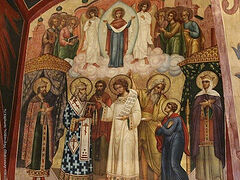
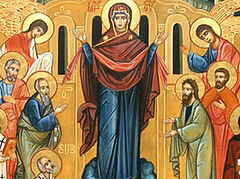
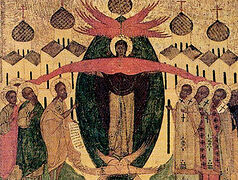
That this present feast is one of the most joyful, for it shows the intercession of the Mother of God for us before God; that, for this very reason, we ought to spend today in works of piety and Christian love, so as to be found worthy of the protection of the Most Blessed One; and that all who neglect their salvation, until they amend, cannot have any just hope of her intercession for them before God: these important and necessary truths are, without doubt, more or less known to every one of us. Therefore, let us turn our attention elsewhere, to the very image of the Protection of the Mother of God, and see whether we can find some new instruction in it.
 Photo: ruvera.ru Do you remember, brethren, how the glorious event that we’re commemorating happened? The usual Saturday evening All-Night Vigil was being celebrated in the Blachernae Church in Constantinople, with St. Andrew the fool-for-Christ, among others, present. Amidst the hymns and prayers, this man of God, at the fourth hour of the night, suddenly beheld in the air the Mother of God with the Forerunner of Christ and St. John the Theologian, with a multitude of angels and saints, praying for mankind and covering the people in the church with her most pure omophorion. Full of spiritual joy, the seer turned to his friend and disciple in spirit, St. Epiphanios, and asked whether he saw the miracle. “I see it, father,” Epiphanios replied, “and I’m terrified.” When the others in the church also learned of this miracle, joyful trembling seized them all. With compunctionate hearts, they began to thank God and glorify the Protectress of all, and the pious Emperor Leo and the holy Patriarch Tarasios established an annual commemoration of this consoling event.
The first thing we should focus our attention on here is the very appearance of the Mother of God with the angels and saints.
So it’s not in vain that we believe that celestials take a great part in the events of the human world, that our elder brothers in Heaven care about the salvation of us little ones on earth! What else should they use their power and nearness to the throne of grace for, if not to help us who are struggling in the sea of worldly misfortunes and worries? If we, for all the coldness of our earthly hearts, can’t look upon the less fortunate without compassion, without helping them, then how could Heavenly beings be mere idle spectators of our spiritual and bodily poverty and not spread their blessed covering over us?
It’s not in vain, therefore, that we believe that the Heavenly powers are present with us in church! Where should they be more constantly than there, where their King and Lord is especially present? We don’t see them because the radiance of Heavenly glory is unbearable to the mortal eye, but they see us and everything we have—our very thoughts and desires. The time will come when we shall see them. We shall enter, if we’re found worthy, into their most radiant fellowship. Until then we must believe in their invisible presence and, believing, go to church as often as possible. But if we wish to be in church with the angels, then, brethren, we must also stand in church like the angels, “laying aside all earthly cares.” Otherwise, the tempter may appear even in Paradise, and even in Paradise you may merit that dreadful sentence: Thou shalt surely die! (Gen. 2:17).
The second item worthy of pious attention in the apparition of the Mother of God is the manner in which she appeared in the air to those who beheld her. As the Mother of the Heavenly King, she could’ve appeared seated on a throne, sending down blessings upon mankind from its height, but she appears praying! Why so? Let us understand that there is one supreme ruler of all, in Heaven and on earth, in time and eternity—God the Father! There is one Redeemer, the Herald of God’s will, the Lawgiver and Judge, Who is able to save and to destroy (Jas. 4:12)—God the Son! There is one Comforter and Giver of grace-filled gifts, Sanctifier of repentant sinners—God the Holy Spirit!
What about the All-Holy Virgin? The preeminent heir of grace and the first intercessor at His throne for mankind. Whoever offers prayers to her in this spirit will act in accordance with her desire. On the contrary, honoring her name excessively, to the point of comparing it with the name of God, to the detriment of the respect that we owe our Creator and Redeemer, is not honor, but an insult to her who, calling herself the handmaid of the Lord (Lk. 1:38) while on earth, certainly hasn’t abandoned this humility in Heaven. Do it not, the angel once said to the Apostle John, who had probably taken him for the God-Man and wished to honor him with Divine honor. Do it not: for I am thy fellowservant... Worship God (Rev. 22:9). The Most Holy Virgin will say the same, and with still greater force, to those who, through lack of understanding, might start to render her worship equal to that which is due to God.
But do we need to be particularly worried today about an excessive zeal for the Most Holy Virgin? Alas, in our time, we ought to fear a lack of it! The Mother herself will render to the Son on our behalf what belongs to Him. Let us rather learn from her what we need most: prayer.
If nothing can be done in Heaven without prayer, if even the one who is more honorable than the Cherubim and more glorious beyond compare than the Seraphim needs prayer, then how necessary prayer is for us, brethren! Therefore, how much is lost by those who neglect this gift of God! And many are neglectful of it! There are people who don’t pray at all. Others pray, but with compulsion, with difficulty. To them, prayer seems a heavy tribute, like forced labor for a master. And indeed, it’s difficult to pray when you don’t feel the need to, when you don’t know why and what to pray for.
But who’s to blame that Heavenly manna turns into bitterness in our mouths? True prayer is sweet and nutritious, and there is no man who prays who hasn’t experienced its sweetness. If prayer becomes bitter, it’s because our spiritual taste is spoiled. It’s hard for us to raise our eyes to Heaven because they’re covered with the dust of earthly cares. Anyone who’s starving will cry out for food as soon as he sees another; a drowning man grasps at lifeless things; likewise, anyone who feels spiritual hunger will find his lips opening in prayer of their own accord; whoever sees himself in the abyss of sins will find his eyes and hands involuntarily raised to Heaven.
How can we arouse within ourselves the feeling of this hunger, of this danger? How can we make ourselves see the need for God? By paying strict attention to ourselves and our lives. Try to reflect for a few hours, to say nothing of days, on how we come into the world, why we exist in this world, and what awaits us where we shall go afterwards. Such reflection can’t fail to end with our gaze turning towards Heaven, with a heartfelt sigh before the Omniscient God, Who holds our existence and life in His right hand. The more often you repeat this good experience and think about your eternal destiny, examine your life, and see your sins and impurity, the more you’ll feel the need for Heavenly help and mercy. Prayer will become more necessary and more pleasant, and over time you’ll acquire that holy disposition of being ever in the presence of God, which the Apostle calls ceaseless prayer (1 Thess. 5:17).
Now let us look at those who were found worthy to contemplate the Protection of the Most Holy Virgin. There were many people in the Blachernae Church: There was the emperor, who was called wise for his knowledge; there was the Patriarch, who was later canonized for his sanctity of life; there were distinguished and wealthy people, but none of them saw what was happening in the air; only Andrew and Epiphanios, men of the lowest standing, despised by many during their earthly life, were deemed worthy to witness the miracle. Heaven is near and open to all who are worthy, however insignificant they may be among men!
Nothing in the circumstances of the apparition suggests that it was revealed to the holy seers in some special way from above, or that their spiritual eyes were opened for this occasion by a special power of God. Their ascetic life and unceasing self-denial had so refined their spiritual senses that the presence of Heavenly beings couldn’t remain hidden from them. This is usually the case with great ascetics: few of them lack the gift of spiritual vision, which belongs to all people but is suppressed by the weight of the flesh in the unregenerate.
A particularly remarkable trait of St. Andrew is that he was a fool for Christ; that is, he appeared, for Christ’s sake, to be bereft of reason. And behold, it’s this man bereft of reason who’s the first to see what surpasses all reason! Let us not draw from this anything to the detriment of the human mind, as a faculty given by God and constituting an adornment of our soul; nor let us extract from it unfavorable conclusions for human knowledge, which likewise comes from God and, sanctified by grace, serves not only earthly well-being but also aids us on the way to Heaven. We cannot, however, fail to notice here what has been remarked so many times and is impressed with such force in the word of God: that human wisdom, because of its almost constant errors, is regarded by God as foolishness (1 Cor. 1:20), and is therefore condemned to destruction (1 Cor. 1:19)!
There’s something in the wisdom of the earth that makes it hardly capable of receiving insights from above; there’s a dark side to the fallen human mind that’s hostile to Heaven. What is it? What makes earthly wisdom, which in and of itself should be praiseworthy, God-defying? What makes human reason, which is godlike in and of itself, become unfit? Where is the beginning of evil? In what the Apostle calls knowledge which puffeth up (1 Cor. 8:1), or arrogance. Filled with the light of knowledge, the mind naturally begins to shine; but this radiance, owing to the infirmity of the noetic eyes in fallen man, mostly blinds him; and instead of beholding light in God’s light with gratitude and humility, it begins to think that the radiance it gives off is its own.
Hence the dangerous feeling of self-satisfaction and forgetfulness of our own poverty; then an encroachment upon omniscience and resistance to Divine revelations and mysteries; then forgetfulness of God, contempt for the Church, and disrespect for social order; then the weakening of the conscience, the slavery of sensuality; then doubt of sacred things, even what constitutes the proper dignity of human nature; and people who began by thinking they know everything and that they’re above everything often end up doubting their own existence, placing themselves on equal footing with irrational beasts! Thus, earthly wisdom is made foolish and destroys itself even before it’s destroyed by the God of knowledge (1 Kg./1 Sam. 2:3).
Is it any wonder then that such wisdom is condemned to ruin? Although such a progression from knowledge to impiety is unnatural in and of itself, since earthly light ought to lead to Heavenly Light and the human mind ought to turn a man toward the mind of God, the corruption of men almost always produces the opposite. Rather than fruitlessly sorting out what in human wisdom deserves to be spared and what does not, God has established this rule: Everyone who desires salvation must renounce earthly wisdom and become a fool for Christ’s sake. If any man among you seemeth to be wise in this world, let him become a fool, that he may be wise (1 Cor. 3:18).
Consent or refusal to renounce our own wisdom, being a condition of salvation, is also an unmistakable sign of whether a man has true or false wisdom. Those who have true wisdom immediately exchange it for the wisdom of grace, always ready to take their minds captive into obedience to the mind of God; but those whose wisdom suffers from the disease of arrogance will find it very hard to let it go. But this letting go can be either open or hidden. We see the open form in the fools for Christ: They completely renounced their own minds—a high form of asceticism that’s accessible to few, not only because it’s extremely difficult for our self-loving hearts to willingly appear bereft of reason, but also because a man constantly vacillates between two dangers in such asceticism: betraying the holy vow of foolishness for Christ’s sake, or violating the duty of love toward his neighbor by scandalizing him, by failing to give him needed counsel, or in some other way.
But you can also be a fool for Christ without appearing to be devoid of reason, even using all the riches of human wisdom. The Apostle Paul was a fool for Christ’s sake (1 Cor. 4:10) but taught at the Areopagus! Sts. Basil the Great, Gregory the Theologian, and John Chrysostom were luminaries of their age and yet weren’t strangers to foolishness for Christ. All this happens through humility for Christ’s sake; humility reconciles earthly wisdom with foolishness for Christ’s sake. Those who are guided by humility regard all their knowledge, first, as an underserved gift from God, so they have no cause to boast. And besides, earthly wisdom itself, proceeding rightly in them, soon brings them to the limits of human knowledge. Unable to cross the border yet feeling the need to go further, it hands its pupil over to faith, that is, it yields its place to the holy foolishness of God (1 Cor. 1:25).
Before such men, wise in the eyes of the world and simultaneously foolish in the eyes of God, the mysteries of the spiritual world were unveiled, as their hagiographies attest, with the same ease as before those who, for Christ’s sake, seemed utterly mindless to the world.
We could also touch on some other matters in the miraculous appearance of the Most Holy Virgin, which we now celebrate: For example, why was the vision not noticed by a man such as Patriarch Tarasios? Why was St. Andrew, in beholding the vision, filled more with joy, and St. Epiphanios with fear? This should give each of you something to contemplate. The purpose of Christian teachings shouldn’t be to communicate everything possible about a given subject, but to arouse reflection in the listeners. Those who add their own reflection to what they hear draw much even from little; but those who only listen without any reflection find even much to be useless.
So, in place of a conclusion, accept my request that you continue it with your own reflection.
May the Lord’s blessing upon such a good work be with you all!
Amen.