Photo: sestra.help
In the Name of the Father, and of the Son, and of the Holy Spirit.
The spiritual life of a Christian is extraordinarily diverse, and it has always been this way. The Old Testament sought to encompass this diversity of spiritual life through numerous prohibitions against sin and a multitude of rites and purifications. The man of the Old Covenant had to remember and observe all these things in order to draw nearer to God.
When God Himself came down to earth, He abolished many prohibitions and rites that had only temporary significance, so that it might be easier for us to be renewed in the Spirit. And in a few commandments and words, He revealed to us what is most essential: how we may draw nearer to God.
Yet because of our sinfulness, because of the old man within us, even this often remains incomprehensible to us.
A person comes to the Church for Confession. Perhaps it is his first time; perhaps he has been attending church for many years. Yet as he approaches the Mystery of Repentance, he discovers, time and again, that he is not prepared to repent. He does not know where to begin or what sins he has actually committed.
This happens because of our profound inattentiveness, not only to our spiritual life but even to our own experiences and feelings.
And so, lest any of us should say that he does not know what he has truly sinned in, and in order to help us recognize our own sins, Christ sums up all piety in a single commandment: Thou shalt love thy neighbour as thyself.
In today’s Gospel reading, this same commandment is expressed somewhat differently: And as ye would that men should do to you, do ye also to them likewise (Luke 6:31).
If we reflect upon these words, we will see how easy it becomes to recognize our own transgressions.
Every person, according to the words of Holy Scripture, loves and nourishes his own flesh—that is, himself. No one ever wishes to destroy himself. Everyone desires to be treated with kindness, compassion, and mercy. Everyone seeks sympathy and protection. These are natural human feelings.
And Christ tells us that even by these natural feelings, which are inherent in every human being, we can recognize all the ways in which we sin.
Look at how you live. Do you treat the people around you as you expect others to treat you? And if you do not, then this is precisely what you must repent of.
Christ then goes on to explain how Christian love and mercy differ from ordinary human relationships, which may not be sinful by earthly standards but are sinful before God.
He says: For if ye love them which love you, what thank have ye? And if you do good only to those who do good to you, what thanks or benefit is there in that? And if you lend only to those from whom you expect repayment, knowing that they are obliged to repay you and will certainly do so soon, what thanks or benefit is there in that? (cf. Luke 6:32–34).
According to human reasoning, we might say that there is great benefit in all this, because it enables us to live comfortably on earth. But Christ is not speaking here of earthly benefit or earthly gratitude. He is asking: What benefit will this bring you in entering the Kingdom of God? None of these things will help us enter the Kingdom of God.
Any sinner can live in this way, performing certain good deeds not for the sake of the Kingdom of Heaven, not in order to draw nearer to God, but simply to enjoy a comfortable life on earth. But for a Christian, whose goal is to acquire the Holy Spirit—that is, to be renewed through the fruits of meekness, mercy, and humility, and thereby to be united with God—such a life is of no benefit whatsoever. For such a life will come to an end while the soul remains in this state of spiritual darkness, at the moment when it departs from the body.
How, then, should we live? Christ tells us that we must live contrary to human reasoning; we must love without expecting love in return, and do good without thinking about when or by whom we will be repaid. It is precisely this disposition that Christ calls mercy. And He tells us that if we live in this way, we will receive great benefit and a great reward.
What is this reward? The Lord describes it as our becoming sons of God: Ye shall be the children of the Highest (Luke 6:35). In other words, God will truly become our Father—not merely our Father as our Creator, but our Father because He will see that we are living as His children ought to live.
Concluding this teaching, Christ says: Be ye therefore merciful, as your Father also is merciful (Luke 6:36). This is the highest and most godly quality of the human soul, one that every Christian can and must attain.
Why does Christ exalt mercy so highly? Because in nothing else, dear brothers and sisters, can we become so like God as in mercy. If we consider how God treats the world, we will see that His dealings with it are founded above all upon mercy, for God bestows His goodness upon people without demanding anything from them in return. While love often seeks to be loved in return, mercy extends itself to those from whom it can receive nothing. Mercy may be called love in its most exalted form—exalted because it reaches down to those who are beneath it.
If we wish to know whether we are truly merciful and how close we have drawn to God, we must examine how we treat those who occupy a lower position than ourselves. We are usually hypocritical and flattering with those who are above us, be it openly or secretly. We strive to please our superiors. Therefore, if we show what appears to be mercy toward those who are above us, this tells us little about how faithfully we have fulfilled the commandment. But if we strive to behave in this same way toward those who are beneath us—to please them, care for them, and even flatter them, that is, to show them an honor they may not deserve—then we are practicing mercy and acting as God Himself acts toward each one of us.
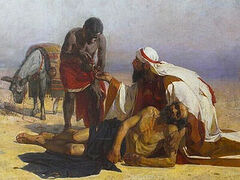
Mercy has many degrees and manifests itself in many different ways. First of all, Holy Scripture teaches us that many of our sins can be atoned for through acts of mercy. When a person begins to treat others mercifully, he also begins to recognize his own sins and repent of them. Thus, by helping another person and showing him mercy, he is, above all, helping his own soul.
Furthermore, Holy Scripture teaches us that mercy can be cultivated through service to those around us—to the sick, the infirm, and all who need the care of others. Holy Scripture also calls every kind word that can uplift our neighbor an act of mercy. Just as a word can destroy a person, not only spiritually but even physically, so a word filled with mercy can restore him to life.
Today, in our society, women who care for others during illness are called nurses. They are called this because society has forgotten mercy—and has not merely forgotten it, but has deliberately sought to drive this virtue out of its life. But in former times, women who cared for the sick and infirm were known by quite a different name. They were called not simply nurses, but sisters of mercy. By this name, society sought to emphasize that the principal purpose of their work was not merely the healing of the human body. The most important task was to renew one’s own soul through works of mercy and to atone for one’s own sins through merciful deeds. And as for the person who was ill—and all of us will fall ill, and sooner or later an illness will come from which we shall never recover—the purpose was that the sufferer might place his hope not so much in physical recovery as in God’s mercy toward him, and that he might not fall into despondency because of his illness.
When we see our neighbor caring for us, do we not remember God, Who cares for us when we diligently fulfill His commandments?
It is difficult to be merciful. It means rising above the limitations of human strength. True mercy was impossible until Christ came to earth, until God Himself revealed to us the perfect example of mercy. And yet we cannot be saved unless we fulfill this commandment.
Therefore, on this day, nothing else in the Church is set before us so insistently, nothing else so urgently calls for our attention, as the exhortation of Christ our Savior Himself:
Be ye therefore merciful, as your Father also is merciful (Luke 6:36).
Amen.