That ye love one another (Jn. 13:34)
On October 7/20, the Russian Orthodox Church commemorates St. Jonah (Pokrovsky), Bishop of Hankou and the Wonderworker. Let us consider his life on this day.
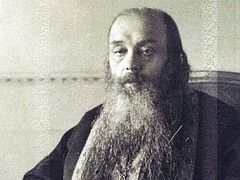
 St. Jonah (Pokrovsky) The future saint was born on April 17, 1888 in the Kaluga governorate and was named Vladimir at his Baptism. He was born into a peasant family. The boy was orphaned at an early age, facing poverty and hardship, and had to earn his own living. Fr. Elias Pokrovsky, a village deacon from a church in the Dmitrov district of the Moscow governorate, took the boy into his family. He also gave the orphan his own last name.
Vladimir graduated from the Kaluga Theological School and entered the theological seminary in 1903. After graduating with honors, he enrolled in the Kazan Theological Academy. During his second year, Vladimir began participating as a missionary in meetings with sectarians and Old Believers at the Theophany Church in the city of Kazan. Throughout his studies, he was under the spiritual guidance of the Optina elders—Sts. Joseph and Anatoly. Under their influence, the student decided to take monastic vows. For a short time, he performed obediences at the Optina Monastery, where he was officially registered as a monk. During his third year at the Academy, he was tonsured with the name Jonah in honor of St. Jonah of Kazan (the sixteenth century; feast: September 22/October 5).
After becoming a hieromonk, he returned to the Kazan Theological Academy, from which he graduated with honors in June 1914. His Master’s thesis was dedicated to a truly monastic theme and was titled, “The Biblical and Patristic Teaching on the Holy Spirit as the Comforter.” This work was highly praised by the Academy’s inspector, Archimandrite Gury (Stepanov), who later became the administrator and abbot of the Moscow Sretensky Monastery.
In Kazan, Hieromonk Jonah was pastored by Elder Gabriel (Zyryanov), who lived with Archimandrite Gury. The elder was very strict with his spiritual child. For instance, when Hieromonk Jonah was offered a position as a New Testament lecturer, he initially refused. He mentioned this to his father-confessor, who saw God’s will in the offer. For his hasty refusal, the elder gave his disciple a penance of 300 prostrations accompanied by the Jesus Prayer.
Out of obedience to his spiritual mentor, Fr. Jonah served for some time as an associate professor at the Kazan Theological Academy. Soon afterwards he volunteered as a military chaplain and took part in the Brusilov Offensive. In the field, he proved to be a humble and zealous pastor, dedicated to serving God, the Tsar, and the Fatherland.
In 1918, Hieromonk Jonah returned to Kazan, where he resumed his teaching duties. In May of that year, he was arrested for “counter-revolutionary activity”—a charge under which numerous New Martyrs and Confessors of Russia were arrested in the following years. In Fr. Jonah’s case, the authorities took issue with his interpretation of the Decree on the Separation of Church and State and his distribution of the pamphlet titled, “The Significance of Monarchy in the Building of the Russian State.”
The saint recalled that time: “Having been detained for only a few hours, I managed to escape. However, on arriving in Perm by barge, I was caught and brutalized—my hair was torn out—and carried off to prison, unconscious and wearing nothing but a shirt. Four days after my confinement, I and eighteen other prisoners facing particularly grave charges were put on a train, then onto a steamboat, and sent down the Tavda River toward Tyumen to stand trial before the People’s Tribunal. On the sixth day, the steamboat came under fire from the forces of the Siberian Government, which had just liberated Tobolsk, and we were set free.
“Sick, and having absolutely no form of identification, I managed to feed myself for a month by begging in Christ’s name. By working in the fields, I clothed myself and, under a fictitious surname, joined a cooperative. After serving as an instructor for two months and securing a certificate of employment, I obtained a position as a primary school teacher in the Tobolsk governorate. When it became possible for me to get a newspaper and thus learn about the situation in Omsk and about the people living there who knew me, I traveled to Omsk and delivered a report to the Provisional Supreme Higher Church Administration. In June 1919, I received an army appointment as a chaplain to the 11th Army Corps and, by decree of the Higher Church Administration, was elevated to the rank of igumen.”
Soon, Igumen Jonah became the chief chaplain of Ataman Alexander Dutov’s Independent Orenburg Army. Under pressure from the Bolsheviks, the army retreated toward the Chinese border. It was in their camp that the wonderworking Tabynskaya Icon of the Mother of God was rediscovered,1 bringing great consolation to both the Cossacks and the local population. Fr. Jonah never parted with the icon, celebrating daily prayer services in front of it. However, the Cossacks’ temporary living conditions were harsh. The saint described them as follows: “There was neither shelter nor food… A march in winter, with the constant threat of blizzards that destroyed everything in their path… Although the Reds were hot on the heels of the Orenburg Army units, and anyone could have crossed over to them without any risk—even taking a cart with them—aside from about a dozen cases, none of the soldiers defected to the Reds. Instead, eating half a pound2 of bread as black as earth every other day, and spending November nights under the open sky, protected by the Queen of Heaven, everyone arrived safely in Semirechye.”3
 Tabynskaya Icon of the Mother of God Fr. Jonah was appointed chief priest of the Semirechye region. The army was stationed in the very areas where, just a few decades later, new martyrs for the faith would shine forth known as the twelve women New Martyrs and Confessors of Akmola from the Synaxis of the Saints of Kazakhstan. Typhus was rampant among the soldiers, and Fr. Jonah did not escape this ordeal either. Despite everything, in early 1920, they decided to cross the Chinese border through the spurs of the Pamir Mountains. The detachment had to overcome the icy Kara-Staryk Pass. They traveled on horseback, but the exhausted horses kept slipping into the abyss. The half-conscious Ataman Dutov had to be lowered down a sheer cliff on ropes. There was no food. Fr. Jonah shared the detachment’s fate, his hands scraped raw and bleeding against the rocky ledges.
Eventually, the detachment reached the village of Suiding in Xinjiang Province, where they quartered in barracks. The Chinese authorities demanded that they surrender their weapons. In return, the Cossacks were promised safety, food, and housing. However, the Chinese side failed to fulfill these conditions. The Cossacks and officers had to sell their uniforms and take up grueling, virtually unpaid labor. At one point, Fr. Jonah was left entirely alone with the detachment after the Cossack ataman had been killed. The future hierarch became the chief priest for all Russians in Xinjiang Province. As the Russian population in China continued to grow, a Commission for Russian Affairs was formed, and Igumen Jonah was sent to Beijing to protect their interests. At parting, the Cossacks presented him with a beautiful pectoral cross on an Orenburg Host ribbon.
Fr. Jonah’s long journey to Beijing began, lasting several months. Along the way, he wrote to the Cossacks: “Villainous hands have torn away our father-ataman, leaving us orphaned. And now I, too, the Ataman’s closest brother-in-arms, am forced to embark on this distant journey to China’s capital, Beijing… Therefore, my beloved friends, remember firmly that you have a spiritual father in Beijing who has bound himself by oath to watch over you sleeplessly and never leave you without aid. I will manage to come to terms with the members of the military Government, should they be found in the East, as well as with the representatives of foreign powers and wealthy Russians. I will prove to them how dear you are to our Motherland, Russia, for all the suffering you have endured for its sake…”
At a stop in Shanghai on December 20, 1920, Fr. Jonah learned that the Chinese had opened the border, and several thousand Cossacks had been captured by the Red Army. Ataman Dutov’s detachment, numbering approximately 1,000 men, managed to escape into remote areas of Xinjiang Province, but the fate of those people remained unknown. The Tabynskaya Icon of the Mother of God, which they had brought from Russia, was also lost.

In January 1922, Fr. Jonah sent a report on his ministry to Metropolitan Anthony (Khrapovitsky), the Chairman of the Higher Russian Church Administration Abroad (which later became the ROCOR). A decision was made to elevate him to the rank of Archimandrite, which was soon followed by his episcopal consecration. Bishop Jonah went on to head the See in Hankou and became the rector of St. Innocent’s Missionary Church in Manchuria.
One of the parishioners of the Church of St. Innocent recalled Bishop Jonah’s arrival: “Everyone was expecting the bishop to appear in the way the public usually imagines him—that is, in full majesty, imposing, and largely unapproachable. But Bishop Jonah knew where and to whom he was going. He realized who and what was waiting for him. He understood that those who were well-fed and content did not need him—it was the destitute who awaited him, and it was to them that he came. He arrived not as a Prince of the Church, but above all as a loving friend and father: humbly, offering warmth and comfort to all. Everyone was struck by the archpastor’s extraordinary simplicity and accessibility. Like a bright icon lamp, Bishop Jonah’s ministry in Manchuria flared to life, illuminating the face of Christ calling out to the suffering: Come unto Me, all ye that labor and are heavy laden, and I will give you rest (Mt. 11:28). But words were not enough—giving no thought to his own strength and health, and completely forgetting himself, Vladyka devoted his energies entirely to serving God and his neighbor.”
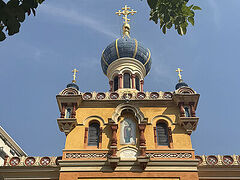
Another witness of life in Manchuria during those years recalled: “The population of the city of Manchuria, having arrived from various parts of Russia, had not been properly brought up in the faith. The Mission’s new, spacious, and magnificent church was attended by few believers, and church preaching was very weak. A zealous servant of the Church of God and an outstanding preacher, the young and energetic Bishop Jonah first of all took up the religious and moral cultivation of his flock. He established the celebration of services according to the Typicon at his church, started a wonderful choir, and preached tirelessly. Soon, the church was filled with worshippers, eventually becoming too crowded.” This church was later restored, and a side-chapel was built in honor of St. Nicholas the Wonderworker. The early Liturgy, which Bishop Jonah attended, was served there, while he celebrated the late Liturgy himself. He had a profound love for church services and would celebrate even when running a high fever.
Bishop Jonah’s missionary work, however, extended far beyond the church walls. He taught the Law of God, lectured at theological and religious courses in Harbin, and organized evenings of Russian song to uplift the spirits of Russian emigres. He paid special attention to charity work—founding free schools, setting up a soup kitchen, an outpatient clinic, and a pharmacy, as well as opening an orphanage. A former resident of this children’s home later recalled: “I remember he always started his sermons with the words, ‘Children, love one another!’ Everyone who saw Vladyka Jonah even once will surely remember him with a kind word. Many, very many, learned to read and write thanks to him.”
Under the bishop, leaflets of spiritual and moral content were published and distributed to the flock. This good and great deed inevitably stirred up envious people and slanderers. But to this St. Jonah only replied, “Our enemies’ rumors pave our way to the Heavenly Kingdom.”
Vladyka himself led a very modest life; his clothes were patched, his food was simple, and he gave his entire teaching salary to help poor students. The flock loved their cheerful and kind archpastor: people came to his apartment without fear. He welcomed everyone—not only Russians, but also locals and foreigners. Children especially loved this good shepherd. One of his peers later said, “We did not take sufficient care of our Vladyka, and neither did he spare himself. He received people from seven in the morning to eleven in the evening. Throughout his long workday, people flocked to the doors of his cell; and it was like this day in and day out—on both feast days and weekdays. And from eleven in the evening, instead of resting, Vladyka would turn to new work… He had to answer extensive business correspondence, write his next pastoral exhortation, and prepare a leaflet for print—an endless mountain of work… Only the night watchman knew when the light in the cell of this hardworking archpastor would finally go out. And there were nights when the light never went out at all—the sun would replace the lamp, and yet another arduous day of labor would begin.”
In the autumn of 1925, Bishop Jonah contracted a severe throat infection, which ultimately led to blood poisoning (sepsis). Shortly before his repose, he wrote in a letter to a brother in Christ: “Let us hasten, let us hasten now to prepare ourselves, so that we may go with joy to the Immortal King. We do not know—perhaps both my candle and yours are burning out. How precious every minute is in working out our salvation!” The candle of his life was indeed burning out, very rapidly.
 After the feast of the Protecting Veil of the Theotokos, the doctor said that Vladyka was dying and that very little time was left. One of those present at his passing recalled: “Vladyka began to prepare for confession and Communion. Putting on his mantia, he said, ‘It is time to get ready.’ Having confessed and received the Holy Mysteries of Christ, Vladyka undressed, sat down, and typed his spiritual testament on a typewriter. Having set down his final will, he stood up, took the Book of Prayers, and himself read the Canon for the Departure of the Soul. I stood behind Vladyka and prayed together with him, while the doctor gently supported him. Having finished reading the Canon, the saint began to take leave of those present. Asking forgiveness, Vladyka bowed to the feet of all, and after blessing everyone, he lay down on the bed and said, ‘I am dying.’ We placed a cross and a lit candle in his hands. I started reading the Prayers for the Departure of the Soul. As I read the kontakion ‘O My Soul,’ tears suddenly welled up in my eyes. At that moment, the dying bishop drew his last breath and departed to the Lord.” This happened on October 20, 1925.
That same night, Bishop Jonah appeared in a dream to a sick boy who could not walk. He said, “Here… take my legs—I don’t need them anymore—and give me yours.” By morning, the boy rose on his own two legs. This case was documented by doctors.
A great gathering of people attended Vladyka’s burial. The saint was buried behind the altar of the church where he had served. Other miracles also occurred through prayers to him. The holy archpastor’s relics, however, were lost. In February 2016, Bishop Jonah (Pokrovsky) was canonized for Churchwide veneration by a decision of the Council of Bishops of the Russian Orthodox Church.
Holy Hierarch Jonah, pray to God for us!
Bibliography:
I. M. Kontsevich. Acquisition of the Holy Spirit (Moscow: Institute of Russian Civilization, 2009).
Biographical Dictionary of Missionaries of the Russian Orthodox Church, Compiled by Priest Sergei Shirokov (Moscow: Bely Gorod, 2004).
Spiritual Spring, a publication of the Diocese of Western America, 2015.