In the name of the Father, and of the Son, and of the Holy Spirit!
Dear brothers and sisters, today we honor the memory of one of the greatest spiritual mentors of the nineteenth-century Orthodox Church, St. Ambrose of Optina. He is widely known for his short aphorisms. For example, when asked, “How should we live?”, He would often reply, “Live without distress, don’t condemn, don’t annoy, and my respects to all.” Or he would also say, “You and I have thought much, yet thought up nothing. It’s better to rely on the all-good Providence of God, which is powerful enough to bring everything to a beneficial end, far beyond our expectations.” He also noted, “Whoever is proud fades away like grass; but whoever fears God is granted the Lord’s mercy.” And he advised everyone to be simpler in the best sense of the word, expressing it like this: “Where there is simplicity, there are a hundred angels; but where there is complexity, there are none.” It is worth noting that St. Ambrose was not a man of formal academic learning, yet he possessed a rare gift of discernment and spiritual insight. His advice and sayings were always practical, clear, and accessible to everyone. He usually spoke and wrote about what truly matters most—the salvation of the soul, and how to be saved.
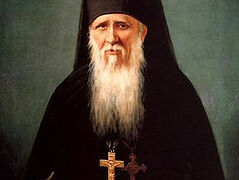
 S. Ivleva, St. Ambrose of Optina
In one of his sayings, he outlines the path to salvation quite succinctly, referencing St. John Chrysostom. He writes: “There are three degrees, or conditions, for salvation. The first is not to sin. The second, having sinned, is to repent. The third, for one who repents poorly, to endure the afflictions that come upon him.” Let us say a few words about each of these three conditions.
Firstly, not to sin—that is, not to sin consciously, not to yield to sin voluntarily, and not to surrender oneself to sin. Of course, human nature is inclined toward evil. But that is precisely why the Holy Fathers call us to mindfulness, watchfulness, and the guarding of our hearts. Sin rarely begins with an action. It is conceived within the heart and starts with a thought, a desire, and an inner consent to doing wrong. The Holy Scriptures say in the Book of Proverbs: Keep thy heart with all diligence; for out of it are the issues of life (Prov. 4: 23). When a Christian strives to guard his heart, lives in prayer, remains attentive, and watches over himself, it becomes much harder for sin to take hold of him.
Secondly, if you have sinned, you must repent. The Holy Fathers teach that even if you happen to sin, under no circumstances should you despair; nor should you remain in sin, but rather repent. However, repentance is not merely saying the words, “Lord, forgive me.” Repentance is a change of direction. Metaphorically speaking, you were walking to the left, toward a chasm, an abyss, and then you turned around and walked to the right, in the opposite direction. We cannot consider ourselves to be repenting if we stay on the same path, if we still cling to this or that sin, if we fail to ask God to help us root it out of our hearts, and if we refuse to make efforts to pull it out like a stubborn weed. Repentance is sorrow for the sin committed, the resolve not to return to it, and a struggle against it.
Thirdly, those who repent poorly must endure afflictions that come upon them. If our repentance is superficial, it can cause us to be overtaken by sorrows. Why? Not because God wants to punish us, but because He desires to purify us and bring us to true repentance. And in this, God’s mercy is manifested. When someone does not labor to improve himself voluntarily, God, out of His love, allows afflictions. He acts like a surgeon performing a painful but sometimes vital operation.
This is how briefly and clearly St. Ambrose of Optina points out the path to salvation. Do not commit sin willfully, but if you happen to sin, repent with a firm intention not to repeat it, and fight against it. And, perhaps most importantly, ask the Lord Jesus Christ for help in overcoming and changing yourself. Also, remember that even our tribulations are God’s mercy to us sinners.
Through the prayers of St. Ambrose of Optina, may the Lord help us and save us! Amen.