Alexander (Grenkov), the future elder, received the name Ambrose in monastic tonsure in honor of St. Ambrose of Milan. The ancient saint, like the Optina elder, had not originally thought of monastic life—he was preparing for state service and became a lawyer. Yet both, by Divine Providence, were given a special direction in life, which at first had flowed in an entirely different channel. The future St. Ambrose of Milan was elected bishop even before his baptism, but afterward studied theology, fought against heresies, and became a teacher of the Church. As for Alexander, during an illness that left little hope for recovery, he made a vow to enter a monastery. After that, his life became filled with zeal; simple people sought him out, members of the capital’s intelligentsia came to visit the elder and left written notes about him.
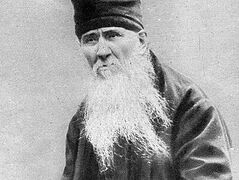
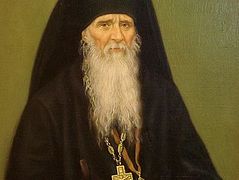
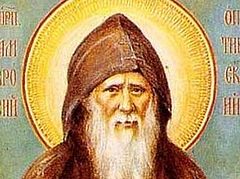
The iconography of St. Ambrose of Optina is based on the icon painted for his canonization. That icon, in turn, was created from both portraits and photographs of the saint. St. Ambrose of Optina is among the first Russian saints to have been photographed.
Elder Ambrose’s time coincided with the early era of photography. Both photography and contemporary lithography of that period are remarkable for their choice of subjects. Soon, photography, like lithography, would come to include everything dear to the heart of an Orthodox pilgrim, from the cathedrals of the Kremlin to remote monasteries and their holy relics.

Optina Hermitage itself was also captured in printed architectural plans. The unusually colorful views of that time were based on the more traditional schematic, monochrome (essentially black-and-white) plans with conventional symbols marking the buildings. Through the use of geodesy, geometry, artistic taste, and pious inspiration, a new type of colored planimetry was created, representing a bird’s-eye view.
On these plans, the monastery buildings were rendered precisely and realistically, and trees of various species—including the pine groves surrounding the monastery—were painted in a picturesque manner. In reality, in the nineteenth century, one could view the monastery and its coniferous woods “from above,” from a bird’s-eye view, only from a hot-air balloon.
Elder Ambrose was canonized in 1988.1 Today, he is venerated as one of the Optina Elders, whose collective commemoration was established in 2000 [in the Moscow Patriarchate]. The synaxis includes the venerable fathers Leo (Nagolkin), Macarius (Ivanov), Moses (Putilov), Anthony (Putilov), Hilarion (Ponomaryov), Anatoly (Zertsálov), Isaac (Antimonov), Nectarius (Tikhonov), Joseph (Litovkin), Barsanuphius (Plikhankov), Anatoly (Potapov), Nikon (Belyaev), and Isaac (Bobrakov). Together with these other Optina Elders, St. Ambrose is also commemorated in the Synaxis of the Saints of the Kaluga Land.
Throughout the Kaluga Diocese, there are many depictions of Father Ambrose—not only in icons but also in other forms of church ornamentation. It is well known that exterior church murals are usually reserved for the most significant sacred figures and events. At the Holy Gates of the Vvedensky (Presentation) Monastery of Optina, there is a wall painting depicting Father Ambrose alongside other Optina Elders who influenced him—Joseph, Leo, Hilarion, and Macarius—set against the background of the monastery itself.
The icon of the Synaxis of the Optina Elders is located in the Church of St. Nicholas in Pyzhi, Moscow. A mosaic image of Saint Ambrose is placed above the entrance to the Church of St. Ambrose in Shamordino Convent, to whom he gave special spiritual care during his lifetime.

In the nineteenth century, lithography, like iconography, often presented not only sacred subjects but also introduced the faithful to holy sites and relics. The very monasteries and their interiors were considered sacred. Lithographs guided the pilgrim’s attention toward what was most worthy of veneration. This is what distinguishes them from modern photography, which tends to be momentary and often arbitrary. Even a “church photographer” today might photograph a fence or a dove on a dome without explaining the subject’s sacred meaning.
During the time of Father Ambrose, photography was only beginning to take on genre characteristics and was used to depict concrete realities. A well-known photograph shows Elder Ambrose blessing the grave of Mother Sophia, the first abbess of Shamordino Convent. The photo was published before the Revolution, clearly titled as such. Another is captioned “St. Ambrose on the threshold of his cell.” The very presence of these inscriptions indicates that such photographs were meant as direct, documentary representations—visual evidence of what one actually saw.
It is similar to a nineteenth-century pilgrim who, having visited a distant monastery, would purchase printed materials or postcards with captions describing what was shown—perhaps a close view of the Vvedensky Cathedral. While the icon seeks to reveal the heavenly reality, the photograph conveys the earthly reality—but directly and precisely: a photograph of the church, the relics, or the saint’s personal belongings.
Nonetheless, the foundation of the saint’s iconography ultimately rests on his portraits. Hieromonk Daniel (Bolotov) painted several portraits, some of which are preserved at Optina Monastery. One portrait, dated 1892 (now in the Central Academic Church of the Moscow Theological Academy), was created a year after the elder’s repose. It depicts him wearing both his pectoral and commemorative crosses, the latter awarded in remembrance of the Crimean War.
In this painting, Father Ambrose reclines on pillows, gazing directly before him. The work had several authorial replicas, including one showing the elder with his spiritual daughter Olga Goncharova. These portraits carry a distinctly iconographic spirit: St. Ambrose appears in monastic garb and skufia, embodying calm dignity and spiritual insight.
Subsequent iconographers naturally adopted this visual type for use in painted icons. Above the saint’s reliquary in the Entrance Cathedral of Optina Monastery stands a hagiographic icon of St. Ambrose, executed by Monk Artemy (Nikolayev).

Saint Ambrose is invariably depicted in the Synaxis of All Saints Who Shone Forth in the Russian Land. He himself made a notable contribution to the development of modern Marian iconography: It was by his blessing that the image of the Mother of God from the “All Saints” icon of the Bolkhov Monastery was taken as the prototype for the icon of the “Multiplier of Wheat.”
This icon was created in 1889, during a severe drought. Its veneration continues to this day, although drought, for the modern person, may seem a less pressing concern. The feast of the icon was entered into the liturgical calendar of the Russian Orthodox Church in 1995. In the Moscow region, on the grounds of the Shchyolkovo Bread Factory, a church has been built in honor of this icon, and the memory of St. Ambrose is particularly celebrated there.
Father Ambrose deeply influenced his contemporaries through his spiritual insight, which was united with simplicity and warmth in his dealings with those who came to him. His sayings—remarkable for their precision and pastoral depth—are still widely published in collected form today.
It is worth noting that while quotations of secular thinkers often appear detached from their original context, the words of Father Ambrose never lose their integrity. He spoke as he lived, naturally and directly. His counsel was often brief, no long discourses, yet always edifying.
In one letter to a spiritual daughter, he even expressed himself entirely through folk proverbs, evidently chosen to suit her particular situation.
 Photo: optina.ru
The Icon of the Mother of God “Multiplier of Wheat” remains closely associated with Saint Ambrose and his compassionate intercession for those suffering from famine or hardship.
 The image of Saint Ambrose of Optina is best known through thousands of icons. He is typically depicted as a venerable monk, holding a prayer rope or a scroll. When the scroll is unrolled, it often bears one of his familiar sayings.
A half-length icon on a blue background is kept in the Church of the Donskaya Mother of God in Mytishchi, showing the saint holding a staff in his right hand and prayer beads in his left.
In the Church of St. Elias (Ilyinsky) in Shuya, Ivanovo region, St. Ambrose appears in a medallion fresco opposite St. John of Svyatogorsk and beside St. Seraphim of Vyritsa.
In the Iveron Chapel in Moscow, the wall decoration features a tiered composition of especially revered saints; above the image of St. Ambrose is that of St. Theophan the Recluse.
In the old iconostasis of the Church of St. Nicholas in Zhegalovo, Shchyolkovo, some of the pre-revolutionary icons of the local tier have not survived; they have been replaced by icons of newer saints, among them St. Ambrose of Optina.
Thus, from nineteenth-century portraits and photographs to the mosaics and frescoes of the present day, the image of St. Ambrose continues to live and inspire, linking the earthly and the heavenly realms through humility, wisdom, and pastoral love.